Physical address:
128 City Road, EC1V 2NX, London,UK

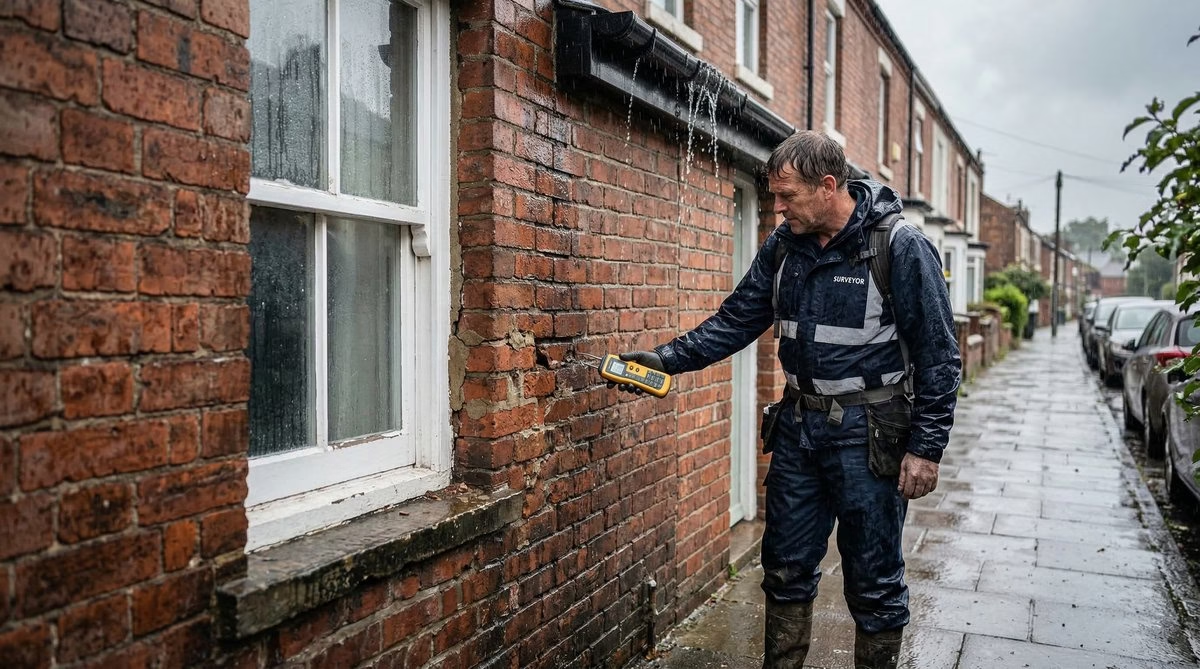
If your house smells damp when it rains — penetrating damp UK searches are piling up in your browser history, you are not alone. We speak to homeowners across London every week who describe the same pattern: the rain starts, and within hours a stale, earthy mustiness rises from walls or cupboards that seemed fine the day before. The smell will not resolve itself once the sun returns. What you are almost certainly dealing with is moisture finding its way inside — and the question that matters is where it is coming in and what to do before it gets worse.
At Fixiz Ltd, we carry out damp investigations and remedial works across London — from Victorian terraces in Hackney to post-war semis in Wimbledon — and rain-related damp is one of the most common calls we receive between October and March. This guide covers what is happening inside your walls, the entry points most likely to blame, what you can check yourself, and when a professional survey becomes the sensible next step.
Why the smell only appears after rain — the mechanics of penetrating damp
Penetrating damp is fundamentally different from rising damp or condensation, even though all three can produce that musty odour. Masonry — brick, stone, render — is not watertight. It is designed to manage moisture, absorbing rainwater and releasing it as the wall dries. When something fails — a cracked render panel, deteriorated pointing, a blocked gutter — water enters faster than it can evaporate, and the saturated masonry slowly releases moisture into the internal plaster and room air.
The reason you notice the smell specifically after rain rather than continuously is a question of saturation thresholds. During dry periods the wall dries back toward equilibrium. A sharp rainfall event tips it over the saturation point again, pushing moisture-laden air into the room. The warmer the indoor air relative to the cold, wet wall, the stronger that drive — which is why the smell is often worse in autumn and winter.
There is also a secondary mechanism involving mould. Once moisture content stays above roughly 70–80% relative humidity for sustained periods, mould colonies produce microbial volatile organic compounds — MVOCs — responsible for that distinctive musty, soil-like smell. Rain events spike local humidity, feeding existing mould and intensifying the odour even if no new water is actively entering. This means that even after fixing the entry point, targeted mould treatment may be needed to eliminate the smell permanently.
One important nuance is the lag between rainfall and symptom. In solid-wall properties — common across Islington, Stoke Newington, and much of inner London — water penetrating a 225 mm brick wall can take a few hours to 48 hours to reach the internal face, frequently causing homeowners to misattribute the smell entirely. We have attended properties in Brixton where the owner was convinced they had a burst pipe, only to find a single failed brick course below a window cill.
The critical point: a smell that reliably worsens after rain and improves during dry spells is almost always penetrating damp until proven otherwise. Condensation does the opposite — it worsens in cold, still air and improves when ventilation increases. If your smell is rain-triggered, look outward first.
The most common entry points — gutters, flashing, pointing, window seals, and render cracks
In our experience working across London properties, the overwhelming majority of rain-triggered damp complaints trace back to one of five failure categories.
Blocked or leaking gutters and downpipes
Gutters are the first line of defence against rainwater hitting your walls, and they are routinely ignored until they fail. A blocked gutter overflows in heavy rain, directing a sheet of water straight down an external wall. We regularly see this in areas like Lewisham and Streatham where mature street trees shed heavily in autumn: gutters clear in spring are blocked solid by November. The tell-tale internal pattern is a vertical stripe of damp at or near a corner, usually extending from just below ceiling level downward.
Failed or missing flashing
Flashing — the lead used to seal junctions between a roof plane and a wall, chimney, or dormer — is one of the most frequently overlooked sources of penetrating damp in Victorian and Edwardian terraces. When flashing lifts, corrodes, or was never properly dressed into the mortar joint, rainwater runs straight behind it into the wall below. A chimney breast showing damp patches at high level is almost always a flashing problem until proven otherwise.
Deteriorated pointing and spalled brickwork
As pointing weathers and recedes, it exposes a channel that rainwater runs into and is held by capillary action. Spalled brick — where frost damage has broken the face away, exposing the porous inner material — compounds the problem dramatically. We attended a property in Peckham last autumn where the homeowner had lived with a damp chimney breast for three years and two previous contractors had treated the internal wall without success. The actual cause was a section of severely spalled facing on the stack, invisible from street level but obvious once we put a ladder up.
Failed window and door seals
Silicone and mastic seals between a window frame and surrounding masonry have a service life of roughly eight to fifteen years. Once they crack or pull away from the substrate, water runs directly into the reveal and can track along the lintel and down into the wall below. The associated damp pattern tends to be localised — patches at the corners of window reveals or watermarks across the internal cill.
Render cracks and hollow render
Cement-rich render is brittle, and seasonal substrate movement creates hairline cracks that admit water. Once behind the render, water cannot easily escape, so the wall stays saturated after each rain event. Hollow render — where the render has debonded from the substrate but not yet cracked — traps moisture effectively and is almost impossible to identify visually. Thermal imaging after a rain event reveals the moisture retention pattern behind apparently intact render surfaces, a particularly common finding on 1930s rendered semis across south and west London.
Quick checks you can do yourself before calling anyone — a room-by-room walkthrough
Before reaching for the phone, a systematic self-inspection will sharpen your understanding of the problem and give a surveyor genuinely useful information. You are not diagnosing the cause definitively — you are mapping symptoms so investigation can focus on the right areas.
The best time to inspect is within 12 to 24 hours of sustained rainfall, while moisture is at its peak. Walk around the exterior first, looking for: overflowing gutters or downpipes with obvious blockages, separated downpipe joints with tide marks below them, visibly recessed or crumbling mortar joints, cracked or hollow-sounding render (tap gently with your knuckle), and areas where the wall looks noticeably darker or wetter than surrounding surfaces.
Then move inside and work top to bottom, since water follows gravity and the highest entry points will manifest symptoms first. In the loft, look for watermarks on the felt or timbers, wet insulation, or dark staining around the chimney stack or dormer cheeks. In top-floor rooms, press your hand against external walls and note any area that feels noticeably cooler or softer — and look for efflorescence (white salt deposits) or paint that is bubbling away from the plaster. Soft or powdery plaster is a reliable indicator of sustained moisture behind the surface. In ground-floor rooms with bay windows, check the internal reveal corners and bay ceiling for watermarks or tide rings, as bay roof junctions are a persistent weak point on Victorian and Edwardian terraces.
A pin-type damp meter costs under £30 from any DIY retailer and provides useful comparative readings across a wall surface. Readings above 20 on most consumer meters indicate elevated moisture; above 30 suggests significant saturation. Record your readings per location and note whether patches feel cold or show visible salt crystallisation — it helps a surveyor calibrate their own equipment and prioritise investigation areas quickly.
When a professional damp survey is worth it — and what we actually test for
The self-inspection above has real limitations. Consumer damp meters cannot measure moisture in depth, cannot distinguish between free moisture and hygroscopic salt contamination, and tell you nothing about the wall core, cavity, or roof structure behind accessible surfaces. A professional survey adds diagnostic layers that are genuinely difficult to replicate without specialist tools.
You should commission a survey without delay if any of the following apply: damp patches are expanding between rain events rather than drying back; you can see or smell mould in more than one room; there are signs of structural movement such as cracks in the masonry or distorted door frames; the property is being sold or purchased and a buyer’s survey has flagged moisture; or you have had two or more repair attempts that failed to resolve the problem.
A competent survey for a rain-related problem includes a detailed external envelope inspection — not just a glance from ground level — using binoculars or a drone where rooflines and stacks are not safely accessible. It includes internal moisture mapping with a calibrated resistance meter and, where indicated, a carbide (Speedy) test to determine actual moisture content in plaster and masonry samples. Thermal imaging conducted after a rain event reveals the moisture distribution behind wall surfaces with far greater precision than surface readings alone — and is particularly effective for tracing moisture pathways through solid masonry.
Be cautious of any survey that recommends internal tanking or chemical injection without first identifying and resolving the external entry point. Barrier treatments applied internally are occasionally appropriate as a secondary measure, but they will always fail if the source of water ingress continues unchecked. Any reputable surveyor will tell you plainly: fix the outside first.
How Fixiz investigates rain-related damp — moisture mapping, thermal imaging, and targeted repairs
When a Fixiz surveyor arrives at your property, the investigation begins outside — always. Internal symptoms can be highly misleading about the actual entry point. A damp patch on a ground-floor front wall may trace back to an overflowing back-gutter behind a first-floor parapet, with water travelling inside a cavity for several metres before emerging internally. Our standard protocol starts with a full external envelope inspection at height where required, combining binoculars, a pole-mounted camera, and drone inspection where planning permits. We photograph all candidate failure points before discussing findings, so you can see exactly what we see.
Inside, we carry out systematic moisture mapping using a calibrated resistance meter across affected walls. Where moisture content is elevated, we follow up with thermal imaging — particularly useful in the hours after a rain event, when differentials between wet and dry masonry are at their sharpest. The thermal images allow us to trace the moisture pathway and identify the specific external failure causing the internal saturation pattern.
One instructive case involved a period conversion in Finsbury Park where the management company had spent three years attributing a first-floor flank wall to rising damp, applying successive coats of waterproof paint. Our thermal survey, conducted the morning after sustained overnight rainfall, showed a clearly defined moisture plume entering from the junction of the party wall and a flat roof extension — a failed upstand detail invisible from ground level and overlooked in every previous inspection. Targeted repointing and a replacement lead upstand resolved the problem entirely within one season.
Once the entry point is confirmed, our remediation is targeted rather than speculative. Typical scopes include: chimney flashing replacement and repointing; gutter and downpipe clearance or replacement; localised repointing to failed mortar courses; window and door perimeter resealing; and render crack repair with a flexible, breathable compound. Where mould has established on internal surfaces, we carry out targeted biocidal treatment followed by encapsulation — we do not consider a job complete until both the water source and the secondary biological contamination have been addressed.
Frequently asked questions
Can condensation produce the same smell as penetrating damp?
Yes — both can support mould growth that produces a musty odour. The distinguishing feature is timing: condensation-related smell worsens during cold, still periods when ventilation is reduced, and improves when windows are opened. If your smell is clearly triggered by rainfall and improves during dry spells, the mechanism is almost certainly penetrating damp. The two can coexist, which is why a thorough survey is valuable — it will distinguish between them rather than attributing everything to one cause.
How long does it take for a damp smell to disappear after the entry point is fixed?
In straightforward cases, a correctly repaired wall will typically dry out within four to eight weeks — assuming adequate ventilation. In longer-standing cases where plaster is heavily salt-contaminated, the smell may persist for several months and may require replastering to eliminate fully. If mould has established on internal surfaces, biocidal treatment is needed in addition to drying — the MVOC smell will continue until the colony is killed and encapsulated.
Is it safe to live in a house with rain-related penetrating damp?
In most cases, penetrating damp does not create an immediate structural emergency, and properties can continue to be occupied while investigations are arranged. However, if mould is visible in bedrooms or rooms used by people with respiratory conditions or young children, professional mould remediation should be prioritised. If structural timbers are showing signs of moisture-related deterioration, the urgency increases. Do not delay a survey — penetrating damp does not resolve itself, and the longer it continues the more costly the remediation becomes.
My neighbour has the same problem — could it be a shared wall or drainage issue?
Absolutely, and this is more common than many homeowners realise. In terraced and semi-detached properties, a shared party wall, gutter run, or drainage channel can create damp that originates on one side of the boundary but manifests on the other. We investigated a pair of Victorian semis in East Dulwich where both households had recurring damp on the ground-floor party wall — the actual cause was a collapsed underground gully directing surface water against the shared foundation. Resolving it required a coordinated drainage repair agreed with the neighbouring owner. If your damp pattern tracks along a boundary wall, include a shared drainage survey in the investigation scope.
Does buildings insurance cover penetrating damp repairs?
Standard buildings insurance policies generally do not cover gradual deterioration — which is how most insurers classify penetrating damp from failed pointing, aged flashing, or blocked gutters. Cover may apply if a sudden storm event caused demonstrable damage to a previously intact roof or gutter system. It is always worth reviewing your policy schedule and making an enquiry if you believe a single weather event accelerated the problem. A surveyor’s report identifying the failure point and its likely duration is useful evidence in any insurance discussion.
Ready to move from confusion to construction? Get in touch with Fixiz today for a no-pressure chat about your project and the fastest route to full compliance.