Physical address:
128 City Road, EC1V 2NX, London,UK

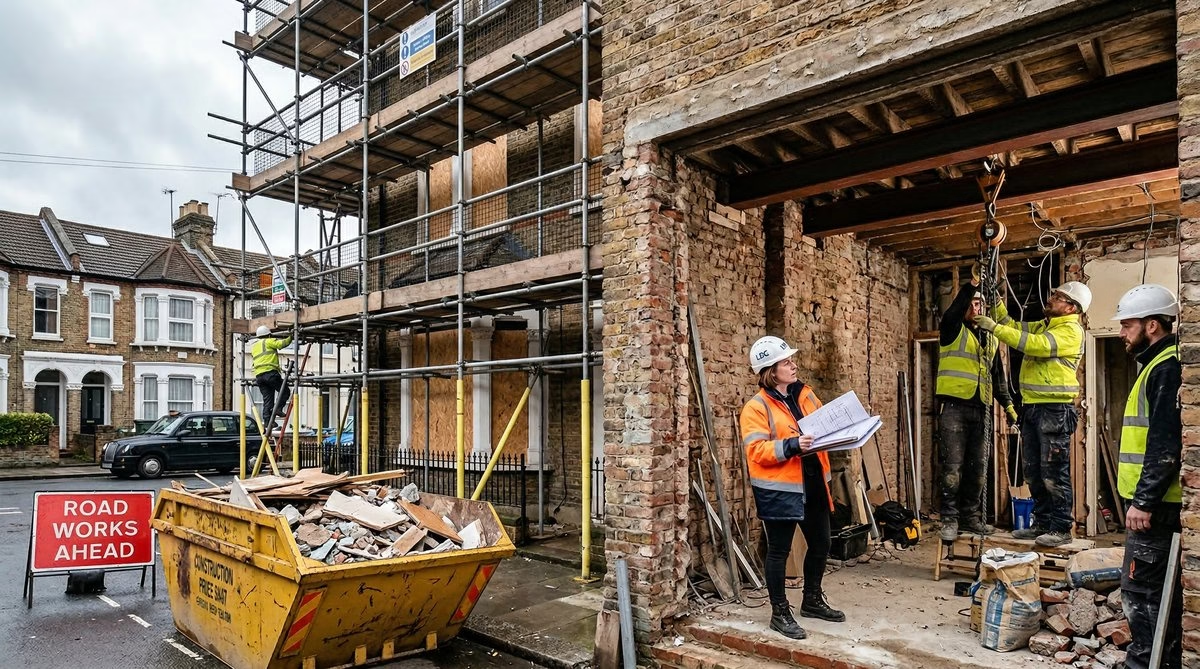
If you have ever received three quotes for the same renovation and wondered how they could differ by £30,000, you are not alone — and you are not imagining things. UK renovation costs why so expensive how to control budget is one of the most searched phrases among homeowners right now, and for good reason. Fixer-uppers are priced within a whisker of turnkey homes, yet the gap between asking price and a liveable result is vast, murky, and full of surprises. At Fixiz, we scope renovation projects across London every week — from a single-floor refurb in Hackney to a full gut-and-rebuild in Dulwich — and we see the same confusion play out repeatedly. This article explains what actually drives renovation costs up, why quotes vary so wildly, and how we approach scoping to protect your budget from the moment we walk through the door.
Why renovation quotes vary so wildly — the hidden reasons behind the numbers
The first thing to understand is that a renovation quote is not a fixed price for a fixed thing — it is a priced interpretation of a scope. If the scope is vague, incomplete, or riddled with assumptions, two builders standing in the same kitchen will produce two completely different numbers. This is not dishonesty; it is often a fundamental difference in what each contractor has assumed they will find, what they have included, and how much risk they have priced in.
One of the biggest contributors to wildly varying renovation quotes is the quality of the specification. A detailed specification tells every contractor exactly what materials, finishes, methods, and allowances apply to every line of work. Without one, each builder fills in the blanks with their own judgement — and those blanks can be worth tens of thousands of pounds. The builder who came in cheapest may simply have left the most blanks unfilled. When those blanks get filled during construction — as they inevitably must — costs escalate fast.
We recently quoted a Victorian terrace in Brixton where the owner had received quotes ranging from £85,000 to £148,000 for what was described as a “full renovation.” When we compared scope documents, we found that the lower quotes excluded structural engineer fees, party wall awards, full rewiring, and any drainage investigation. The higher quotes had priced contingency for all of these. Neither was wrong exactly — but the client was not comparing the same project.
There is also a postcode and logistics dimension that gets underpriced. Congestion zone charges, permit-to-skip licensing, restricted delivery windows, and the cost of inner-London labour all compound. A builder pricing a job in Wandsworth for the first time, having mostly worked in Essex, will either underprice those logistics or not mention them until they appear as a variation.
Tip: Before comparing quotes, ask every contractor to confirm in writing what is excluded. An exclusion schedule is just as important as a price schedule.
The real cost drivers most homeowners miss — structural, damp, services, and access
Once you move past quoting variability, the next layer of cost confusion comes from genuinely hidden scope — work that only becomes visible once walls are opened up, floors are lifted, or drains are rodded. This is where renovation budgets most commonly drift, and where the difference between a well-scoped project and a poorly-scoped one becomes financially painful.
Structural issues are the most feared — and rightly so. In London’s predominantly Victorian and Edwardian housing stock, structural surprises are near-certainties on any substantive renovation. Failed lintels, undersized floor joists, and removed load-bearing walls without proper steel support are common findings. The question is not whether to expect them, but whether you have scoped and priced for the investigation that would reveal them before you start.
On a project in Lewisham, we were engaged after a client had already received two quotes and was ready to proceed. During our pre-contract structural survey, we identified that the rear outrigger had a stepped foundation requiring underpinning before the proposed loft conversion could go ahead. Neither previous quote had flagged this. The cost of discovering it mid-project — with scaffolding up and walls open — would have been significantly higher than the cost of addressing it beforehand.
Damp gets systematically underpriced. There is a spectrum — genuine rising damp, penetrating damp from defective pointing, and condensation misdiagnosed as structural damp — and each has a very different remediation cost. Thermal imaging surveys and damp meter readings give you a true picture. Without them, builders price surface level, and the real scope only emerges once the plaster is off.
Services — electrical, plumbing, and heating — represent one of the most significant hidden cost areas in older properties. A full rewire on a four-bedroom Victorian terrace typically runs £8,000–£14,000. New consumer units, smoke detection to current Building Regulations, and earthing upgrades are not optional — they are legal requirements triggered the moment you begin notifiable electrical work.
- Structural survey: Commission one before accepting any quote. A pre-contract structural engineer report typically costs £500–£1,500 and can save multiples of that in avoided mid-contract surprises.
- EICR: An Electrical Installation Condition Report on the existing installation tells you the true scope of any electrical upgrade — not a builder’s assumption.
- Drainage CCTV survey: For any project involving groundworks or below-ground drainage, a pre-contract CCTV survey costs £200–£500 and routinely reveals root ingress or fractured pipes that would otherwise surface mid-project.
Tip: Think of pre-contract surveys as insurance, not overhead. Finding a problem before work starts gives you options. Finding it on site — mid-contract, walls open, scaffolding up — is always the most expensive version of the same discovery.
How to read a quote properly — red flags, allowances, and what “provisional sums” really mean
Most homeowners receive a renovation quote, look at the total, and make a decision based on gut feel. What they should be doing is reading every line — because how a quote is constructed tells you far more about the true final cost than the headline number alone.
The first thing to look for is the ratio of fixed prices to allowances. A well-structured quote clearly distinguishes between items that are fixed — demolition, structural steel, floor screeding — and items that are provisional or based on allowances, such as floor finishes, sanitaryware, and kitchen units. Allowances are placeholders. Every allowance is a potential variation, positive or negative, once selections are made.
Provisional sums are placeholders for work that needs to happen but cannot be fully priced at tender stage — groundworks where ground conditions are unknown, structural steel where engineer’s drawings are not finalised, or damp remediation where the full extent is unclear. They are entirely legitimate, but a quote that converts most of its scope into provisional sums is, in effect, a cost-plus contract in disguise.
On a project in Peckham, we reviewed a quote where over 40% of the total value was held in provisional sums. The headline price looked competitive. But once we mapped those provisional sums against likely final costs, the realistic out-turn was £35,000 above the quoted figure — a figure the client had nearly committed to without understanding.
Red flags to watch for:
- No exclusion schedule: If the quote does not state what is excluded, you have no way to understand the true scope boundary.
- Lump-sum pricing without breakdown: A quote that says “full renovation — £95,000” with no line items gives the contractor enormous latitude to define what “full” means.
- Allowances below market rate: A kitchen allowance of £4,000 when you are expecting a mid-range fitted kitchen will be exceeded. A realistic mid-range kitchen supply and install in London is typically £12,000–£25,000.
- No mention of statutory approvals: Building Regulations fees, structural engineer fees, and party wall surveyor costs are real project costs. A quote that omits them is not a complete picture.
Tip: Ask every contractor to provide a breakdown of their provisional sum and PC sum items separately from fixed-price items. This single request will immediately clarify how much of the headline price is genuinely fixed.
Our approach at Fixiz — detailed scoping that keeps your budget honest
At Fixiz, we made a deliberate decision not to compete on headline price. We compete on scope quality, transparency, and the accuracy of our out-turn costs — because a client who knows what they are actually spending is a client who trusts us and refers us. A client who discovers mid-project that costs have ballooned feels deceived, even if no dishonesty was intended.
Our scoping process begins before we produce any numbers. For any project above a cosmetic refurbishment, we commission or coordinate the pre-contract surveys described above — structural, damp, services condition, and drainage as appropriate. We do not price what we can see and hope for the best. We understand what we are dealing with before we quote.
We recently worked on a full renovation in Tooting — a mid-terraced Victorian property purchased specifically as a project. Before producing our quote, we arranged a structural engineer visit, an independent EICR, and a damp survey. The structural survey revealed that a chimney breast had been partially removed without the requisite steel support — a remediation cost of around £3,800 that would otherwise have appeared as a variation on day three of the strip-out. The damp survey revealed localised penetrating damp at a single gable wall — a targeted repointing job rather than a full remediation. The client’s out-turn spend was within 4% of the original budget. That is what honest scoping produces.
Our variation process is equally rigorous. Every variation — whether client- or contractor-initiated — is priced and approved in writing before work proceeds. There are no verbal agreements on price changes. If we open a wall and find something unexpected, we stop, document what we have found, produce a costed variation notice, and wait for written approval before continuing.
Tip: When evaluating contractors, ask how they handle unexpected discoveries on site. A contractor who says “we’ll deal with it when we get there” will be calling you with bad news mid-project. A contractor who describes a documented variation process is one you can trust with your budget.
How to build a realistic contingency without panic-budgeting
Every renovation guide will tell you to hold a contingency. What they rarely explain is how to size it rationally — with reference to actual risk rather than a generic percentage. The right contingency is a function of scope uncertainty, property age, and how thoroughly you have investigated before committing to contract.
A full renovation of an unmaintained Victorian terrace, priced on a provisional-sum-heavy quote, might need 20–25% held back — not because the builder is bad, but because the scope is genuinely uncertain. A well-surveyed modern property with a detailed fixed-price contract might reasonably carry 5–8%.
Here is how we advise clients to structure their contingency:
- Start with a base contingency of 10% on any London residential renovation — a reasonable floor for unexpected but routine discoveries such as a corroded length of pipework or a timber joist that needs sistering.
- Add risk-specific contingency for each identified but unquantified risk. If the drains have not been surveyed, earmark £3,000–£5,000 specifically for drain remediation. If the electrical installation is pre-1990 and untested, earmark £8,000–£12,000 for a potential full rewire.
- Separate contingency from client change budget. Contingency covers things that go wrong or cost more than expected. Client change budget covers decisions not yet made — finishes upgrades, additional scope items. Conflating them is how budgets drift without anyone understanding why.
- Review and release contingency by phase. As each phase completes without triggering its associated risk, release that portion back into the project budget or hold it as savings. Contingency is not money that must be spent.
We worked with a client in Streatham who had been told by two previous contractors to “just allow an extra 20%.” We built a risk register — a simple document listing every identified risk, its estimated probability, and its estimated cost range. The client’s total risk-adjusted contingency worked out at 13.5% — meaningfully less than the 20% in their head, which made the project viable where it had previously felt marginal. Final out-turn contingency spend was approximately 8% of total project value.
Tip: Ask your contractor to produce a risk register alongside their quote. Any contractor who has scoped properly will have this information in their head already; writing it down simply makes it visible and shared.
Frequently asked questions
Why do renovation costs in the UK feel so much higher than five years ago?
Several compounding factors have driven UK renovation costs substantially higher since 2021. Material costs — timber, insulation, copper, and structural steel — rose sharply during post-pandemic supply chain disruptions and have not fully retreated. London labour costs have risen alongside broader wage inflation, and skilled tradespeople remain in short supply. Building Regulations have also become more demanding around energy efficiency and fire safety, adding specification cost to projects that would previously have been simpler to approve. These are structural repricings, not temporary distortions.
Is it worth getting a full structural survey before buying a renovation project?
Almost always, yes — and certainly for any property over forty years old where significant works are planned. A full RICS Level 3 Building Survey typically costs £800–£2,000. It identifies structural, damp, and services issues that would otherwise emerge during construction — and gives you a negotiating tool if defects are found before exchange.
What is the difference between a fixed-price contract and a cost-plus contract?
A fixed-price contract means the contractor has agreed to deliver a defined scope for a stated price, with overruns on their risk. A cost-plus contract means the client pays actual costs incurred plus an agreed margin. Fixed-price contracts give certainty — but only if the specification is detailed enough to genuinely fix the scope. A fixed price on a vague spec is fixed in name only — for most London renovation projects, the best approach is a detailed fixed-price contract with clearly labelled provisional sums for genuinely uncertain items, managed via a robust variation process.
How can I tell if a quote is competitive or has simply missed scope?
Compare exclusion schedules rather than headline prices. Ask every contractor to list in writing everything not included in their quote. Map those exclusions against your full project scope and estimate the cost of the gaps. A quote that excludes structural engineer fees, party wall costs, floor finishes, and drainage investigation may look £20,000 cheaper — but when those costs are added back, the true comparison may look very different. Also check allowances: if a contractor’s sanitaryware allowance is £1,500 and your expectation is a mid-range bathroom, that figure will be exceeded before a tile is laid.
Ready to move from confusion to construction? Get in touch with Fixiz today for a no-pressure chat about your project and the fastest route to full compliance.