Physical address:
128 City Road, EC1V 2NX, London,UK

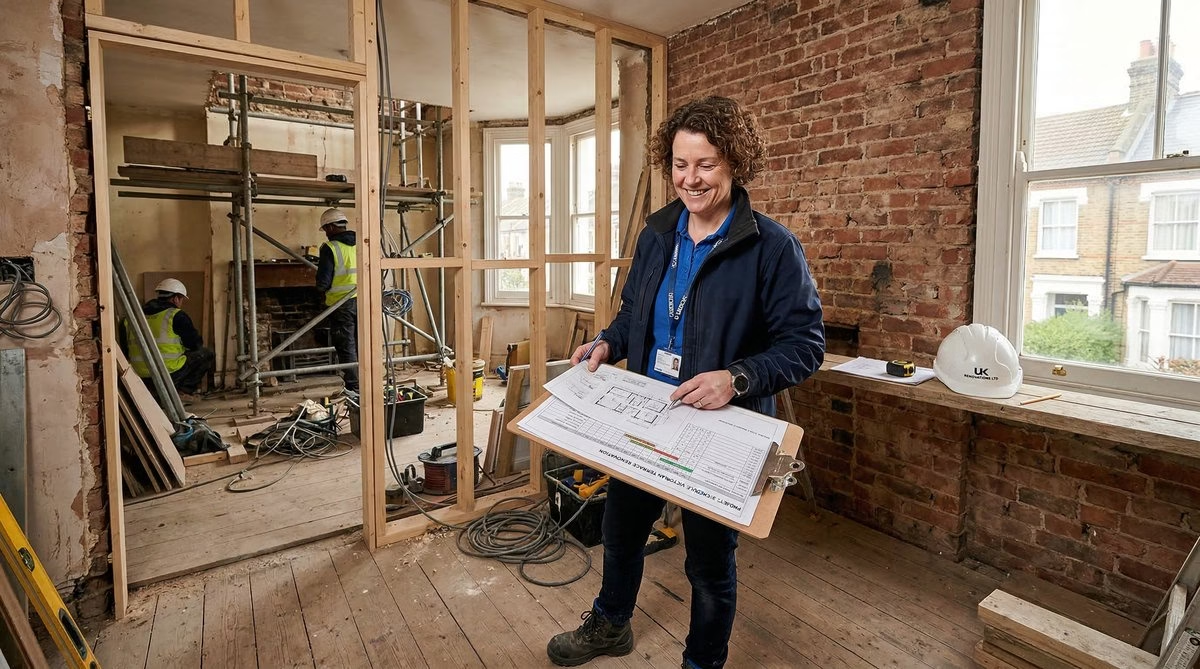
If you’ve spent any time on UK property forums in the last two years, you’ll have noticed the same sentiment appearing with numbing regularity: renovation quotes are insane. Fixer-uppers are priced almost identically to turnkey homes, yet the renovation cost to bridge that gap comes in at a figure that makes the numbers stop adding up entirely. At Fixiz, we understand why UK renovation costs why so expensive how to control budget has become a genuine source of anxiety — and we think there are structural reasons for the problem that most people don’t fully understand. This guide explains those reasons honestly, and shows you how proper scoping, risk quantification, and professional specification keep your project from becoming one of the horror stories.
Why UK renovation costs have risen so sharply — the honest picture
The dramatic increase in renovation costs since 2020 is not primarily a story of builder greed. There are several compounding factors that have driven genuine cost inflation in the construction sector, and understanding them is the first step to building a realistic budget.
Labour market tightening
The UK construction workforce lost a significant proportion of its EU-origin labour following Brexit and the disruption of the COVID period. Industry data consistently shows a structural shortfall in skilled trades — particularly in finishing trades such as plastering, tiling, and joinery. When there are fewer skilled workers available, their rates rise. A plasterer who charged £180 per day in 2018 is now typically charging £280–£320 per day in London and the South East. This is not a temporary aberration; the workforce demographics suggest this tightening will persist.
Material costs
Timber, insulation, plasterboard, copper pipework, and electrical cable all saw significant cost spikes during the supply chain disruptions of 2021–2022. Some of those increases have moderated, but many have not fully reversed. Structural timber in particular remains substantially more expensive in real terms than it was in 2019. For a project with significant structural or carpentry content, this has a material effect on costs.
Energy and overheads
Every contractor’s overheads — fuel, insurance, van costs, tool replacement, accountancy, and now mandatory workplace pension contributions for employees — have increased substantially. A sole trader who quoted keenly in 2018 is now running a business that costs meaningfully more to operate, even before they’ve charged for a single hour of work.
The hidden risk factor
Perhaps the most important and least discussed reason for high renovation quotes is risk. When a builder looks at a Victorian terrace and writes a quote, they are not just pricing the work they can see — they are pricing the probability of finding something expensive that they can’t see yet. Rising damp behind dry-lining. Undersized joists. Non-compliant wiring. Failed drainage. Asbestos-containing materials in artex or floor tiles. A builder who has been caught out by these surprises once or twice will carry a significant contingency — because their margins don’t allow them to absorb a £5,000 surprise on a £30,000 project and remain solvent.
Tip: The difference between a very expensive quote and a less expensive one is often not the day rates — it’s the contingency built in for unknown risk. The way to reduce that contingency is to eliminate as much unknown risk as possible before quotes are sought. This is what proper pre-contract scoping achieves.
Why quotes vary wildly — and what it actually means
Receiving three quotes and finding a £20,000 spread between the lowest and highest is not unusual for a larger renovation project. Most homeowners interpret this as evidence that someone is overcharging or someone is recklessly cheap. The reality is usually more nuanced — and more instructive.
Different scope assumptions
The most common source of quote variation is that the three contractors have quoted three different jobs. Without a detailed specification, each contractor makes their own assumptions about what is included: Does “rewire” include a new consumer unit? Does “damp treatment” include hacking off the existing plaster and re-rendering? Does “roof repair” include the guttering? These assumptions can change the total cost dramatically — and they mean that the “cheapest” quote is often also the most incomplete one.
Different risk tolerance
A sole trader working on tight margins and without the reserves to weather a difficult job will price more aggressively upfront, then manage variations (additional costs charged as the job progresses) to recover margin. A more established contractor with proper systems will include a realistic contingency in their fixed-price contract, which makes their initial quote look more expensive — but removes the risk of runaway costs once work starts.
Different quality standards
A quote that includes full substrate preparation, correct product specification, and compliance documentation will always cost more than one that skips these steps. The cost difference between cheap and correct is rarely visible from the outside — but it becomes very visible when you try to sell the property or when something fails.
Tip: When comparing quotes, always ask each contractor to specify in writing what is included in their price for each major work package — not just the headline items. The documents that emerge from this exercise tell you far more than the number at the bottom of the page.
How to control renovation costs — a practical framework
Cost control on renovation projects is not primarily about finding the cheapest contractor. It is about eliminating uncertainty before work starts, specifying clearly, and managing change rigorously during the build. These are the levers that work.
Pre-contract investigation
For any renovation involving the removal or alteration of existing fabric — opening up floors, removing walls, stripping back plaster — a targeted pre-contract investigation is the single highest-return investment you can make. This typically involves a structural engineer’s assessment of the condition of floors, walls, and any proposed structural alterations, a drain survey if drainage is being modified or the existing drainage is of uncertain age, and a condition survey of the roof if the project scope touches the loft. The cost of these investigations is modest (typically £500–£2,000 depending on scope); the cost of discovering the same issues mid-project can be five to twenty times higher.
Proper specification
A renovation specification is not a list of rooms and works. It is a document that defines the product, the standard, and the testing regime for every work package. It should specify the tile adhesive classification (S1 or S2), the insulation lambda value, the timber treatment specification for any structural timber, the paint system, and the compliance certificates required on completion. A proper specification eliminates scope ambiguity — which eliminates the single largest source of budget overrun on renovation projects.
Contract structure
Fixed-price contracts with clearly defined variation procedures protect homeowners far better than daywork arrangements or informal agreements. A JCT Homeowner Contract (widely available and appropriate for most domestic renovation projects) provides a framework for managing variations, resolving disputes, and protecting both parties. The cost of drawing up a proper contract is negligible against the cost of a contract dispute on a £50,000 project.
Contingency — real contingency
Every renovation budget should include a client-side contingency of 10–15% of the contract sum for a property of known condition, and 15–20% for a Victorian or Edwardian property where hidden defects are more likely. This contingency is not a budget line for upgrades or additions — it is a genuine reserve for unknowns. If you don’t need it, it’s a pleasant surprise. If you do need it, it means the project finishes rather than stalls.
How Fixiz scopes projects and controls costs
At Fixiz we approach renovation scoping as a forensic exercise rather than an optimistic one. We start every project with a pre-contract condition assessment — and where investigation is required before we can price confidently, we recommend and manage that investigation as a paid preliminary stage. This honesty costs us some projects where homeowners want a quick number; it saves the projects we do win from the kind of mid-contract crisis that damages both the client relationship and the finished building.
Our specifications are produced by technically qualified project managers who understand building physics, materials, and compliance requirements — not by salespeople working from a price list. Our quotes are itemised, not lump-sum, which means you can see exactly what you’re paying for and make informed decisions about where to invest and where to economise.
We also manage the variation process rigorously. Every potential variation — whether driven by a client instruction or an unexpected site condition — is priced and approved before work proceeds. There are no surprise invoices at the end of the job. The budget we agree at the start of the project is the budget the project is managed to, within the agreed contingency. This is not a marketing claim — it is a process discipline that we have built our business around.
We work primarily in London and the South East, where construction costs are highest and the risk of hidden defects in pre-war housing stock is most significant. We are direct about what projects cost — and equally direct about what the consequences of cutting corners look like three years down the line.
Frequently asked questions
What is a realistic cost per square metre for a full house renovation in London?
For a full renovation of a Victorian or Edwardian terrace in London — stripping back to structural shell, full rewire, new plumbing, new kitchen and bathrooms, plastering, flooring, and decoration — a realistic range is £1,200 to £2,000 per square metre of gross internal floor area, depending on specification level and the extent of structural intervention. These figures are consistent with RICS data for London and assume professional project management and full compliance documentation.
Why do renovation costs vary so much between London and the rest of England?
London trades typically command a 20–40% premium over the national average, driven by higher living costs, higher overheads, more complex logistics (parking restrictions, access, waste disposal), and higher demand. Day rates for skilled trades are typically £80–£160 per person per day higher than in many other English regions.
How do I know if a renovation quote is realistic or if I’m being overcharged?
Benchmark costs are available from the RICS Building Cost Information Service (BCIS) and from publications such as the Homeowners Alliance renovation calculator. However, the most reliable indicator of a realistic quote is not the total number but the detail behind it — itemised costs, clear inclusions and exclusions, and a contractor who can explain their assumptions. A very cheap quote with no detail is a far higher financial risk than an expensive quote with full transparency.
Can I project-manage my own renovation to save money?
Yes, but the saving is rarely as large as homeowners expect, and the risk is considerably higher. Professional project management on a renovation typically costs 10–15% of the contract sum. The value it provides — in avoided defects, managed variations, and compliance documentation — often exceeds this cost on projects above approximately £50,000 in value. For smaller projects, self-management can be viable if the homeowner has the time, technical knowledge, and availability to be on-site or contactable daily.
Ready to move from confusion to construction? Get in touch with Fixiz today for a no-pressure chat about your project and the fastest route to full compliance.