Physical address:
128 City Road, EC1V 2NX, London,UK

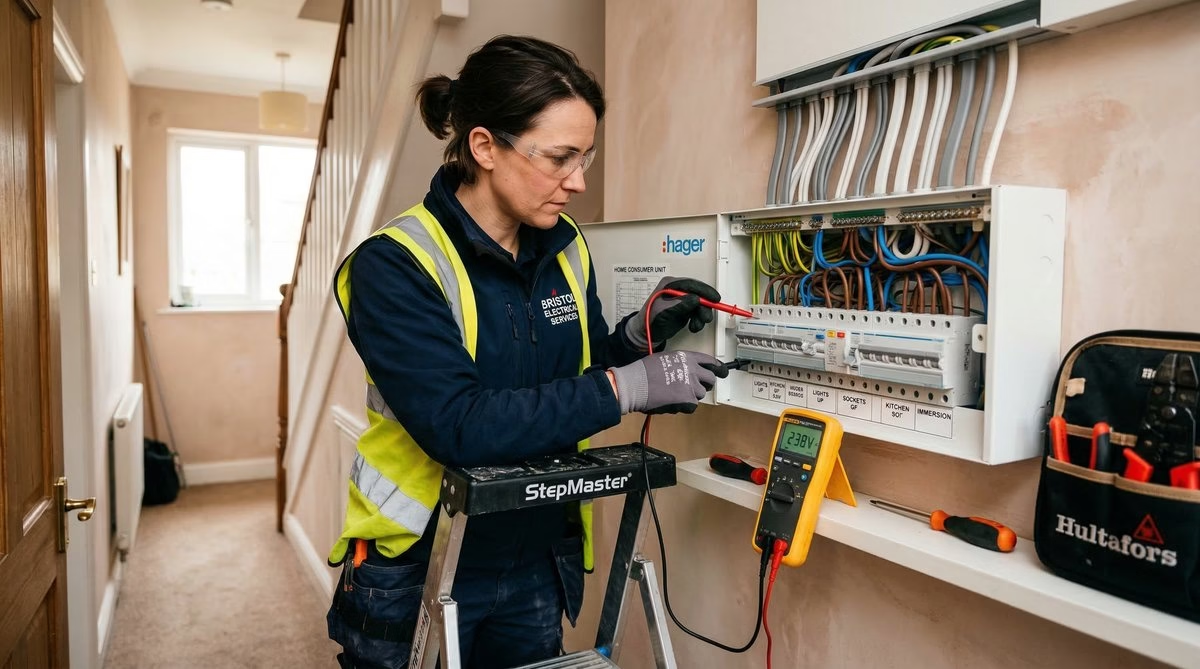
Most homeowners only discover how much they do not know about electrical certification when a solicitor’s enquiry lands two weeks before exchange. Understanding the Part P rewire certificate electrical installation certificate who issues question before work starts — rather than after the walls are plastered and the conveyancer is asking difficult questions — is the single most effective thing you can do to protect your safety and your sale. In this guide we walk through exactly what Part P demands, which documents must exist after a rewire, who has the legal authority to issue them, and the mistakes that turn a straightforward compliance matter into a months-long ordeal.
What Part P Actually Requires — and Why It Exists
Part P of the Building Regulations came into force in England and Wales in January 2005. Before that, any competent person — or even an enthusiastic amateur — could carry out domestic electrical work without notifying anyone, contributing to thousands of house fires and electrocutions annually. Part P changed that by bringing notifiable electrical work in dwellings under the same framework as other safety-critical building work.
At its core, Part P requires that all notifiable electrical work in a dwelling is either carried out by a Part P registered electrician — someone enrolled in a government-authorised competent person scheme such as NICEIC, NAPIT, or ELECSA — or is notified to and inspected by your local authority Building Control department before it is completed and covered up. There is no third option. The regulation does not care whether you have been wiring sockets for thirty years or whether your neighbour is a retired electrician who will “have a look”. If the work is notifiable, it must be certified by one of those two routes — full stop.
What counts as notifiable? A full or partial rewire is always notifiable. So is the installation of a new consumer unit, any new circuit, or any work in a special location — bathrooms, shower rooms, kitchens (certain zones), and outdoors. When in doubt, assume it is notifiable. A quick call to a registered electrician will confirm it in seconds.
We recently helped a homeowner in Battersea whose handyman had rewired two bedrooms and installed a new consumer unit — cosmetically tidy, but no notification, no certificate, and no record. When our client came to sell, the buyer’s solicitor raised a formal requisition. We had to carry out a full Electrical Installation Condition Report (EICR), notify Building Control retrospectively, and produce a remediation schedule. The episode added three weeks and several hundred pounds — all avoidable if the work had been certified correctly.
Part P exists to ensure every domestic installation is designed, installed, and verified to BS 7671 — the IET Wiring Regulations — and that a competent third party has confirmed it meets the standard. It is the mechanism that keeps people alive and gives buyers confidence in the property they are purchasing.
The Certificates You Need — EIC, MEIWC, BS 7671, and Building Regs Sign-Off
A common misconception is that electrical compliance involves a single certificate handed over at the end of the job. A properly documented rewire produces several documents — each serving a different purpose, each legally significant.
The most important document following any new installation or rewire is the Electrical Installation Certificate (EIC). Defined in BS 7671, the EIC certifies the design, construction, inspection, and testing of a new electrical installation. It must be signed off separately by the designer, the installer, and the inspector and tester — on most domestic rewires, one or two individuals fulfil all three roles but must still sign each function. The EIC is accompanied by a Schedule of Inspections and a Schedule of Test Results. These are not optional extras — they are integral parts of the certificate. An EIC without its schedules is incomplete.
For smaller additions to an existing installation — a new circuit added to an existing board, for example — the correct document is a Minor Electrical Installation Works Certificate (MEIWC). This shorter form certifies a single addition or alteration. It is not appropriate for a full rewire; only an EIC will do.
The third critical element is formal Building Regulations compliance sign-off. If your electrician is registered with a competent person scheme, they notify the scheme, and the scheme issues a Building Regulations Compliance Certificate on behalf of local authority Building Control — usually within a few weeks of completion. If your electrician is unregistered, they must notify Building Control directly before work begins and pay an inspection fee. In both cases, the result is a document proving the work was formally notified and signed off under the Building Regulations. You must keep this permanently with your property records.
On a full rewire in Camden, we completed the EIC with full test schedules on the day of final inspection, notified NICEIC within 24 hours, and the client received their Building Regulations Compliance Certificate within ten days. Store it alongside the EIC, gas safety certificates, and all other building work documentation in a single property file — when a conveyancer asks years later, everything in one place is invaluable.
- Electrical Installation Certificate (EIC): with Schedules of Inspections and Test Results — certifies the installation to BS 7671.
- Building Regulations Compliance Certificate: issued by the competent person scheme or Building Control — proves Part P notification and sign-off.
- Minor Electrical Installation Works Certificates (MEIWCs): for any subsequent additions or alterations to circuits after the main rewire.
- EICR (Electrical Installation Condition Report): not issued after a new installation, but required for existing installations — requested at sale or by landlords every five years.
Who Can Issue Certificates — Registered Electricians vs Building Control
Only a person who is both technically competent and either registered with an approved competent person scheme or working under a formal Building Control application can issue legally valid Part P certification for a domestic rewire. This is not a grey area.
A competent person scheme is a government-authorised body — the main ones are NICEIC, NAPIT, ELECSA, and SELECT (Scotland) — that assesses and registers electricians who demonstrate the knowledge, skills, and experience to self-certify their work. Registered contractors are subject to regular technical assessments to maintain membership. When they complete notifiable work, they notify the scheme electronically and the scheme issues the compliance certificate on behalf of the local authority. This is the most common and most straightforward route.
The alternative route — direct notification to local authority Building Control — is available to any contractor, whether registered or not, and in theory to homeowners undertaking their own work. You notify Building Control before starting, pay an inspection fee (typically £200–£500), and a Building Control Officer inspects the installation. Note that Building Control inspects but does not test — you still need a qualified electrician to carry out formal testing and issue the EIC. Building Control then issues a completion certificate confirming the work was notified and inspected.
Here is what cannot happen. A DIY enthusiast cannot sign off their own Part P work without Building Control. An unregistered electrician cannot self-certify. We are regularly asked whether we can “just sign off” an installation another contractor carried out — we cannot. An electrician can only issue an EIC for work they designed, installed, and inspected and tested themselves. What we can do is carry out an EICR, remediate any departures from BS 7671, and then certify the remediated installation — which is a legitimate, if more involved, process.
Always ask any electrician for their scheme name and registration number, and verify both on the scheme’s website before work begins. NICEIC, NAPIT, and ELECSA all provide free online verification tools. A registered electrician will never hesitate.
Common Mistakes That Cause Nightmares at Sale Time — and How to Avoid Them
In our experience at Fixiz, the vast majority of electrical compliance problems on pre-sale properties are entirely avoidable. They stem from a small number of recurring mistakes — usually made in good faith — that homeowners only discover when a conveyancer raises a formal requisition.
- Accepting a certificate without a scheme registration number: Some electricians issue template EICs that look official but carry no scheme notification. Without a corresponding Building Regulations Compliance Certificate from a recognised scheme or Building Control, Part P has not been met — regardless of how professional the EIC looks.
- Losing the original certificates: Electrical certificates must be kept permanently with the property. If the issuing scheme still exists a copy may be retrievable — but this is not guaranteed for older work. Store certificates in a dedicated property file from day one.
- Assuming old work is exempt: Pre-2005 work was not subject to Part P, but a buyer’s solicitor may still require an EICR to assess the current condition of an older installation. If it reveals Category 1 or Category 2 defects, remediation will be needed before sale regardless of when the work was done.
- Confusing an EICR with an EIC: An EIC certifies a new installation. An EICR reports on the condition of an existing installation. Retrospective testing cannot recreate an EIC for work already completed and covered — these are fundamentally different documents.
- Using an unregistered electrician to save money: The short-term saving is almost always eclipsed by the cost of retrospective Building Control notification, potential remediation, and delay to the sale. We have seen transactions fall through entirely because buyers were unwilling to proceed without proper compliance documentation.
We worked with a client in Islington whose full rewire five years earlier had produced an EIC but no Building Regulations Compliance Certificate — the electrician’s scheme registration had lapsed. We carried out an EICR, remediated several Category 2 observations, and assisted with a retrospective Building Control application. The process took four weeks, adding significant cost and stress to what should have been a clean sale.
Tip: Before any electrician starts notifiable work, ask for their scheme name and registration number and verify both online. It takes two minutes and could save weeks of stress at sale time.
How Fixiz Manages Electrical Compliance on Every Project
At Fixiz, electrical compliance is built into every project from initial survey to handover — not bolted on once the physical work is done. We understand that a rewire is a significant disruption and investment, and the last thing anyone needs is to discover the paperwork was not in order years later.
Every electrical project begins with a design review. Before a single cable is run, we confirm the scope of notifiable work, verify that the design meets BS 7671 18th Edition (Amendment 2), and confirm our NICEIC registration is current and in scope. We do not sub-contract notifiable electrical work to unregistered individuals, and we do not allow other contractors on site to carry out electrical work without verifying their credentials first.
During installation, our supervisors carry out stage inspections to confirm wiring routes, conductor sizing, protective device selection, and earthing arrangements before anything is concealed. On larger rewires we carry out intermediate testing to catch issues while walls are open — particularly important in older London properties, where previous electrical work of uncertain provenance is a frequent discovery.
On completion, we carry out a full inspection and test to BS 7671, complete the EIC with Schedules of Inspections and Test Results, and notify NICEIC within 24 hours of practical completion. Clients receive their Building Regulations Compliance Certificate from NICEIC within approximately two weeks. We also provide a Handover Pack containing the EIC, all test schedules, a summary of any inspection observations, and guidance on the recommended interval for a future EICR.
We were recently asked to quote on a rewire in Hackney where the homeowner had already received quotes from two other contractors — neither had mentioned Part P notification, scheme certification, or handover documentation. Ask any contractor: “What certification will I receive and when will my Building Regulations Compliance Certificate arrive?” A contractor who cannot answer clearly is not the right choice.
Frequently Asked Questions
Can I carry out my own rewire and then have an electrician certify it?
No. An electrician can only certify work they designed, installed, and inspected and tested themselves. If you carry out your own rewire, you must notify local authority Building Control before starting, pay the relevant fee, and have Building Control inspect — including before walls are closed. You will still need a qualified electrician to carry out formal testing to BS 7671 standards. Building Control issues a completion certificate confirming the work was inspected, but this is not the same as the EIC a scheme-registered electrician produces under self-certification.
What happens if I sell a property without a Part P certificate?
Your conveyancer must disclose the absence of a Building Regulations Compliance Certificate for notifiable electrical work. The buyer’s solicitor will raise a formal requisition and the transaction will stall. Your options are: obtain indemnity insurance (which does not make the installation compliant), make a retrospective Building Control application (which requires inspection and may require remediation), or renegotiate the sale price. None of these is as good as correct documentation from day one, and some buyers will simply walk away.
How long are electrical certificates valid for?
An Electrical Installation Certificate does not expire — it records the installation’s condition on the date of issue. However, installations degrade over time, which is why periodic reinspection via an EICR is recommended: every ten years for owner-occupied homes (or on change of ownership), and every five years by law for privately rented properties. The Building Regulations Compliance Certificate also has no expiry — it confirms the original work was notified and signed off, and remains valid indefinitely.
My electrician says they don’t need to register with a scheme because they have 30 years of experience — is that right?
No. Experience does not substitute for scheme registration under Part P. BS 7671 has been updated multiple times since 2005, and an electrician who last studied the regulations formally thirty years ago may not be working to the current 18th Edition. Scheme registration requires ongoing technical assessment, providing an independent quality check. An unregistered electrician carrying out notifiable work is not self-certifying — they are carrying out unnotified work in breach of the Building Regulations, regardless of how technically sound that work may be.
Do I need a new certificate if I just change the consumer unit?
Yes. Replacing a consumer unit is notifiable work under Part P. A registered electrician must issue an Electrical Installation Certificate and notify their scheme. A responsible electrician will also assess existing circuits before replacing the board — and may issue an EICR as part of that process. A consumer unit replacement without a certificate is a common gap in property paperwork that causes exactly the same conveyancing problems as an uncertified full rewire.
Ready to move from confusion to construction? Get in touch with Fixiz today for a no-pressure chat about your project and the fastest route to full compliance.