Physical address:
128 City Road, EC1V 2NX, London,UK

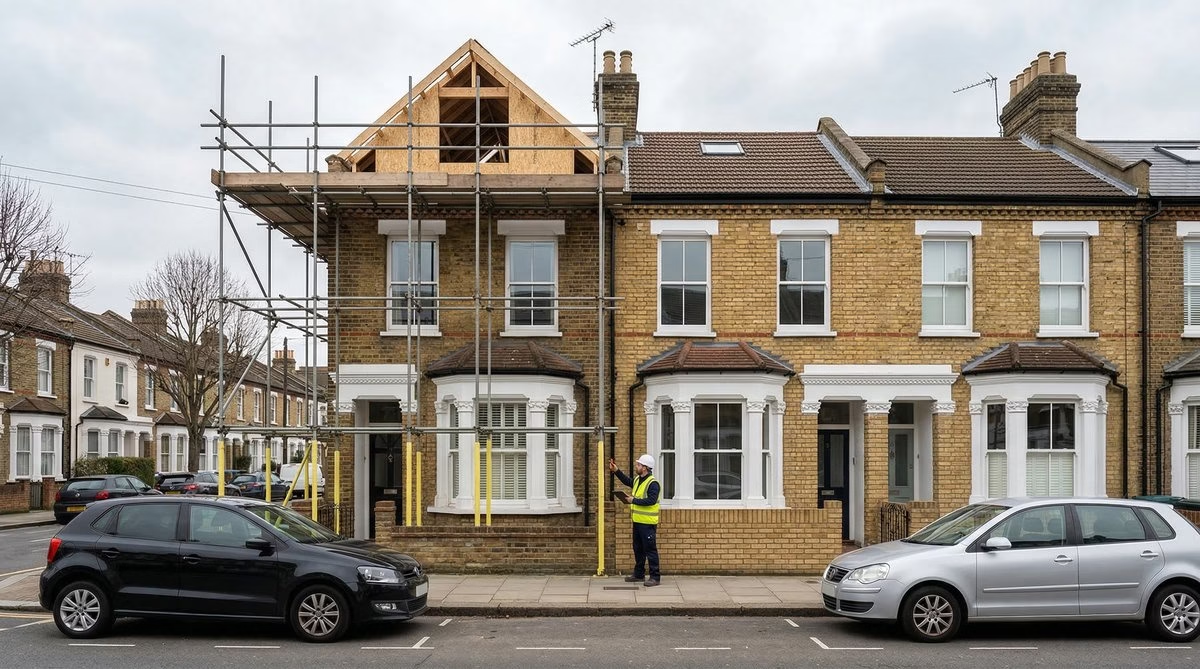
If you are converting your loft in a terraced or semi-detached London home, there is a good chance the party wall surveyor cost loft conversion UK question will land on your desk within weeks of your first structural drawing — largely invisible on early budgeting spreadsheets. By the time a homeowner in Islington or Lewisham realises they must pay not only their own surveyor but very possibly their neighbour’s surveyor too, the figure can feel like a punch to the project budget. At Fixiz, we work through this process on London loft conversions week in, week out. This guide sets out exactly what the Party Wall Act requires, what realistic 2026 costs look like, why you carry the bill for both sides, and — most importantly — how careful early engagement keeps those fees under control.
When a loft conversion triggers the Party Wall Act — and when it doesn’t
The Party Wall etc. Act 1996 applies whenever your proposed work touches, cuts into, or structurally affects a wall or structure shared with an adjoining owner. For most loft conversions in London’s dense terraced and semi-detached streets, the Act is almost inevitable — but it is worth understanding the precise triggers so you are not throwing money at the process unnecessarily.
The most common trigger in a standard loft conversion is the insertion of steel beams into the party wall. In virtually every dormer, Mansard, hip-to-gable, or structural Velux conversion, the engineer’s scheme involves bearing new roof or floor steels into the shared masonry. The moment a beam pocket is cut into the party wall — even just 25mm — Section 2 of the Act is engaged and a Party Structure Notice must be served at least two months before work commences.
Removing or reducing a shared chimney breast is a second common trigger — many Victorian and Edwardian terraces in Hackney, Haringey, or Wandsworth have chimney stacks running through the party wall, and work to remove, stabilise, or build around them is notifiable. Increasing the height of a party wall or inserting a damp-proof course are further notifiable works under Section 2.
There are genuine scenarios where the Act does not apply. A truly detached property with no shared walls is exempt. In some designs, structural engineers can position steel columns on a purpose-built internal pad foundation entirely within the building owner’s own property, so beams never touch the party wall. We have used this approach on projects in Brockley and Forest Hill where consent from a neighbouring tenant was uncertain — a legitimate design-led way to sidestep the Act that we always explore at feasibility stage.
Equally, Velux roof windows that sit entirely within your own roof slope and involve no cutting of shared walls are unlikely to trigger the Act. If there is any doubt, the prudent position is to assume the Act applies and serve notice. Failure to do so can expose you to injunctions and costly remediation after the fact — a risk never worth taking on a project of this scale.
Typical party wall surveyor costs for loft conversions — realistic 2026 figures
The honest answer to “what will the party wall surveyor cost me?” is: it depends on how many parties are involved and whether your neighbour appoints a separate surveyor. But there are well-established ranges in the industry, and with a straightforward loft conversion in 2026, you can plan your budget around the following figures.
Where a neighbour consents in writing to your Party Wall Notice — signing the acknowledgement and raising no objection — no surveyor needs to be formally appointed. Your only cost may be £250 to £400 for a professional to prepare and serve the notices on your behalf. Many of our Fixiz projects in areas like Streatham and Tooting proceed on this basis, particularly where we help the client speak informally with neighbours before the notice lands on the doormat.
Where the neighbour does not consent — either actively dissents or simply fails to respond within 14 days, which legally counts as dissent — the formal surveyor-appointment process begins. At this point, there are two routes:
- Agreed surveyor: Both parties appoint a single impartial surveyor to act for both. For a loft conversion, typical fees fall in the range of £900 to £1,200 — covering the Party Wall Award and a Schedule of Condition for the adjoining property.
- Two surveyors: The building owner appoints their own surveyor; the adjoining owner appoints a separate one. Because you pay both sets of fees, the total for a loft conversion rises to approximately £1,800 to £2,400 — and this is where the hidden-cost surprise typically strikes homeowners who have not been briefed on the rules.
Hourly rates for party wall surveyors in 2026 typically run from £150 to £270 per hour for routine cases, with premium London practices billing up to £350 to £450 per hour on complex structural schemes. A Schedule of Condition — a photographic and written record of the neighbouring property’s condition before works start — typically costs £450 to £700 as a separate line item, and is almost always recommended. Without it, any crack discovered by your neighbour during or after the build is assumed to be your fault, regardless of whether it pre-existed.
If you have a mid-terrace property with neighbours on both sides who both dissent and appoint separate surveyors, you are looking at a realistic outlay of £3,600 to £4,800 before any dispute escalation. This is not the norm — but it is not vanishingly rare in inner-London terraces, and homeowners who budget only for a single surveyor fee are sometimes caught out. Budget for the worst case and treat anything less as a saving.
Who pays — and why the building owner usually covers both sides
The rule that the building owner — the person carrying out the construction — typically pays for everyone’s surveyor is one of the most counterintuitive elements of the Party Wall Act. It feels unfair. Your neighbour receives a professionally drafted Award, a surveyor’s visit to their home, and a documented record of their property’s condition — and you foot the bill for all of it.
The legal basis is Section 10(13) of the Act: costs of making the party wall award are in the first instance to be met by the building owner unless the Award determines otherwise. The policy rationale is straightforward: your works are the source of the risk to your neighbour’s property. You are the one inserting steel into a shared wall, potentially vibrating their plaster. The process exists to protect them, and it is your project that makes it necessary.
In practice, the surveyor-fee responsibility rarely shifts away from the building owner. The main exceptions are: where an adjoining owner requests additional protections that go beyond what the Act requires — in that case, the extras may be apportioned back to them; or where the proposed works involve repairing a wall in shared disrepair, in which case RICS guidance indicates costs can be shared in proportion to each party’s use and responsibility.
What this means practically: assume you are paying for everything. We have seen genuine budget strain on loft projects in Peckham and Battersea where homeowners simply did not know this rule existed until the invoice arrived. Your building owner’s surveyor can formally contest the reasonableness of the adjoining surveyor’s fees — but this only works if your surveyor is proactive in reviewing the other party’s billing. At Fixiz, we make a point of briefing homeowners on the “both sides” cost rule at the very first project meeting, so there are no surprises mid-build.
How costs escalate — disputes, third surveyors, and condition schedules
The baseline figures above assume a relatively smooth process: notices served correctly, neighbours consenting or appointing surveyors without hostility, and the Award agreed without fundamental disagreement. The problems arise when the process becomes contentious.
The third surveyor is a mechanism built into the Act for exactly this eventuality. Where the building owner’s surveyor and the adjoining owner’s surveyor cannot reach agreement on the Award terms — or where either party disputes the fee assessment — the matter is referred to a third surveyor, appointed jointly at the outset. Third surveyor referrals typically cost £300 to £600 per referral, borne by the party whose position the third surveyor finds against. The process also adds weeks to your timeline, and construction delay can easily cost more than the direct surveyor fees.
One scenario we see periodically in densely packed parts of East London — areas like Bethnal Green or Stoke Newington — is the multiple-party situation in converted flats. If your property shares a party wall with a converted Victorian house, you may need to serve notices on both flat leaseholders and the freehold company — potentially three or four separate sets of surveyors, pushing the party wall process cost to £5,000 or more even on a straightforward dormer loft.
Unauthorised works — where a building owner proceeds without serving notice or without waiting for the Award — carry the most severe consequences. Courts have issued injunctions halting work mid-build and requiring complete reversal of structural changes. Industry data points to average costs of around £8,000 for unauthorised works and up to £12,000 where structural damage is alleged. A less dramatic but common escalation is simply a slow-moving neighbour — a 14-day response period dragging to weeks, surveyors taking time to negotiate, and your two-month lead time stretching to four months. Every week of delay has a tangible cost in extended scaffolding, temporary roof structures, and deferred use of the completed space.
How Fixiz manages the party wall process for loft conversions — early engagement, controlled costs
At Fixiz, the party wall process is not something we bolt on at the end of design. We treat it as a live cost and timeline risk from day one — and that change of framing makes a significant practical difference to how costs land.
Our approach begins at feasibility stage. When we first review a client’s property — whether that is a mid-terrace in Clapham or a semi in Muswell Hill — we identify the party wall implications as part of the same conversation as planning permission and structural requirements. If a design change can avoid the party wall entirely, we flag that as a live option alongside its cost and programme implications. Where the Act is unavoidable, we build the surveyor cost into the initial budget estimate so clients know from day one what the realistic range is.
The second intervention that consistently saves money is informal neighbour engagement before the formal notice. We encourage clients to have a straightforward conversation with their neighbours — explaining what the work involves, how long it will take, and what protections the party wall process gives them. A neighbour who understands the Act is far more likely to consent promptly than one who receives a formal legal notice completely cold.
On one recent Fixiz loft project in Brockley, our client’s neighbour was initially resistant to any works. We arranged a short informal meeting, walked through the structural drawings, and confirmed a full Schedule of Condition would be conducted before a single hole was made. The neighbour consented within the fortnight, we appointed a single agreed surveyor, and the entire party wall process cost under £1,100.
Where neighbours do appoint separate surveyors, we proactively manage the fee scrutiny process. Our appointed building owner’s surveyor is briefed to review the adjoining owner’s invoices carefully and challenge any items that are disproportionate. We have successfully reduced neighbour surveyor bills by 20 to 30 per cent through this mechanism alone. We also handle all notice preparation and service as part of our project management scope — notices served incorrectly restart the two-month clock from zero, and the cost of getting them right the first time is a fraction of the delay cost when they go wrong.
Frequently asked questions
Do I always need a party wall surveyor for a loft conversion?
Not always. If your neighbour consents in writing to the Party Wall Notice within 14 days, no surveyor needs to be formally appointed and no Party Wall Award is required. The notice must still be served if the works trigger the Act — but a consenting neighbour resolves the process with minimal cost. Where the neighbour dissents or fails to respond, a surveyor (or surveyors) must be appointed and an Award produced before work can begin.
Can my neighbour appoint whichever surveyor they want, regardless of cost?
Your neighbour has the right to appoint any RICS-accredited or Faculty of Party Wall Surveyors member they choose, and you cannot direct that choice. However, your building owner’s surveyor has a formal role in scrutinising the adjoining surveyor’s fees — they must be reasonable and proportionate. If billing is excessive, your surveyor can object and refer the matter to the pre-selected third surveyor for determination. This is a genuine check on runaway costs, provided your own surveyor is proactive.
What is a Schedule of Condition and is it worth the extra cost?
A Schedule of Condition is a professionally prepared photographic and written record of the neighbouring property’s condition — cracks, damp, surface finishes — taken before your works begin. It typically costs £450 to £700. Without it, any damage alleged during or after the loft conversion is presumed to be your responsibility, because there is no baseline to compare against. On a build costing £50,000 to £90,000, the condition schedule is one of the best-value protections in the entire project.
What if I have neighbours on both sides — does the cost double?
Yes, effectively. Each adjoining owner is a separate party under the Act, must receive their own notice, is entitled to appoint their own surveyor, and generates their own Award. For a terraced property with neighbours on both sides — both of whom dissent and appoint separate surveyors — you could realistically be looking at £3,600 to £4,800 in party wall costs before any dispute escalation. The best mitigation is early, friendly engagement with both neighbours simultaneously so that, where possible, you secure consent from both within the 14-day window.
How long does the party wall process typically take for a loft conversion?
The minimum timeline from serving notice to starting work is two months, assuming the neighbour dissents promptly and surveyors are appointed quickly. In practice, the full process from first notice to signed Award commonly takes eight to twelve weeks — and can stretch to four or five months where there is delay or significant negotiation. This is why we serve Party Wall Notices at the earliest possible stage of a Fixiz project, as soon as the structural design is sufficiently developed to describe the works accurately, rather than waiting until building regulations drawings are approved.
Ready to move from confusion to construction? Get in touch with Fixiz today for a no-pressure chat about your project and the fastest route to full compliance.