Physical address:
128 City Road, EC1V 2NX, London,UK

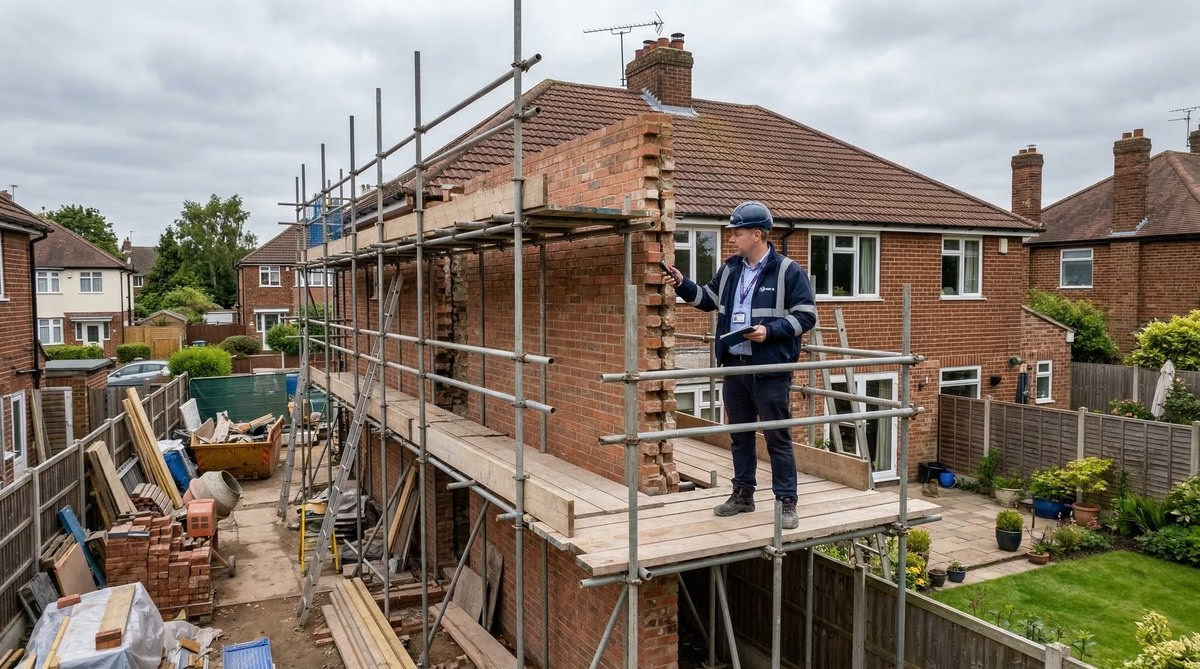
You have planning permission. You have your builder booked. Then your neighbour goes silent — and suddenly the phrase party wall notice ignored surveyor costs extension UK is all you can think about at two in the morning. It is one of the most common sources of anxiety we encounter at Fixiz: from a Victorian terrace in Wandsworth where a rear extension was held up for three months by a non-responsive neighbour, to a semi-detached in Dulwich where a routine side-return triggered competing surveyor appointments and a bill far beyond what the homeowner had budgeted. The Party Wall Act 1996 exists to protect everyone — but when poorly understood, it becomes a source of delay, cost, and genuine distress. This article explains what the process requires, what happens when things go wrong, how fees accumulate, and how to stay in control from the moment the first notice lands on your neighbour’s doormat.
What the Party Wall Act 1996 actually requires — and when it applies to your extension
The Party Wall etc. Act 1996 governs construction work on, at, or near a boundary shared with an adjoining owner. It applies across England and Wales, and it is not optional. If your proposed extension falls within its scope, you must serve notice before work can legally begin — regardless of whether you have planning permission or whether your builder is ready to start on Monday.
For a typical rear or side-return house extension in London, the Act is most likely triggered in three scenarios. First, under Section 6, if you plan to excavate within three metres of an adjoining building and your excavation depth is lower than the bottom of their foundations, you must serve a Notice of Adjacent Excavation. Most extension footings in terraced or semi-detached London properties fall within this zone. Second, under Section 3, if any part of your work directly involves the party wall itself — cutting in a beam, raising the wall, or forming openings — a Party Structure Notice is required. Third, under Section 1, if you are building a new wall at or astride the boundary, a Line of Junction Notice applies.
Notice periods are fixed by law. A Party Structure Notice requires a minimum of two months before work begins; an Adjacent Excavation Notice under Section 6 requires one month. The most common mistake we see is homeowners serving notice too late, assuming consent will come quickly. Not every extension triggers the Act — if your works are entirely on your own land, involve no boundary excavation, and do not touch the party wall, you may be outside its scope. But in densely built London, doubt is the sensible default.
The Act applies even when you are working on your own side of the boundary. Proximity and depth are what matters under Section 6 — not ownership. We have seen projects in Tooting and Clapham where homeowners were certain the Act did not apply, served no notices, started digging, and then faced the uncomfortable prospect of stopping on site or retrospectively managing a dispute while the build was underway. Both outcomes are avoidable with the right preparation at the outset. At Fixiz we carry out this initial scoping as part of our project consultation, so you know exactly where you stand before any timelines are agreed with your builder.
What happens when your neighbour ignores the notice — the “deemed dispute” path
This is the scenario that generates the most anxiety. You served the notice in good time. You were polite. You perhaps knocked on the door to introduce yourself and your builder. And then — nothing. No response. Your neighbour simply does not reply.
Under the Party Wall Act, silence is not consent. If your adjoining owner fails to respond within 14 calendar days, a dispute is automatically deemed to have arisen — regardless of their intentions. The legal consequence is clear: you cannot proceed as though consent has been given. A formal Party Wall Award must be obtained before work can legally begin.
Once 14 days have passed without a written response, you may serve a further notice giving your neighbour a final 10-day window. This triggers your right to appoint a surveyor on your neighbour’s behalf if they still do not engage. It can feel adversarial. It is, however, entirely lawful, and in most cases it is the most practical way to keep your project moving.
Once surveyors are in place, they work together to produce a Party Wall Award — a legally binding document setting out what work will take place, the access arrangements, and how any damage will be assessed. The Award protects both parties, with your neighbour’s interests represented even if they never actively participated.
When a neighbour actively dissents, both parties appoint their own surveyors to negotiate an Award. If the two surveyors cannot agree, they appoint a Third Surveyor to adjudicate — the most expensive route. In our experience across South London, including projects in Herne Hill, Streatham, and Peckham, the vast majority of two-surveyor disputes are resolved without reaching that stage. The key point we always stress: a deemed dispute is not a catastrophe. It is a defined legal process with a defined outcome, and the way to reduce anxiety is to move through it methodically.
Surveyor fees explained — who pays, how costs escalate, and how to keep them reasonable
The building owner — the person doing the works — is generally responsible for paying not just their own surveyor’s fees, but also the reasonable fees of the adjoining owner’s surveyor. When two independent surveyors are involved, costs can rise quickly. Understanding the fee structure in advance is the most effective way to manage the risk.
In 2025, party wall surveyors charge hourly rates of between £90 and £450, with London rates at the upper end. A single-surveyor award for an extension typically costs £1,000 to £1,500. When both parties appoint separate surveyors, the combined cost rises to £2,400 to £3,000 for most London extensions — higher if the project is complex or multiple adjoining owners are involved. Basement projects can reach £3,500 to £5,000 or more.
Costs spiral when disputes become protracted. Each letter, site visit, and revision to the draft Award is chargeable time. A neighbouring surveyor who is inexperienced or obstructive can add hundreds of pounds with each exchange. The most effective containment measure is serving well-drafted, complete notices from the outset. An incomplete notice can be challenged, requiring reservice and restarting the 14-day clock. Clear communication with your neighbour before the notice arrives also reduces the risk of dissent and an aggressive surveyor appointment.
A Schedule of Condition — a photographic record of your neighbour’s property before works begin — is essential. It typically costs £450 to £700 in London and is money well spent. You can also request fixed or capped fees at the outset; reputable surveyors will be transparent about their fee structures. At Fixiz, we always encourage clients to instruct professionals who charge on a fixed-fee basis wherever possible, and we can recommend experienced party wall surveyors with whom we have worked on previous London projects. One final point: if you proceed without serving the required notices at all and your neighbour takes action, the cost of retrospective proceedings — including their legal and surveyor costs — always exceeds the cost of doing the party wall process properly in the first place.
Timeline traps — how party wall disputes delay your build and what you can do about it
Builders have diaries. Materials are ordered against expected start dates. Scaffolders, groundworkers, and structural engineers are coordinated around a programme. When the party wall process introduces unexpected delays, the knock-on effects can push a build back by weeks — and in a worst case, by several months. The timeline risks compound at multiple stages.
If your neighbour does not respond within 14 days, you must serve the further 10-day notice, wait for that to expire, then appoint surveyors. The surveyors then need time to carry out inspections, correspond, draft the Award, and agree the final document. In a straightforward case, this takes four to six weeks from the point surveyors are appointed. In a contested case, it can take three to four months. We have seen projects in Battersea and Balham where the party wall process added nearly five months to a build programme because the notice was served too late and the neighbour’s surveyor was slow to engage.
The single most effective protection is to serve party wall notices as early as possible — ideally as soon as planning permission is granted. Do not wait until your builder is ready to start. Notice periods are floors, not targets. There is also a widely held misunderstanding that deserves addressing: you cannot start notifiable works once the two-month notice period expires if a dispute is still unresolved. The passage of time does not resolve a dispute; only an Award does. If surveyor negotiations are ongoing when your notice period expires, your builder must wait. This is the timeline trap that catches the most projects.
Multiple adjoining owners multiply the risk. In a mid-terrace property, you may have obligations to neighbours on both sides simultaneously. Each must be served separately, and each has the independent right to dissent. Careful sequencing — knowing in advance which neighbour is most likely to be straightforward and which may require more time — is part of the planning process we carry out with our clients before anything is formally submitted.
How Fixiz guides you through the party wall process — from notice to award
At Fixiz, we manage house extensions from initial feasibility through to completed build. We have worked on party wall matters across the full range of London’s residential property stock — Victorian and Edwardian terraces, 1930s semis, converted flats, and contemporary new-builds. The party wall process is not a peripheral concern: it is a core part of the project management work we do for every client whose extension triggers the Act.
Our approach begins well before a notice is served. During project scoping, we assess which sections of the Act apply, identify all adjoining owners who need to be notified, and map out realistic timeline implications for the build programme. If we are working with a client in Wandsworth on a rear extension involving excavation within three metres of a neighbour’s foundations, we build the two-month notice period into the programme from day one — not as an afterthought. This means that by the time planning permission comes through, the party wall process is already underway.
We help clients draft clear, accurate notices that give the process the best possible start. A well-written notice explains the works in plain language, includes the required drawings, and invites the neighbour to engage positively — without being legalistic or adversarial in tone. In our experience, the quality of the initial notice significantly affects whether a neighbour consents, ignores, or actively dissents. Where a neighbour does not respond or formally dissents, we work with our recommended party wall surveyors to manage the process efficiently. We attend site visits, provide the documentation surveyors need, and push back when fees escalate unreasonably. We have done this for clients across South and West London, including a case in Dulwich where a neighbour’s surveyor raised a series of technical objections that our team — working with the building owner’s surveyor — resolved within two weeks rather than the months it might otherwise have taken.
Our goal is simple: move your project from notice to award to build as quickly and cost-effectively as the law allows. What we can always control is the quality of preparation, the speed of response, and the professionalism of the people involved. That is what we bring to every project.
Frequently asked questions
Do I need a party wall agreement for a single-storey rear extension?
In most London terraced or semi-detached houses, yes. If your extension involves excavation within three metres of your neighbour’s building at a depth lower than their foundations — typical for standard strip or pad footings — Section 6 applies and you must serve an Adjacent Excavation Notice. If the works also touch the party wall itself, a Party Structure Notice under Section 3 is additionally required. The depth of the footings is the critical factor, not the size of the extension. We always recommend a preliminary assessment before assuming the Act does not apply.
What happens if I start building work without serving party wall notices?
Starting notifiable works without the required notices is unlawful. Your neighbour can seek an injunction to stop work immediately, and you would likely pay all costs of retrospective proceedings — including their surveyor and potentially legal fees. Without a Schedule of Condition, any damage claim becomes a matter of competing assertions rather than documented evidence, an extremely difficult position to defend. The cost and disruption of working without notices is always greater than the cost of doing things properly from the start.
Can my neighbour demand any surveyor they like, and do I have to pay?
Your neighbour may appoint a surveyor of their choice, and as the building owner you are generally responsible for their reasonable fees. Those fees are not unlimited — they must be proportionate to the complexity and work undertaken. If fees are excessive, your own surveyor can challenge them, and the Third Surveyor can adjudicate on costs if needed. This is another reason why appointing an experienced building owner’s surveyor from the outset is worth the investment — they will monitor opposing fees and push back when costs are not justified.
How long does it take to get a Party Wall Award once surveyors are appointed?
In a straightforward case, a Party Wall Award for a standard extension can be agreed within four to six weeks of surveyors being appointed — covering the Schedule of Condition, correspondence, and production of the Award document. Where there are complications — multiple adjoining owners, complex structural works, or a slow surveyor — the process can take three to four months. The key variable is how quickly surveyors communicate and how efficiently the contractor provides technical documentation.
What is a Schedule of Condition and is it compulsory?
A Schedule of Condition is a photographic and written record of your neighbour’s property before works begin. It is not legally compulsory, but most surveyors include it within the Award process and it is strongly advisable. If your neighbour later claims damage from your extension, the Schedule demonstrates whether that damage pre-existed the works. Without it, the dispute becomes a matter of competing assertions rather than documented evidence. In London, a Schedule typically costs £450 to £700 — money that almost always earns its keep.
Ready to move from confusion to construction? Get in touch with Fixiz today for a no-pressure chat about your project and the fastest route to full compliance.