Physical address:
128 City Road, EC1V 2NX, London,UK

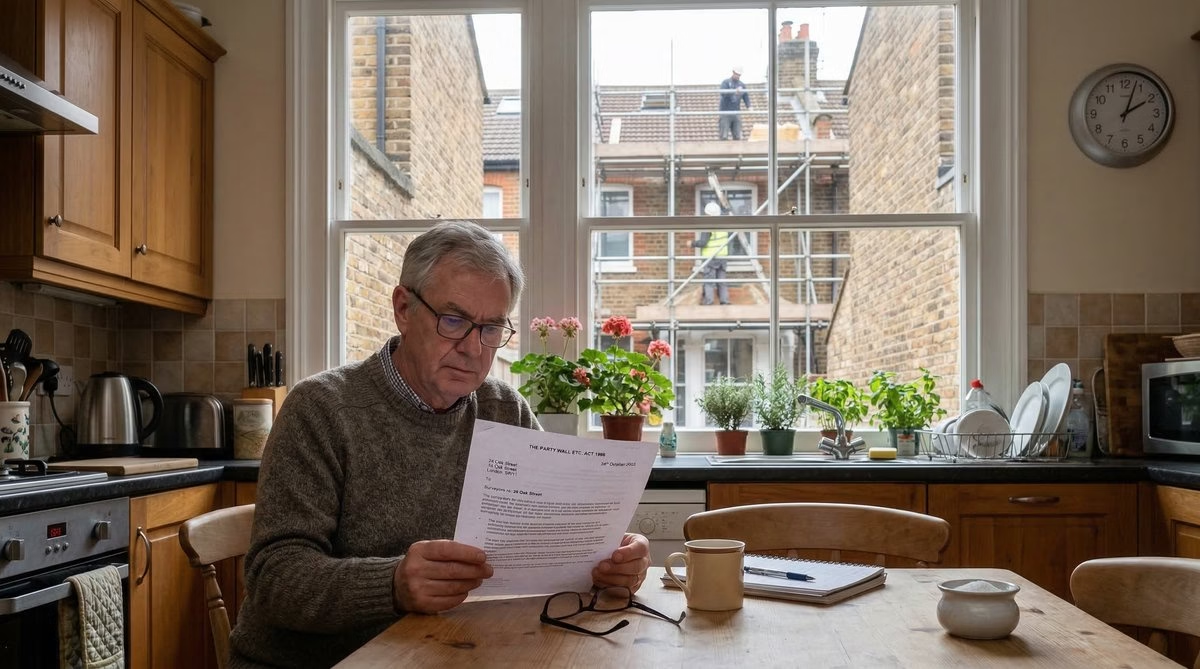
You open the post one morning and find a formal letter from next door’s architect. It explains that your neighbour plans a loft conversion and — under the Party Wall etc. Act 1996 — you must decide whether to consent or dissent. Then comes the phrase that stops most people cold: “If you do not reply within 14 days you will be deemed to have dissented and a dispute will be deemed to have arisen.” Suddenly a building project two walls away feels like an imminent legal crisis on your doorstep.
At Fixiz, we work on loft conversions across London every week — from Islington terraces to Victorian rows in Peckham — and we speak to neighbours who have received exactly this letter and felt exactly this dread. The question they almost always ask: should I consent, dissent, or is it safe to ignore? The answer matters, but it is far less frightening than the legal language suggests. This article breaks down party wall notice consent dissent deemed dispute UK law in plain English so you can decide — confidently.
What the three options actually mean — consent, dissent, and the 14-day silence rule
When a building owner serves a party wall notice under the Act, you — the adjoining owner — have three possible responses. Two are active choices and one is a legal default that kicks in whether you intend it or not.
Option 1: Consent in writing
Consenting means you are satisfied with what is proposed and you confirm that in writing — usually by signing and returning the acknowledgement form that should accompany the notice. Once you consent, the building owner can proceed without a formal Party Wall Award. Your statutory rights under the Act remain intact — consent does not mean you have waived all future recourse if damage occurs.
Consent is straightforward, fast, and costs you nothing. We typically discuss it with neighbours where the proposed works are simple, the building owner has shared drawings, and the contractor is reputable. Before signing, always request a Schedule of Condition — a photographic and written record of your property’s existing state before work begins. It costs the building owner nothing extra and gives you clear evidence if you need to raise a damage claim later.
Option 2: Dissent — appoint a surveyor
Dissenting means you do not consent to the works proceeding without a formal Party Wall Award first. Dissent is not a refusal to let the work happen — it is a request for the statutory safeguards the Act was designed to provide. When you dissent, you either appoint your own party wall surveyor or agree to use a single impartial “agreed surveyor” who represents both sides. The surveyor prepares a Party Wall Award — a legally binding document setting out precisely how the works will be carried out, what protections are in place for your property, what hours the contractor can operate, and how any damage will be remedied.
Critically, the building owner pays the reasonable costs of the surveyor process — including your surveyor’s fees if you appoint one separately. The Act is designed so the financial burden sits with the owner doing the work. A single agreed surveyor for a loft conversion typically costs £900–£1,200; separate surveyors typically cost £1,800–£2,700 total — all borne by the building owner.
Option 3: The 14-day silence rule — doing nothing
If you do not reply in writing within 14 days of receiving the notice, the Act deems a dispute to have arisen — automatically. You do not have to write back saying you dissent. The silence itself is the trigger. The clock starts from the date you received the notice, not the date you read it. This rule exists to stop projects stalling indefinitely. But it also means your inaction has legal consequences — and not necessarily the ones you might assume.
“Deemed dispute” demystified — it sounds scary but here is what it triggers in practice
The phrase “deemed dispute” is the most alarming part of any party wall notice. It sounds as though you are already in a legal fight before a single brick has been touched. In fact, the term has a very specific and much more mundane meaning under the Party Wall etc. Act 1996.
A deemed dispute is simply the legal mechanism that activates the Act’s formal dispute resolution process — the appointment of surveyors and the preparation of a Party Wall Award. It does not mean you have done anything wrong. It does not mean a solicitor will write to you or that you face any penalty. It is a procedural trigger, nothing more.
When a deemed dispute arises — whether because you actively dissented or because 14 days passed without response — the building owner must appoint a party wall surveyor. They then serve a further notice giving you 10 days to appoint your own surveyor. If you do not, the building owner’s surveyor may act as agreed surveyor for both parties. A Schedule of Condition is prepared, a Party Wall Award is drawn up and served on both parties, and works can then begin under its terms.
We have spoken with homeowners in Stoke Newington and Herne Hill who were genuinely relieved when we explained this. They had assumed “deemed dispute” was the start of court proceedings, costs orders, and solicitors’ letters. In the overwhelming majority of loft conversion cases, it is nothing of the sort. It is a structured administrative process designed to protect everyone and keep the project moving. The “dispute” is resolved by the Award itself.
When to consent (and what protections you lose) vs when to dissent (and what you gain)
Neither consenting nor dissenting is inherently the right answer. The correct choice depends on the nature of the works, your relationship with your neighbour, how much information you have been given, and the level of formal protection you want documented before work begins.
The case for consenting
For a standard loft conversion — particularly a hip-to-gable extension or rear dormer on a terraced house — the risks to your property are generally low and well understood. If your neighbour has been open about the plans, you have seen drawings, and the contractor is reputable, consent is often the most proportionate response. Consenting is quicker: it removes the Award process, which can add three to six weeks to the programme. Your rights to claim for damage after the fact remain even if you consented upfront.
What you give up when you consent
Without a Party Wall Award there is no formal document setting out working hours, noise and dust controls, access arrangements, or the precise remediation process if damage occurs. For most standard loft conversions this is an acceptable trade-off — provided you have the Schedule of Condition in place. For more complex works involving underpinning, deep excavations, or major structural alteration to the party wall itself, the absence of an Award is a real vulnerability.
The case for dissenting
Dissent makes most sense when works are complex or high-risk; when you have not been given adequate drawings or method statements; when you have concerns about the contractor’s competence; or when you simply want the formal protection of a legally binding Award before anything begins. Dissenting does not make you a difficult neighbour — it is precisely what the Act is designed to facilitate. For loft conversions involving significant structural steelwork through or adjacent to the party wall, we regularly advise neighbouring owners in Hackney and Tooting that dissent and an Award gives them meaningful, documented protection. The building owner pays; you gain an independent expert reviewing the proposals and a binding document governing how the works proceed.
What happens if you simply ignore the notice — the automatic escalation path
Ignoring a party wall notice does not make the process go away — it simply hands control to the building owner and their surveyor. Here is the sequence that unfolds automatically once 14 days pass without a written response:
- Days 1–14: The response window. You can consent in writing, dissent in writing, or do nothing.
- Day 15 onwards: A deemed dispute arises automatically. The building owner must appoint a party wall surveyor.
- Second notice served: The building owner’s surveyor serves a further notice requiring you to appoint your own surveyor within 10 days.
- 10 days expire without response: The building owner’s surveyor is empowered to act as agreed surveyor for both parties.
- Award prepared and served: The Party Wall Award is issued to both parties. Works may then commence under its terms.
What does not happen when you ignore the notice: you do not go to court, you do not receive a penalty, and your right to claim compensation for damage is not extinguished. But you do lose the opportunity to choose your own surveyor and to influence the terms of the Award before it is finalised.
We spoke with a homeowner in a Lewisham terrace who had ignored two sets of notices, assuming her neighbour needed her explicit agreement before starting. She was surprised when an Award appeared through her letterbox — drawn up by a surveyor she had never met, appointed on her behalf — saying work would begin in 28 days. The Award was fair and protective, but she had missed the window to negotiate specific conditions she would have liked. Ignoring the notice had not blocked the works; it had simply reduced her influence over how they were governed.
Under Section 1 of the Act — new building on the boundary line — silence has an additional consequence: if you do not respond within 14 days to a notice about a proposed wall built astride the boundary, the building owner must build entirely within their own land. For most residential loft conversions, however, Section 2 (existing party wall) and Section 6 (excavation) apply, and under those sections silence means deemed dissent and Award rather than any absolute barrier.
How Fixiz advises neighbours on both sides — keeping projects moving and relationships intact
At Fixiz, we manage loft conversions throughout London — from Victorian terraces in Streatham to Edwardian semis in Walthamstow — and party wall compliance is built into every project from day one. We work with building owners to serve notices correctly and on time, and we regularly speak with their neighbours about what the notice means.
Our advice is always the same: do not let the legal language make the decision for you. The Act is a framework designed to enable work to proceed fairly, not to create obstacles. The process works best when both parties engage promptly and in good faith. For building owners, we ensure notices go out with full drawings, a clear description of works, and the correct notice period — at least two months under Section 2 for works to an existing party wall. A notice served incorrectly can be invalid, restarting the clock and adding weeks to the programme. When neighbours dissent, we treat that as a normal part of the process and work constructively with their surveyors to produce an Award that satisfies both sides.
For neighbours, we encourage engagement rather than silence. If you have questions about what the works involve — what “hip-to-gable” means, whether steelwork will go through your wall or run parallel to it, how long construction will take — ask. In our experience, most party wall difficulties arise not from the legal process but from poor communication beforehand. A neighbour who feels kept in the dark is far more likely to dissent and scrutinise every detail of the Award. A neighbour who has been briefed and treated with respect is far more likely to consent and keep the project on programme.
Frequently asked questions
Does consenting to a party wall notice mean I cannot claim for damage later?
No. Consenting does not remove your right to seek compensation if the building work damages your property. The Party Wall etc. Act 1996 preserves the building owner’s liability for damage regardless of whether a formal Award is in place. What consent removes is the pre-agreed written mechanism for dealing with that damage — which is why requesting a Schedule of Condition before you consent is so important.
Can I withdraw my consent after giving it?
Technically yes, provided works have not yet started. In practice, withdrawing consent late in the process — after the building owner has programmed contractors — can create complications. Courts expect both parties to act in good faith. If you consented and have since received information that genuinely changes your view of the risk to your property, withdrawing and requesting an Award is a legitimate step. If you simply changed your mind without new grounds, consider the timing carefully.
Who pays for the party wall surveyor if I dissent?
The building owner pays the reasonable fees of the entire party wall process — including your surveyor’s fees if you appoint one separately. You should not receive a bill for dissenting or for appointing a surveyor. Typical costs for a loft conversion run from £900 to £1,200 for a single agreed surveyor, rising to £1,800–£2,700 if both parties appoint separate surveyors — all borne by the building owner under the Act’s cost framework.
What is a Party Wall Award and how does it protect me?
A Party Wall Award is a formal, legally binding document prepared by the appointed surveyor or surveyors. It sets out the scope of the notified works, the construction method, working hours, access arrangements, and the process for recording and remediating any damage to your property. It may also include specific safeguards such as vibration monitoring or temporary weather protection. Once served, both parties are bound by its terms — giving you a clear, enforceable baseline if the building owner deviates from what was agreed.
How long does the party wall process take — will it delay my neighbour’s project?
If you consent promptly, there is minimal delay. If you dissent, a Party Wall Award typically adds three to six weeks to the programme — a window any competent project manager builds in from the outset. It is not a penalty; it is a planned phase running concurrently with other pre-construction preparation.
What if the party wall notice appears to be invalid or incorrectly served?
A notice can be invalid if served on the wrong person, if it describes the works inaccurately, or if it gives the wrong notice period. If you believe the notice you received is defective, raise this with the building owner or their surveyor promptly — challenging a notice retrospectively creates complications for everyone. In London, where many loft conversions involve leasehold flats and shared freeholds, a brief consultation with an independent party wall surveyor before the 14-day window closes will give you clarity quickly and at minimal cost.
Ready to move from confusion to construction? Get in touch with Fixiz today for a no-pressure chat about your project and the fastest route to full compliance.