Physical address:
128 City Road, EC1V 2NX, London,UK

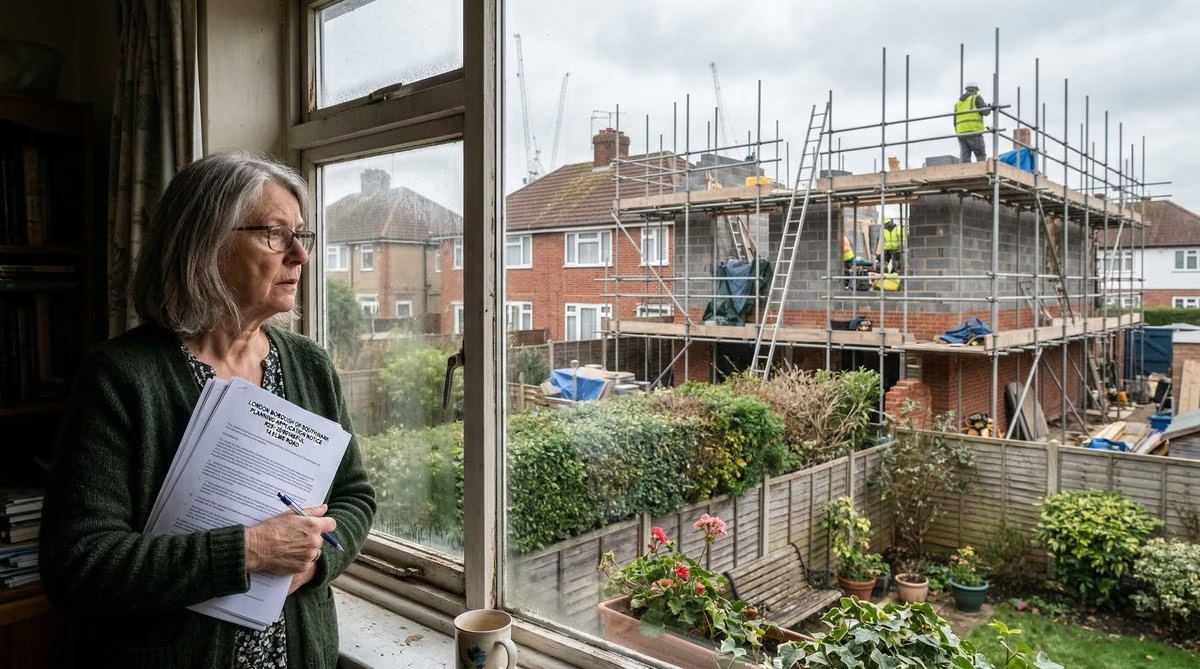
You checked the planning portal last Tuesday — and there it was: your neighbour’s rear extension, already approved. You missed the consultation window. Now the concrete is being mixed and you’re wondering whether it’s too late to challenge planning permission after approval neighbour extension UK-wide rules allow. The short answer is: formal challenge is difficult, expensive, and rarely successful for neighbouring homeowners. But that does not mean you are powerless. The party wall process, planning conditions monitoring, and a professional condition survey will protect your interests far better than any legal challenge. At Fixiz Ltd, working across London every week, we have helped dozens of affected neighbours find a sensible path forward.
Can you challenge a planning decision after it’s been made — the honest answer
The planning system in England gives no third-party right of appeal. As the Planning Portal makes clear, only the applicant can appeal against a planning decision. If consent has been granted to your neighbour, you cannot ask for that decision to be reversed in the way the applicant could have appealed a refusal. No amount of objection correspondence after the decision is issued will change the outcome of an already-determined application.
However, the absence of a right of appeal does not mean there is no avenue for scrutiny. The distinction that matters is between challenging the merits of the decision — which you cannot do — and challenging the lawfulness of the process by which it was made. If the local planning authority (LPA) failed to follow proper procedures, ignored a statutory consultee, failed to notify you correctly, or did not consider a material planning consideration, those are potential grounds for a complaint or, in extreme circumstances, judicial review.
Before concluding that a process failure occurred, pull the planning file. Every granted application is a public document. You can view the case officer’s report, the list of consultees notified, any representations received, and the conditions attached to the permission. In our experience working with homeowners in areas such as Walthamstow and Hackney, the most common reason a neighbour missed the consultation period is a letter arriving at a slightly incorrect address, or during a period away. That alone may not constitute unlawful process, but establishing the facts is the essential first step.
If there was genuine procedural fault — not just a decision you disagree with — complain to the council first, then escalate to the Local Government and Social Care Ombudsman (LGSCO). The Ombudsman has previously found fault where a council failed to evaluate the impact on a neighbour’s light before granting consent. A finding of fault does not automatically overturn the permission, but it can result in the council reconsidering, paying compensation, or tightening enforcement of conditions. Process complaints work best when the procedural failing is clear and documented — they rarely succeed when the council simply reached a conclusion you disagree with.
Judicial review — when it applies, what it costs, and why it rarely works for neighbours
Judicial review is the High Court mechanism for challenging whether a public body — here, the LPA — acted lawfully. Crucially, the court does not re-examine the planning merits. It will not say the extension was too big or too shadowy. It only asks: did the council follow the correct legal process? Even if you are certain the extension will harm you, the court cannot substitute its judgement for the council’s on the planning question.
For a neighbouring homeowner concerned about a residential extension, the hurdles are steep. You must demonstrate sufficient standing, identify a genuine error of law — not merely a harsh outcome — and you must act fast. There is a strict six-week window from the date of the grant within which a judicial review claim must be filed. Miss that and the door closes permanently. Beyond the deadline, the financial exposure is the decisive factor for most residents. Legal practitioners specialising in planning litigation note that the total legal cost of even the simplest judicial review challenge can easily reach £20,000 to £30,000. Following the Supreme Court’s ruling in CPRE Kent v Secretary of State [2021] UKSC 36, claimants whose permission for judicial review is refused at the initial stage can also face costs orders in favour of the LPA and interested parties — meaning cost exposure begins before any substantive hearing. We have seen homeowners in areas like Islington and Stoke Newington explore this route, only to conclude — after a frank consultation with a planning barrister — that the LPA’s decision was procedurally sound and the cost risk was not proportionate.
The Aarhus Convention provides partial protection: planning judicial reviews are treated as environmental claims, allowing the court to apply a costs cap — typically £5,000 for an individual — to limit maximum exposure. That is some reassurance, but it does not eliminate the financial risk or the burden of finding specialist legal representation at short notice.
The honest bottom line: judicial review is a legitimate tool when an LPA has genuinely erred in law. For most residential extension disputes centred on daylight and sunlight concerns, it is not a proportionate or likely route to success. The same resources directed towards the party wall process and a professional condition report will deliver far more tangible protection.
What you can realistically do — checking conditions, monitoring the build, and enforcement
Once you accept that overturning the planning consent is unlikely, the most productive question becomes: what does the permission actually allow, and is the build complying with it? Consents are almost always granted subject to conditions — legally binding requirements the development must meet. A breach of conditions is a separate matter from the original grant, and one on which you have real leverage as a neighbour.
Start by obtaining the decision notice from your council’s planning portal. Read every condition carefully. Common conditions on residential extensions include: restrictions on permitted construction hours; pre-commencement requirements to agree materials or detailed drawings before works begin; height restrictions on ridge or eaves; restrictions on windows in specific elevations to protect privacy; and drainage details to be agreed before groundworks start. If any condition is being breached, you have grounds to report to the LPA’s enforcement team.
Planning enforcement powers are discretionary — the council is not obliged to act on every report — but councils are obliged to investigate and keep proper records. The Local Government and Social Care Ombudsman has found fault with councils that unreasonably delayed investigating enforcement complaints. If the council refuses to act on a clear breach, the Ombudsman route opens again.
Your enforcement complaint carries far more weight with clear, dated photographic evidence. Log every observation, including working hours that appear to fall outside permitted times. Reference each photograph to the specific condition number on the decision notice. We worked alongside a homeowner in Leyton who secured an enforcement investigation — and ultimately a correction notice — through nothing more than meticulous, dated photographs submitted with clear references to the relevant conditions. It costs nothing but time and diligence, yet it is often the most effective tool available to a neighbour who missed the original consultation window. If the build matches the approved drawings but a condition is clearly being ignored, that is your strongest and most direct line of enforcement action.
The party wall angle — your separate rights even when planning is approved
This is the point that many affected neighbours do not fully appreciate: the Party Wall etc. Act 1996 operates entirely independently of the planning system. Your neighbour securing planning permission does not satisfy — or even partially satisfy — their obligations under the Party Wall Act. These are two completely separate legal frameworks, and compliance with one says nothing about compliance with the other.
If your neighbour’s extension involves work on or near the shared boundary — including excavation within three metres of your foundations, or any building astride or immediately adjacent to the party wall — they are legally required to serve a Party Wall Notice before works begin. You have statutory rights under this process regardless of what the planning system has decided.
Upon receipt of a Party Wall Notice, you can consent to the works, dissent and agree to appoint a surveyor jointly, or dissent and appoint your own surveyor at your neighbour’s cost. If a Party Wall Award is made, it can include a schedule of condition — a detailed photographic and written record of your property’s current state before the build begins. If your walls crack, your foundations are disturbed, or any other damage occurs, the schedule is your baseline evidence for claiming compensation under the Act.
If your neighbour has not served a Party Wall Notice and works have already started, the Act still applies. You can appoint a surveyor immediately — the works do not acquire immunity by starting without notice. An urgent party wall survey can document the current condition of your property before any damage progresses, and an award can be sought retrospectively to govern remaining works and compensation for damage already caused.
From a sunlight and daylight perspective, the party wall process does not override the planning decision — but it gives you a formally documented, legally enforceable pre-build record. If your right to light — a private law easement under the Prescription Act 1832, acquired after 20 years of uninterrupted enjoyment — is infringed, that is a civil matter entirely separate from the planning outcome. A party wall surveyor can advise on whether a right to light claim merits separate legal assessment.
How Fixiz helps when you’re on the receiving end — surveys, condition reports, and practical advice
At Fixiz Ltd, we are a London-based property works company, and much of what we do sits at the intersection of planning, construction, and neighbour rights. When a build goes up next door and the consultation period has already closed, we are often the first call a worried homeowner makes — and we can help in several practical ways.
The first thing we do is review the approved planning documents with you. We look at the decision notice, the approved drawings, and any pre-commencement conditions. We can quickly identify whether the build as being carried out appears to match what was approved — and flag any material departures that should be reported to enforcement. We have supported homeowners in areas such as Chingford and Wanstead in preparing robust, well-referenced enforcement complaints that have led to formal investigation and, in some cases, enforcement action.
We also carry out professional pre-build and mid-build condition surveys. If works are already under way and no schedule of condition has been prepared, it is not too late — documenting the current state of your property now means you have a clear before/after record if damage occurs. Our condition reports include time-stamped, georeferenced photography, written descriptions of every potentially vulnerable element, and a clear format that is accepted by party wall surveyors and courts alike.
If your neighbour has not yet served a Party Wall Notice and works are within the Act’s scope, we can advise you on your rights and, if needed, refer you to a qualified party wall surveyor. We work with a network of RICS-qualified surveyors across East and North London, and we know which professionals move quickly when an active build demands urgent attention.
We are not solicitors and we do not give legal advice — but we know the construction side of these disputes in granular detail, and we know how to marshal the documentation that makes a complaint, an enforcement report, or a party wall claim as strong as it can be. If sunlight and daylight are your primary concern, we can also assess whether the finished extension appears to deviate materially from the approved heights and dimensions, which is sometimes the most direct route to an enforcement outcome.
Frequently asked questions
Can I appeal my neighbour’s planning permission after it has been granted?
No. In England and Wales there is no third-party right of appeal against a granted planning permission. Only the applicant can appeal against a refusal. Your post-approval options are: process complaints to the council or Ombudsman, enforcement of planning conditions, and the separate rights afforded by the Party Wall etc. Act 1996.
Is it too late to use the Party Wall Act if building has already started?
No. If your neighbour failed to serve a Party Wall Notice before starting notifiable works, they are in breach of the Act regardless. You can appoint a party wall surveyor at any point during the build to carry out an urgent condition survey, document any existing damage, and seek a retrospective Party Wall Award. The building owner normally bears the surveyor’s costs.
What is judicial review and is it realistic for a residential extension dispute?
Judicial review is a High Court process that examines whether the LPA acted lawfully — it does not re-examine the planning merits. For most residential extension disputes it is not realistic: costs typically start at £20,000–£30,000, there is a strict six-week filing deadline from the grant date, and the court intervenes only when a genuine legal error is identified, not merely because the outcome was unfavourable.
Can I complain to the Local Government Ombudsman about a planning decision?
Yes, in certain circumstances. The LGSCO will not re-decide the planning application, but it will investigate whether the council followed proper procedures and assessed material considerations such as daylight and sunlight impacts. If fault is found, the council may be required to take remedial action or pay compensation. Exhaust the council’s own complaints process first, then complain to the Ombudsman within 12 months of becoming aware of the fault.
What is a right to light and does it give me grounds to stop the extension?
A right to light is a private law easement, entirely separate from the planning system, that entitles a building owner to minimum natural illumination through defined apertures. It can be acquired after 20 years of uninterrupted enjoyment under the Prescription Act 1832. If your neighbour’s extension substantially infringes an established right to light, you may have grounds for a civil claim in the courts. A specialist rights-of-light surveyor can assess whether an actionable infringement exists.
What should I do right now if I am worried about my neighbour’s approved extension?
Act on three fronts simultaneously: download the decision notice and approved drawings from your council’s planning portal and read every condition; begin dated photographic monitoring of the build; and check whether a Party Wall Notice has been served — if not, and if the works fall within the Act’s scope, contact a party wall surveyor immediately. Fixiz can help you assess the situation and identify the right priorities.
Ready to move from confusion to construction? Get in touch with Fixiz today for a no-pressure chat about your project and the fastest route to full compliance.