Physical address:
128 City Road, EC1V 2NX, London,UK

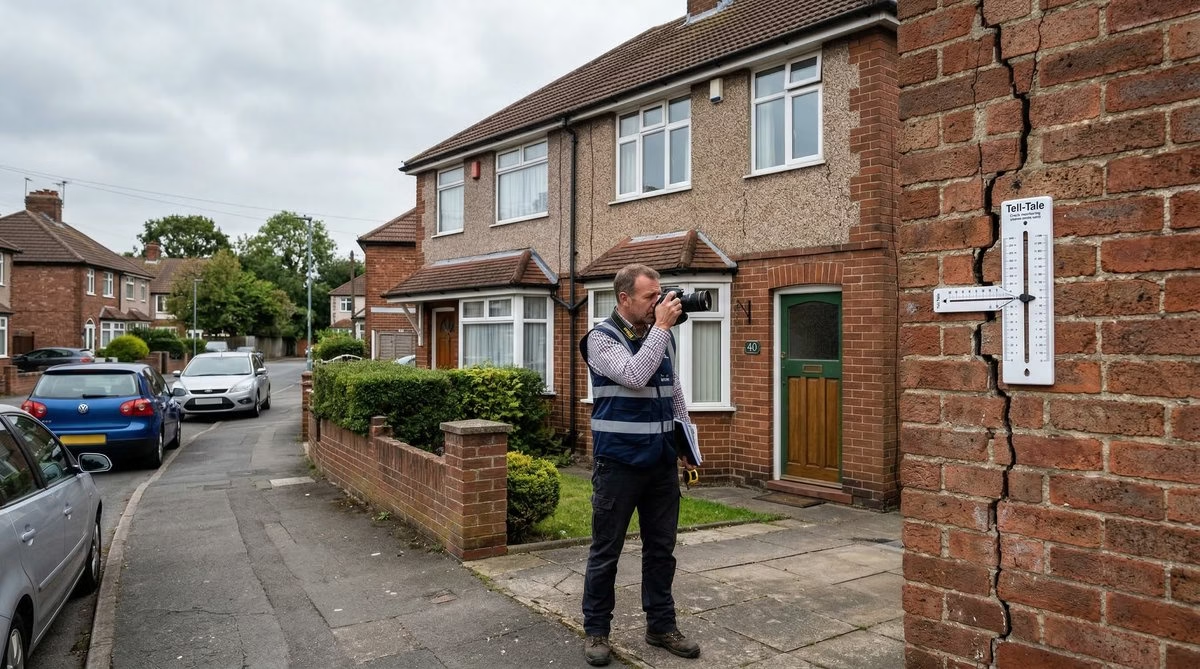
You noticed the scaffolding go up next door, heard the drilling, and now there is a fresh crack running down your bedroom wall. You ask your neighbour whether they served a Party Wall Notice. They say they didn’t need to. You check with the council — no Building Control approval either. If you are searching for answers about neighbour structural work no party wall notice no building control UK, you are not alone. This is one of the most common — and most stressful — disputes we deal with at Fixiz. In this article we walk you through your rights, the steps to take right now, and how to protect your property even if your neighbour is being uncooperative or is already trying to sell.
When structural work next door should have triggered a Party Wall Notice — and what counts
The Party Wall etc. Act 1996 is not complicated in its intent: before a building owner carries out certain types of work that could affect a shared wall, a boundary, or an adjoining owner’s property, they must serve formal written notice. The law applies across England and Wales, and it is not optional — it is a legal requirement, not a courtesy.
The works that trigger the Act are broader than most homeowners realise. Cutting into a party wall or party structure to insert a beam is a notifiable act. Underpinning or raising the height of a party wall is notifiable. Demolishing and rebuilding a party wall is notifiable. Excavating within three metres of an adjoining structure down to a lower foundation level is notifiable. And — critically, given how common it has become — removing a chimney breast that is attached to or forms part of a party wall is almost always a notifiable act under Section 2 of the Act.
The reason the chimney breast scenario causes so much trouble is that homeowners often think of the chimney as theirs alone. In reality, a chimney stack shared between two terraced or semi-detached properties is a party structure. When your neighbour removes their side of the breast, they disturb the shared structure, alter the load paths, and can introduce movement or instability that crosses the boundary line and affects your side. We were called to assess a party wall in Battersea last year where a homeowner’s neighbour had removed an entire ground-floor chimney breast without notice. By the time our structural engineer arrived, there was a visible step in the shared flank wall and the chimney stack above — sitting entirely within our client’s roof space — had rotated slightly and cracked the surrounding masonry. None of this was covered by the neighbour’s builder, because there was no surveyor, no schedule of condition, and no agreement in place.
It is also worth being clear about what counts as a “building owner” under the Act. It does not matter whether the person doing the work is the homeowner, a tenant, or a developer — anyone carrying out notifiable works must serve notice. The adjoining owner must receive that notice before works begin and has the right to appoint a party wall surveyor to protect their interests. If none of this happened, the building owner is already in breach of the Act, had no legal entitlement to proceed, and any damage they cause creates direct liability.
No Building Control sign-off either — why this doubles the risk to your property
Party Wall law and Building Regulations are two entirely separate systems — but when a neighbour carries out structural work without satisfying either, the risk to you doubles in very practical ways.
Building Regulations approval is required whenever structural work is carried out, including the removal of a chimney breast, the insertion of an RSJ steel beam, or any change that affects the stability of the structure. It is not the same as planning permission — it is specifically about ensuring the work meets minimum safety standards. A Building Control officer or an approved inspector will check calculations, inspect at key stages, and ultimately issue a Completion Certificate confirming the work is safe and compliant.
When your neighbour skips Building Control — deliberately or through ignorance — there is no independent check that the correct steel was specified, that the padstones and bearing lengths are adequate, or that the residual chimney stack is properly supported. In a chimney breast removal, the stack above must be adequately supported by a properly designed beam at each floor level where the breast has been removed. Get that wrong, and the stack can shift or collapse. A homeowner in Peckham contacted us after noticing that their shared chimney stack had started to lean visibly. Their neighbour had removed the breast on both the ground and first floors, installed a standard lintel rather than a structural steel, and never obtained Building Control approval. Emergency propping and re-support works were required, and the costs ran into the tens of thousands.
From a legal and insurance perspective, a property with unpermitted structural work is treated as a liability. Most home insurers have clauses that limit or void cover where works were carried out without the required consents. The absence of a Completion Certificate will appear in property searches, cause issues at sale, and may mean a mortgage lender refuses to lend on the property. The good news is that retrospective Building Control approval — sometimes called a regularisation certificate — is possible. Your neighbour can apply for one, and a council inspector can assess the completed work. If it is found to be non-compliant, the council can require it to be opened up, altered, or partially demolished. That is your neighbour’s problem to solve — but understanding what a regularisation application involves gives you useful leverage.
What you can do right now — documenting damage, contacting Building Control, and your legal options
Before instructing anyone or sending any letters, document everything you can see. Take timestamped photographs of every crack in your property. Use a steel rule or a crack gauge to measure crack widths and photograph the measurement. Make notes of when the works started, what you observed, and any conversations you have had with your neighbour. This contemporaneous record will be essential if you later need to pursue a compensation claim or instruct a surveyor to establish causation.
Once documented, contact your local council’s Building Control department and ask them to check whether any application was made. Building Control officers have the power to inspect completed structural work, require a regularisation application, or issue an enforcement notice requiring the building owner to make the works safe. You do not need to be the homeowner who carried out the work to make this enquiry — any member of the public can report a concern. Keep a written record of any reference number given.
In parallel, instruct an independent structural engineer or party wall surveyor to inspect your property and produce a formal condition report. This establishes the state of your property right now and provides professional evidence of any damage causally linked to the neighbouring works — evidence you need if causation is later disputed.
On the legal side, you have options even though no Party Wall Award exists. The Party Wall etc. Act 1996 does not require an Award to have been made before you can claim compensation — if the building owner carried out notifiable works without serving notice, they remain liable for any damage caused. You can pursue a claim through the county court, or through the small claims track if the amounts are modest. We were contacted by a homeowner in Tooting whose neighbour had carried out a full chimney breast and party wall alteration without notice, then flatly denied any connection to the cracking that followed. After we produced a detailed damage report citing the sequence of events and the structural logic of the movement, the neighbour’s solicitor recommended they settle. The costs avoided by having that report far exceeded the cost of commissioning it.
What happens if the neighbour is selling — searches, indemnity insurance, and buyer protection
Neighbours who have carried out unpermitted structural work and then try to sell create a specific set of problems for adjoining owners — and for any buyer who does not look carefully enough. Understanding what happens in this scenario can help you act quickly and protect your own position.
When a property is sold, the buyer’s solicitor will conduct a local authority search that reveals whether any Building Control applications were made and whether any enforcement notices have been issued. If you have already reported the works to Building Control and they have raised a formal concern, that will appear in searches and will need to be resolved before the sale can complete. This is one reason why making a Building Control report early — and keeping a written record of it — is worth doing even if it feels confrontational.
Sellers of properties with unresolved building work often attempt to resolve the matter through indemnity insurance — a single-premium policy that indemnifies the buyer and their mortgage lender against the financial consequences of the missing consent. It does not make the work safe or compliant. From your perspective as the adjoining owner, the existence of an indemnity policy does not extinguish your right to claim for damage to your own property. If the neighbour’s property is listed for sale and you are aware that structural works were carried out without a Party Wall Notice and without Building Control approval, write formally to their solicitor to put them on notice of any existing or potential claims. Once a sale completes, tracing liability becomes more difficult, and a new owner who was unaware of your claims may resist them. By serving formal notice before completion, you create a record that the issue was known and active at the point of sale.
Buyers of the affected property should obtain their own structural survey before exchange and — where party wall works were carried out without notice — seek a reduction in the purchase price to reflect the cost of remediation and the risk of future liability. A structural engineer’s report provides the evidential basis for that negotiation.
How Fixiz helps adjoining owners — independent surveys, damage reports, and remedial guidance
At Fixiz, we work with adjoining owners across London who find themselves in exactly the situation described in this article — structural works carried out next door without notice, visible damage appearing, and no clear path forward. We are not solicitors and we do not provide legal advice, but we offer the technical expertise and documentation that makes legal and insurance claims possible.
Our first step is always a thorough condition survey of the adjoining property. We document every crack, every sign of movement, and every area of potential structural concern. We photograph, measure, and record — and we produce a timestamped written report that can be used in correspondence with your neighbour, in Building Control enquiries, and in court proceedings if it comes to that. Where the works next door involved a party wall or shared structure, we can also advise on the structural implications and whether they present an ongoing risk to your property.
Where damage has already occurred, we advise on the appropriate remedial works — whether that means monitoring cracks, repairing masonry, or recommending structural remediation — and produce a schedule of works and cost estimate that can serve as the basis for a compensation claim. We have supported a number of homeowners in recovering these costs from building owners who carried out works without proper notice.
We also work with homeowners who need to regularise a situation after the fact. A homeowner in Clapham came to us after a mortgage lender flagged an unapproved chimney breast removal during a remortgage application. We arranged a structural investigation, produced the necessary calculations with an engineer, and supported a successful regularisation application — all within six weeks. Our role is to give you the technical clarity and professional documentation to move forward with confidence, whether that means claiming compensation, reporting to Building Control, or simply knowing your property is structurally sound.
Frequently asked questions
Can I force my neighbour to obtain retrospective Party Wall approval?
The Party Wall etc. Act 1996 does not provide a mechanism to compel a neighbour to obtain retrospective approval — the notice provisions apply before work starts. You can, however, pursue them for any damage caused. The absence of notice strengthens your position because they cannot rely on a Party Wall Award as a shield.
What if my neighbour says the chimney breast was entirely on their side?
Even if the breast being removed is wholly within your neighbour’s property, the Party Wall Act may still apply if the work involves cutting into or affecting the party wall itself. The chimney stack above is also frequently a shared structure, and its support is affected by the removal of the breast below. A structural engineer can assess whether the works crossed the line into notifiable territory, and if they did, the absence of notice is a breach regardless of where the bulk of the work sat.
How long do I have to bring a claim for damage caused by my neighbour’s structural work?
The Limitation Act 1980 gives you six years from the date the damage occurred — or from when you discovered it — to bring a claim in negligence or nuisance. The sooner you act, the stronger your position: evidence is fresher and causation is easier to establish. Do not assume that because the works finished several months ago you have missed your chance — seek advice promptly and commission a condition survey.
Will my own home insurance cover the damage?
It depends on your policy wording and the nature of the damage — some policies cover sudden structural damage but exclude gradual movement. Notify your insurer as soon as possible and obtain their guidance in writing. Where the damage is clearly caused by your neighbour’s breach of duty, your insurer may pursue a subrogated claim against your neighbour. A professional structural survey and documented record of the damage significantly improves your position with both your insurer and your neighbour.
Does my neighbour need Building Control approval even for small structural alterations?
Yes. Building Regulations apply to structural alterations regardless of how modest the works appear. Removing a chimney breast, inserting a load-bearing beam, or altering the support structure of a wall are all notifiable under the Building Regulations 2010. There is no threshold exempting structural work. The only works generally exempt are like-for-like repairs and minor non-structural alterations. If your neighbour was told Building Control was not needed for a chimney breast removal, that advice was wrong.
Ready to move from confusion to construction? Get in touch with Fixiz today for a no-pressure chat about your project and the fastest route to full compliance.