Physical address:
128 City Road, EC1V 2NX, London,UK

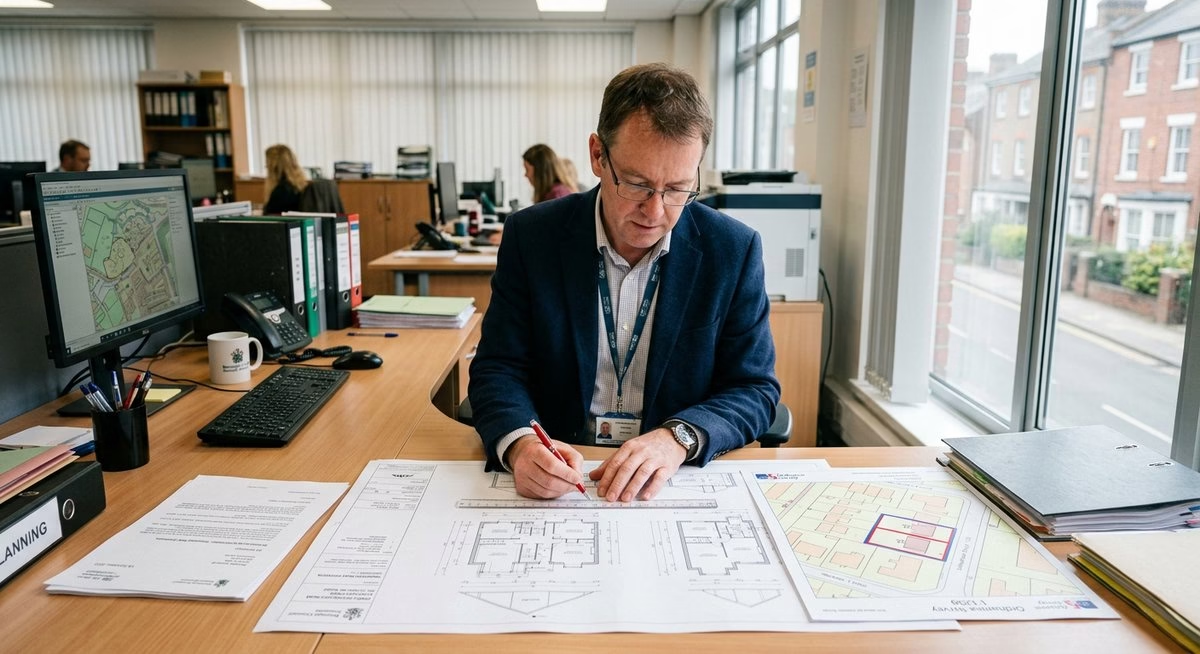
You have measured your rear wall, checked the boundary distances, and confirmed your semi-detached qualifies for a 6-metre single-storey rear extension under permitted development — but now the council says you need “prior approval” and must go through the neighbour consultation scheme rear extension UK process before a single brick is laid. This step trips up more homeowners than almost any other part of the PD system. It is not full planning permission, but it is not a free pass either. At Fixiz, we help clients navigate this 42-day procedure every month, so here is exactly what to expect and how to get through it cleanly.
What Is the Neighbour Consultation Scheme — and Why Does It Exist?
The Neighbour Consultation Scheme is the formal name for the prior approval process that applies to larger single-storey rear extensions built under Part 1, Class A of the Town and Country Planning (General Permitted Development) (England) Order 2015. It kicks in when your extension projects beyond the original rear wall by more than 3 metres for a semi-detached or terraced house (up to a maximum of 6 metres) or more than 4 metres for a detached house (up to a maximum of 8 metres). Extensions within those smaller limits do not trigger the scheme at all — they are straightforward permitted development with no council involvement beyond building regulations.
The government introduced the scheme because extensions of this size can genuinely affect neighbours — blocking light, reducing privacy, or dominating an outlook. Rather than requiring a full planning application, the scheme offers a lighter-touch process: the council consults your immediate neighbours, assesses any objections against a narrow set of criteria, and gives a decision within a fixed 42-day window.
We regularly see homeowners confuse prior approval with planning permission. Under prior approval, the council cannot assess design, appearance, or streetscene impact. The only question — if neighbours object — is whether the extension’s impact on the amenity of adjoining properties is acceptable. That narrow focus is both the scheme’s greatest advantage and its most misunderstood feature.
Step-by-Step: The 42-Day Timeline and Decision Points
The Neighbour Consultation Scheme follows a rigid timetable set out in legislation. Understanding each stage prevents surprises and keeps your project on track.
- Day 0 — You submit your application: You send the completed prior approval form, supporting documents, and the fee to your local planning authority. The 42-day clock starts on the date the council validates your application, not the date you post it.
- Days 1–7 — Council serves notice on neighbours: The local authority writes to the owners and occupiers of all adjoining properties. The notice describes your extension (length, eaves height, maximum height), states when the 42-day period ends, and sets a deadline for objections — a minimum of 21 days from the date of the notice.
- Days 7–28 — Neighbour response window: Adjoining owners and occupiers have at least 21 days to raise objections. During this time, you wait. If no objections arrive, the council can issue a “prior approval not required” notice and you are free to proceed.
- Days 28–42 — Council assessment (if objections received): If any neighbour objects, the council must determine whether the extension’s impact on the amenity of all adjoining premises is acceptable. They may request additional information from you. The council issues either “prior approval granted” or “prior approval refused” within the 42-day window.
- Day 42 — Deemed approval if no decision: If the council fails to notify you of its decision by the end of day 42, you may proceed with the development as submitted. However, exercising this right carries risk — more on that below.
Tip: Count your 42 days carefully from the validated date, not the submission date. If you posted your application with incomplete information and the council requested extras, the clock may only start once everything is received. Ask for written confirmation of the validation date.
What You Must Submit — Minimum Requirements That Catch People Out
The legislation sets out specific minimum information you must provide. Miss any of it and the council can reject your application at validation — before the 42-day clock even starts. Here is the full list:
- Written description of the proposal: This must include the projection beyond the rear wall of the original house, the eaves height, and the maximum height. Vague descriptions like “about 5 metres” are not enough — use exact figures.
- Site plan showing the proposed development: The plan must show the extension’s position and any existing enlargement of the original house that the new extension will join to. While the legislation does not mandate a specific scale, most councils will request a plan drawn to an identified scale (typically 1:100 or 1:200) to assist their assessment.
- Addresses of all adjoining properties: This includes any premises to the side, front, and rear — even if they are not physically attached to your home. A semi-detached house typically has at least three or four adjoining addresses. Missing one can invalidate your application or lead to a flawed consultation.
- Your contact address and email: The applicant’s postal address and, if you want correspondence by email, an email address.
In practice, the bare minimum is rarely enough. From our experience at Fixiz, councils almost always want scaled floor plans and elevations showing the extension in context with neighbouring properties. We always recommend including existing and proposed elevations with clear dimensions, a block plan at 1:500 showing the extension relative to boundary lines, and photos of the existing rear elevation. Submitting these upfront avoids requests for further information that delay your timeline.
Tip: The fee for a prior approval application for a larger home extension is currently £240 (from April 2025). Compare that to £528 for a full householder planning application. The saving is significant, but only if your submission passes validation first time.
How Neighbour Objections Are Handled — What the Council Actually Considers
This is where most confusion lies. Neighbours can write in with any complaint they like, but the council’s hands are tied by the legislation. Under the Neighbour Consultation Scheme, the only matter the local planning authority can assess is the impact on the amenity of all adjoining premises. That means three things in practice:
- Loss of light: Will the extension block a significant amount of natural daylight or sunlight to habitable rooms or main garden areas of neighbouring properties? The council looks at the extension’s height, its position relative to windows, and the orientation of the site.
- Loss of privacy: Although single-storey rear extensions rarely create new overlooking, the council will consider whether the extension’s roof design or any rooflights could introduce overlooking into a neighbour’s garden or rooms.
- Overbearing impact on outlook: A 6-metre projection at 3–4 metres high can feel dominant when viewed from a neighbour’s ground-floor window or patio. The council assesses whether the extension creates an oppressive sense of enclosure.
Crucially, the council cannot consider design quality, materials, streetscene impact, construction noise, property values, or disruption to daily life. If a neighbour objects solely on those grounds, the objection carries no weight under the prior approval process.
We have guided many Fixiz clients through objection responses. The most effective approach is factual evidence: a shadow study showing minimal light loss, a section drawing proving the extension sits below the 25-degree line from the neighbour’s nearest window, or annotated photos showing that existing boundary screening already addresses the outlook concern.
Tip: Talk to your neighbours before you submit. A five-minute conversation over the fence about your plans can prevent a formal objection entirely. We have seen countless cases where early communication turned a potential objection into a supportive comment.
Design Tweaks That Reduce Objection Risk
If you suspect a neighbour may object, small design adjustments before submission can make all the difference. Dropping the roof height on the side nearest a neighbour — say from 3.9 metres to 2.8 metres — significantly reduces overbearing impact and shadow cast. Pulling the extension even 300 mm away from the shared boundary softens the visual effect and aids maintenance access. A lean-to roof sloping away from the neighbour presents a lower profile, and rooflights are always preferable to side windows for avoiding overlooking.
At Fixiz, we always think about the neighbour’s perspective before finalising dimensions. A minor reduction in depth — from 6 metres to 5.5 metres, for example — can be the difference between a smooth prior approval and a drawn-out objection that delays your project by months.
When to Switch to Full Planning Permission Instead
The Neighbour Consultation Scheme is not available to everyone, and sometimes full planning is the smarter route even when prior approval is technically an option:
- Your property is excluded: Flats, maisonettes, listed buildings, and houses in conservation areas, AONBs, National Parks, World Heritage Sites, or SSSIs cannot use the scheme. The same applies if PD rights have been removed by an Article 4 direction or a planning condition.
- Prior approval has been refused: A refusal means the council found the amenity impact unacceptable. You can appeal, but a redesigned scheme submitted as a full householder application often gives more flexibility to negotiate with the officer.
- You want features beyond PD limits: Side-facing windows, heights above 4 metres, or a two-storey element all fall outside what prior approval covers.
- You want certainty of formal consent: Some homeowners — particularly those selling soon — prefer the clarity of a full permission on the planning register.
We have helped clients at Fixiz switch mid-process when the prior approval route was heading towards refusal. Submitting a full householder application at £528 is a small price compared to months of delay and an appeal.
What Happens If the Council Does Not Respond Within 42 Days?
In theory, if the local planning authority does not notify you of its decision within the 42-day determination period, the development may go ahead as submitted. This is sometimes called “deemed approval” — the logic being that the council had its chance and failed to act.
In practice, relying on deemed approval is risky. The extension must still comply with every other permitted development condition — measurements, materials, height limits, boundary setbacks. If your extension does not meet those conditions, the council can take enforcement action regardless of the expired 42 days. The deemed consent only covers the amenity assessment, not overall PD compliance.
From our experience at Fixiz, we recommend chasing the council well before day 42. A polite phone call at day 30 often prompts a decision. If you genuinely reach day 42 without a response, get written confirmation that no decision was issued and ensure your extension complies precisely with the details you submitted — those submitted details are what you are entitled to build, not a modified version.
Common Mistakes That Get Applications Rejected at Validation
Validation rejections are frustrating because they waste time without even starting the 42-day clock. These are the errors we see most often:
- Wrong application form: Some homeowners submit a full householder planning application form instead of the specific prior approval form for a larger home extension. They are different forms with different fees and different processes.
- Incomplete neighbour addresses: Forgetting a property that shares a boundary — especially a house to the rear accessed from a different street — is one of the most common reasons for failure. Walk around your site and note every adjoining address.
- Missing or vague dimensions: The description must include exact projection, eaves height, and maximum height. Omitting any one triggers a rejection.
- No site plan or unscaled drawings: While the legislation says a “plan of the site,” councils interpret this as needing a properly scaled drawing. A rough sketch almost always triggers a request for better plans.
- Incorrect fee: Sending the old fee of £120 or £206 instead of the current £240 will bounce your application straight back.
- Measuring from the wrong wall: The projection is measured from the rear wall of the original house — not the rear wall of an existing extension. If a previous owner added a 3-metre conservatory, your 6-metre extension is measured from the wall behind that conservatory, not its back edge.
Tip: Before submitting, phone your council’s planning department and ask whether they have a local validation checklist for prior approval applications. Some boroughs require additional documents beyond the statutory minimum — a design and access statement, for instance, or photographs of the existing rear elevation.
How Fixiz Keeps Your Neighbour Consultation on Track
At Fixiz, we treat the Neighbour Consultation Scheme as a project in its own right. We prepare submission documents that exceed the minimum requirements — identifying all adjoining addresses, producing scaled drawings with clear dimensions, and drafting the written description in the precise format councils expect. If an objection comes in, we prepare evidence-based responses — shadow diagrams, section drawings, annotated site photos — that address amenity concerns head-on. And if the prior approval route is not the right fit, we tell you early so you can switch to full planning without losing weeks.
Frequently Asked Questions
Can my neighbour stop my extension through the Neighbour Consultation Scheme?
Not automatically. An objection triggers the council to assess the impact on amenity — light, privacy, and outlook. If the council decides the impact is acceptable, your extension proceeds regardless. Neighbours cannot veto the process; they can only raise concerns that the council evaluates on their merits.
What if my neighbour does not respond within 21 days?
If no objections are received from any adjoining owner or occupier within the consultation period, the council will issue a “prior approval not required” notice and you can proceed with the build. Silence from neighbours is effectively consent under this process.
Is prior approval the same as planning permission?
No. Prior approval under the Neighbour Consultation Scheme is a lighter process that only assesses amenity impact on neighbours (if objections are raised). It does not consider design, appearance, materials, or impact on the wider area. It is also cheaper — £240 versus £528 for a full householder application as of April 2025.
Do I still need building regulations approval after getting prior approval?
Yes. Prior approval confirms you may build the extension under permitted development, but the construction must comply with building regulations. You will need a separate building regulations application and inspections during construction.
Can I apply for prior approval after I have already started building?
No. The process must be completed before construction begins. If you have already built without going through the scheme, you would need retrospective full planning permission — a more expensive and uncertain route.
What does “adjoining property” mean — is it just my attached neighbour?
No. Adjoining properties include any premises sharing a boundary with your site — to the side, rear, and front — including properties on a different street that back onto your garden.
Ready to move from confusion to construction? Get in touch with Fixiz today for a no-pressure chat about your project and the fastest route to full compliance.