Physical address:
128 City Road, EC1V 2NX, London,UK
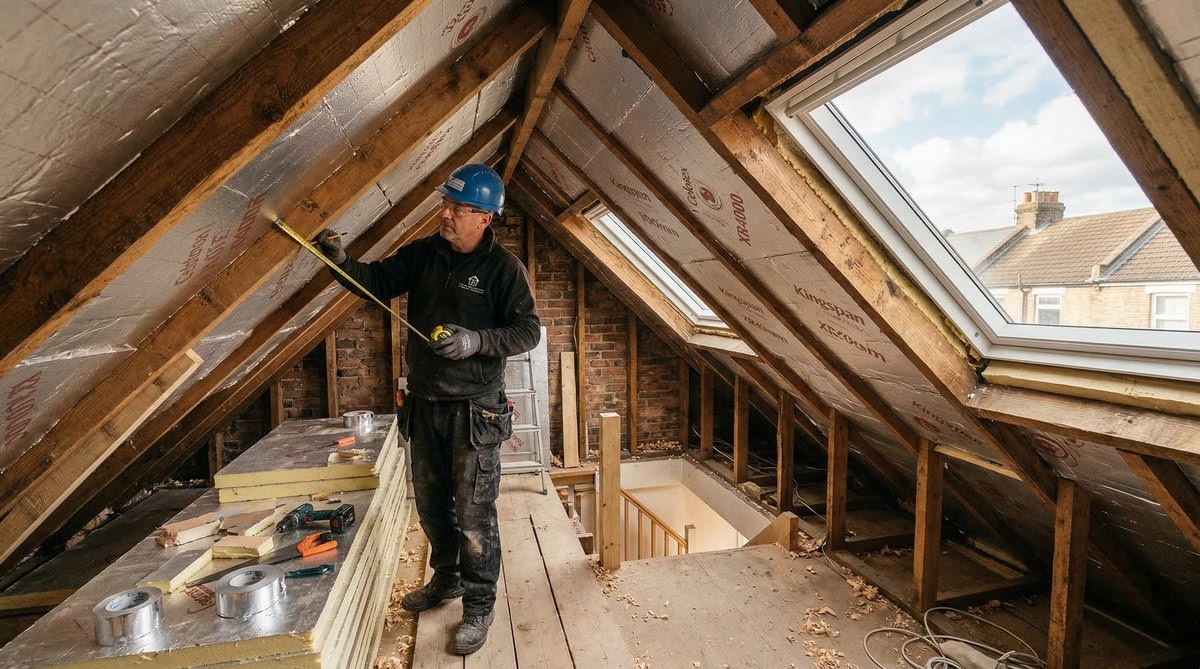
If you’ve just discovered that the insulation installed in your new loft conversion bears no resemblance to what the architect specified, you are not alone — and you are not powerless. The phrase loft conversion insulation not as specified building control UK has become one of the most searched property-dispute queries in London, and for good reason. Builders cutting corners on insulation is one of the most common — and most consequential — defects we encounter in remediation work across the capital. In this article we explain exactly what the departure means legally and technically, what Building Control officers will scrutinise, how to put your builder on notice, and which remediation routes are realistic once plastering is already done.
What Happens When Loft Insulation Doesn’t Match the Spec — and Why It Matters
Architectural drawings are not decoration. When a set of approved plans specifies, say, 100 mm of PIR (polyisocyanurate) rigid board insulation between and below rafters to achieve a target U-value of 0.18 W/m²K, every element of that specification carries weight. The product type, the thickness, the thermal conductivity (lambda) value, and the installation method are all deliberate design choices made to satisfy Part L of the Building Regulations. Substituting mineral wool batts or a thin multifoil system is not a neutral swap — it is a material departure from an approved design, and it almost always results in a loft conversion that fails to meet the required U-value.
Why does this happen so often? In our experience, cost pressure is the primary driver. A full PIR board installation is more expensive in materials than mineral wool, and some builders bank on homeowners never noticing once the plasterboard is on. On a loft conversion we remediated in Wandsworth last spring, the approved drawings specified 90 mm PIR between rafters plus a 25 mm continuous PIR layer below — a well-designed warm-roof build-up. What was actually installed was 100 mm mineral wool pushed loosely between rafters with no below-rafter layer at all. The calculated U-value for the as-built construction was approximately 0.38 W/m²K — more than double the approved target. The homeowner had no idea until a post-completion energy assessment flagged the discrepancy.
The consequences of an insulation departure are not merely bureaucratic. A non-compliant U-value means higher heat loss through the roof plane, condensation risk at cold bridging points, potential for interstitial dampness, and — critically — a property that may be unmortgageable or unsaleable without a Regularisation Certificate or a formal remediation sign-off. If Building Control has already issued a Completion Certificate without catching the defect (which does happen), that certificate can be challenged, and the liability sits firmly with the builder. If Building Control has not yet closed the inspection, you are in a stronger position still.
It is also worth understanding the contractual dimension. Under the Consumer Rights Act 2015, a trader must carry out a service with reasonable care and skill and in conformity with any information given in writing before the contract was made — including architectural drawings issued as part of the specification. A deliberate substitution of materials is a breach of contract regardless of whether Building Control has noticed. Establishing that breach in writing as early as possible is essential, and we will return to that in the section on challenging your builder.
One further point that homeowners often overlook: multifoil insulation products are a particularly contentious substitution. Some multifoil systems carry BBA (British Board of Agrément) certificates that allow them to be used in place of PIR or mineral wool under specific conditions, with specific air gaps and fixings. However, those conditions are rarely met in practice, and many Building Control officers — particularly those working to the LABC or NHBC frameworks — do not accept multifoil as a like-for-like replacement for solid rigid insulation in a standard warm-roof build-up. If your builder has fitted multifoil and is now telling you it is “just as good,” ask them to produce the BBA certificate, the declared R-value, and a U-value calculation signed off by a competent person. If they cannot, that is your first piece of evidence.
What Building Control Actually Checks — and What They’ll Accept
Building Control surveyors are not product brand police — they are ultimately checking whether your loft conversion meets the functional requirements of the Building Regulations, specifically Approved Document L (Conservation of Fuel and Power) and Approved Document C (Site Preparation and Resistance to Contaminants and Moisture). Their primary tool is the U-value calculation, not the product name on the packaging.
This means that, in principle, a Building Control officer may accept an alternative insulation product if the installer can demonstrate — through a credible U-value calculation produced using BS EN ISO 6946 methodology — that the as-built construction achieves the target U-value specified in the approved drawings, or the minimum backstop value set by Approved Document L. For most loft conversion roof planes, that backstop target is 0.18 W/m²K for new thermal elements, though the exact requirement depends on the nature of the works and whether they fall under Part L1A (new dwellings) or Part L1B (existing dwellings).
In practice, however, the substitution almost never achieves equivalence. Mineral wool has a higher thermal conductivity than PIR (typically 0.035–0.040 W/mK for mineral wool versus 0.022–0.023 W/mK for good-quality PIR board). This means that to achieve the same U-value with mineral wool, you need significantly more total thickness — in many cases 50–60 mm more. In a warm-roof build-up where rafter depth is already fixed, that extra thickness simply is not there. A surveyor who asks for a U-value calculation and receives one that shows the as-built construction sitting at 0.30 or worse will not accept it, regardless of what the builder claims verbally.
On a recent project in Hackney, we were called in after a homeowner had received a formal notice from their local authority Building Control team advising that the loft conversion would not receive a Completion Certificate until the roof insulation was either upgraded or independently verified as compliant. The builder had fitted 80 mm glass wool between 100 mm rafters — leaving cold bridges at every rafter, no below-rafter layer, and a calculated U-value of 0.33 W/m²K. The Building Control surveyor had specifically noted in their inspection record that the specification on the approved drawings called for PIR. The builder argued that “the job was done to a good standard.” The surveyor was unmoved. The standard that matters is the Building Regulations, not the builder’s personal benchmark.
What Building Control officers will generally accept as a route to compliance includes:
- A revised U-value calculation: Prepared by a competent person (thermal engineer, approved building physics consultant, or the architect of record) demonstrating that the as-built construction achieves the required U-value by some means — perhaps by using a higher-specification mineral wool product in combination with an additional below-rafter layer of rigid insulation.
- Partial remediation with retained existing installation: If the existing installation can be shown to form part of a compliant build-up (e.g., retained mineral wool between rafters with new PIR added below rafters), some surveyors will accept a staged sign-off approach.
- Full removal and reinstatement to spec: This is the cleanest route and often the one Building Control prefer, but it is also the most disruptive and expensive — and the builder should be paying for it.
- An engineer’s certificate or third-party assessment: Where the construction is no longer accessible (post-plastering), a suitably qualified thermal engineer can sometimes produce a professional indemnity-backed certificate confirming the likely thermal performance based on documentary evidence of the products installed.
Tip: Request a written list of outstanding Building Control requirements as early as possible. Most local authority Building Control teams and Approved Inspectors will provide this in writing if you ask. That document becomes vital evidence if you need to pursue the builder formally.
It is also worth knowing that if your loft conversion was managed under an Approved Inspector (a private building control body rather than the local authority), you have an additional avenue: you can complain to the Construction Industry Council (CIC) Approved Inspectors Register if the inspector signed off work they should not have. This does not resolve your immediate problem but it matters for your paper trail.
How to Challenge the Builder — Practical Steps That Protect Your Position
Challenging a builder over a specification departure is uncomfortable, but it is far easier to do it now than to spend years in dispute or — worse — discover the problem when you come to sell. The key principle is to build your paper trail before you have any conversation that could be construed as accepting the defect.
Follow these steps in order:
- Gather the documentary evidence first: Locate the approved architectural drawings (your copy, or request them from the local authority planning portal), the building specification, and any written contract or quotation that references the insulation type. Screenshot or print the relevant insulation specification details.
- Commission an independent thermal assessment: Before confronting the builder, get a qualified thermal engineer or energy assessor to produce a written U-value calculation for the as-built construction. This costs a few hundred pounds and transforms your position from “I think it’s wrong” to “here is the calculation showing the U-value is 0.34 W/m²K against a specification of 0.18 W/m²K.” That is a very different conversation.
- Send a formal letter of complaint in writing: Email is fine, but a recorded letter adds weight. State the specific departure (product specified, product installed, dimensions), reference the approved drawings by drawing number and revision, reference the U-value discrepancy, and give the builder 14 days to respond with a remediation proposal. Do not accept verbal reassurances — everything must be in writing from this point forward.
- Notify Building Control of the departure: You are not obliged to do this immediately, but it is often tactically useful. Once Building Control are formally aware of a specification departure, the builder cannot claim the work was “inspected and passed.” It also creates an official record.
- Contact your home warranty provider if applicable: If your loft conversion was covered by an NHBC Buildmark warranty, Premier Guarantee, LABC Warranty, or similar, a non-compliant insulation installation may be a valid warranty claim. Check your policy documents and notify the warranty provider in writing.
- Seek legal advice if the builder is unresponsive: Citizens Advice, the Federation of Master Builders dispute resolution service (if your builder was an FMB member), or a solicitor experienced in construction disputes can advise on your options — including a small claims or County Court claim for the cost of remediation.
We have seen builders respond in several ways when challenged. Some — particularly those who know they are exposed — will return and fix the issue at their own cost once they receive a formal written complaint backed by a thermal calculation. Others will argue, delay, or disappear. The written paper trail you build in steps 1–3 is what protects you in every scenario that follows.
One important caution: do not carry out any remediation work yourself before you have exhausted the dispute with the builder, unless Building Control have issued a formal notice requiring immediate action. Undertaking remediation before getting a written response from the builder can be used by them to argue that you have “accepted” the defective work or that any subsequent problems are your own doing.
Realistic Fixes After Plastering — What’s Possible Without Ripping Everything Out
The moment homeowners realise the insulation is wrong, their first fear is usually that the only fix involves tearing out all the fresh plasterboard. In many cases, that fear is justified — but not always. The realistic options depend heavily on the geometry of the roof construction, the depth of the deficiency, and what Building Control will accept.
Here are the main remediation routes we use in practice:
- Below-rafter insulation upgrade (internal): If the original installation omitted the below-rafter insulation layer that the spec required, it is sometimes possible to add this layer by removing and replacing only the plasterboard on the ceiling/roof plane. Rigid PIR boards can be fixed directly to the face of the rafters, new plasterboard battened out and fixed over, and the room re-plastered. This is disruptive and expensive but avoids touching the between-rafter layer. It is the most common remediation route we undertake.
- Overcladding externally: In some cases — particularly where the loft conversion is on a rear extension with a flat or low-pitch roof — it is possible to add an additional layer of insulation above the existing roof build-up from the exterior. This avoids internal disruption entirely but requires planning permission in some cases and is only practical on accessible flat or shallow-pitch surfaces.
- Targeted partial re-work: If the deficiency is localised (e.g., a dormer cheek that was under-insulated while the main roof plane was correctly done), it may be possible to remediate only the problem area. A thermal engineer can identify where the failures are most severe using a thermal bridging calculation or, in some cases, a thermal imaging survey.
- Compensatory measures: Approved Document L does allow for a degree of trade-off between different elements — so if the roof plane is slightly underperforming, a compensatory improvement elsewhere (e.g., upgrading window specifications or adding wall insulation) can sometimes bring the overall dwelling energy performance into compliance. This is a complex route and requires a full SAP (Standard Assessment Procedure) calculation from a qualified assessor, but it is occasionally viable.
On a project we completed in Islington earlier this year, the homeowner faced precisely this situation: a fully plastered loft conversion where the builder had fitted only 50 mm of mineral wool between 100 mm rafters and nothing below. The approved spec called for a full PIR warm-roof system. After negotiation, the builder agreed to fund the internal remediation works. We removed the plasterboard on the two main roof planes, installed 40 mm PIR below the rafters, re-boarded, skimmed, and redecorated. The final U-value calculation confirmed compliance at 0.17 W/m²K — marginally better than the original target. Building Control issued the Completion Certificate within two weeks of the remediation sign-off.
Tip: Always insist on a new U-value calculation after any remediation work, signed by a competent person, and submit it to Building Control formally. A verbal confirmation from a site surveyor is not sufficient protection.
The honest answer about “realistic” fixes is that they are rarely cheap. Remediation after plastering typically costs between £3,000 and £12,000 depending on scope, room size, and the extent of the finishes that need to be reinstated. That cost should sit with the builder — but recovering it may require formal dispute resolution. What we can tell you from years of remediation experience is that the problem never gets cheaper by leaving it. A loft conversion with a non-compliant U-value does not improve with time.
How Fixiz Keeps Your Loft Conversion Compliant From Day One
At Fixiz, we work exclusively in London, and the majority of our loft conversion clients come to us either for new builds or — increasingly — for remediation of work done by others. Both types of project have sharpened our understanding of where compliance failures happen and, more importantly, how to prevent them.
Our approach to insulation compliance is built around a simple principle: the specification is not a suggestion. When we price a loft conversion, the insulation build-up specified in the approved drawings is priced as written. If market conditions change the cost of a particular product between pricing and installation, we discuss that with the client and the architect — we do not make a unilateral substitution and hope no one notices. We have never had a loft conversion fail to receive a Building Control Completion Certificate as a result of an insulation deficiency, and we intend to keep it that way.
In practical terms, our compliance process includes:
- Pre-installation material verification: Before any insulation is fixed, our site manager checks product delivery notes against the approved drawings. Product name, declared lambda value, and dimensions are all confirmed in writing before installation begins.
- Photographic installation records: Every stage of the insulation installation is photographed and logged — between-rafter layers, below-rafter layers, eaves details, and any areas of particular complexity such as dormer cheeks or hip rafter junctions. These records are provided to the client and made available to Building Control on request.
- Independent U-value sign-off: For every loft conversion, we commission a post-installation U-value calculation from an independent thermal engineer. This is in addition to the design-stage calculation produced by the architect. It costs a modest amount and provides cast-iron documentation that the as-built construction meets the specification.
- Direct Building Control liaison: We manage the Building Control inspection process directly, not through the client. Inspection requests are submitted at the right stages, responses are tracked, and any queries are resolved before they become formal notices.
If you are reading this because you are already in the middle of an insulation dispute, we can help with that too. We regularly provide independent assessment reports, remediation scoping, and project management of the fix — including coordination with Building Control and, where needed, supporting evidence for legal or warranty claims. We know how these situations unfold because we have seen them in boroughs from Lewisham to Haringey, and the path through them is rarely as long as homeowners fear when they get the right guidance early.
Frequently Asked Questions
Can Building Control issue a Completion Certificate if the insulation doesn’t match the approved drawings?
Technically, a Building Control surveyor should not issue a Completion Certificate for a loft conversion where the as-built insulation demonstrably fails to meet the U-value required by the approved plans and Approved Document L. In practice, inspectors do not always open up finished surfaces to verify insulation, which means non-compliant work occasionally slips through. If a Completion Certificate has already been issued and you later discover the insulation is non-compliant, the certificate does not protect the builder from liability — it can be challenged, and the builder remains in breach of contract and potentially in breach of the Building Regulations.
What is the difference between PIR board, mineral wool, and multifoil — and does it really matter which one is used?
Yes, it matters significantly in most warm-roof loft conversion applications. PIR (polyisocyanurate) rigid board typically has a thermal conductivity of around 0.022 W/mK, making it highly efficient at thin thicknesses. Mineral wool (glass wool or rock wool) has a higher conductivity of around 0.035–0.040 W/mK, meaning you need substantially more thickness to achieve the same U-value. Multifoil insulation is the most contentious — its claimed thermal performance is disputed by many Building Control officers, and its BBA certificates carry specific installation conditions that are rarely met on site. Substituting any of these products for another without recalculating the U-value is not an acceptable practice, and most substitutions result in a non-compliant build-up unless additional compensatory thickness is added.
My builder says the insulation was “inspected and passed by Building Control” — does that mean it’s compliant?
Not necessarily. Building Control inspections of insulation are typically visual and carried out during the installation stage — before boarding and plastering. An inspector visiting during a busy programme may check the type of product and approximate thickness without producing a full U-value calculation on site. “Passed on inspection” means the surveyor had no specific objections noted at that visit — it is not the same as a formal confirmation that the construction meets the Part L U-value target. Always ask for written confirmation from Building Control that the insulation as installed has been formally verified as compliant with the approved drawings. If they cannot provide that in writing, it has not been formally signed off.
How long do I have to bring a claim against my builder for non-compliant insulation?
Under the Limitation Act 1980, the standard limitation period for a breach of contract claim is six years from the date of breach (or twelve years if the contract was executed as a deed). The clock typically runs from practical completion of the works, not from the date you discover the defect — though the “date of knowledge” provisions under the Latent Damage Act 1986 may extend this in some circumstances. If you have recently discovered a non-compliant insulation installation in a loft conversion completed within the last six years, you are likely still within the limitation period. Seek legal advice promptly — do not wait to see if the problem “gets worse” before acting.
Is it worth getting an independent thermal survey before confronting the builder?
Yes — in almost every case. An independent U-value calculation produced by a qualified thermal engineer or energy assessor costs between £150 and £400 in most cases, and it transforms an opinion into a calculation. When you write to the builder saying “the as-built U-value is 0.34 W/m²K against a specified target of 0.18 W/m²K, a difference of 89%” — backed by a signed professional document — the builder cannot dismiss it as a homeowner’s misunderstanding. It is also the document that Building Control, a warranty provider, a solicitor, or a court will ask for. Getting it early is always the right move.
Ready to move from confusion to construction? Get in touch with Fixiz today for a no-pressure chat about your project and the fastest route to full compliance.