Physical address:
128 City Road, EC1V 2NX, London,UK
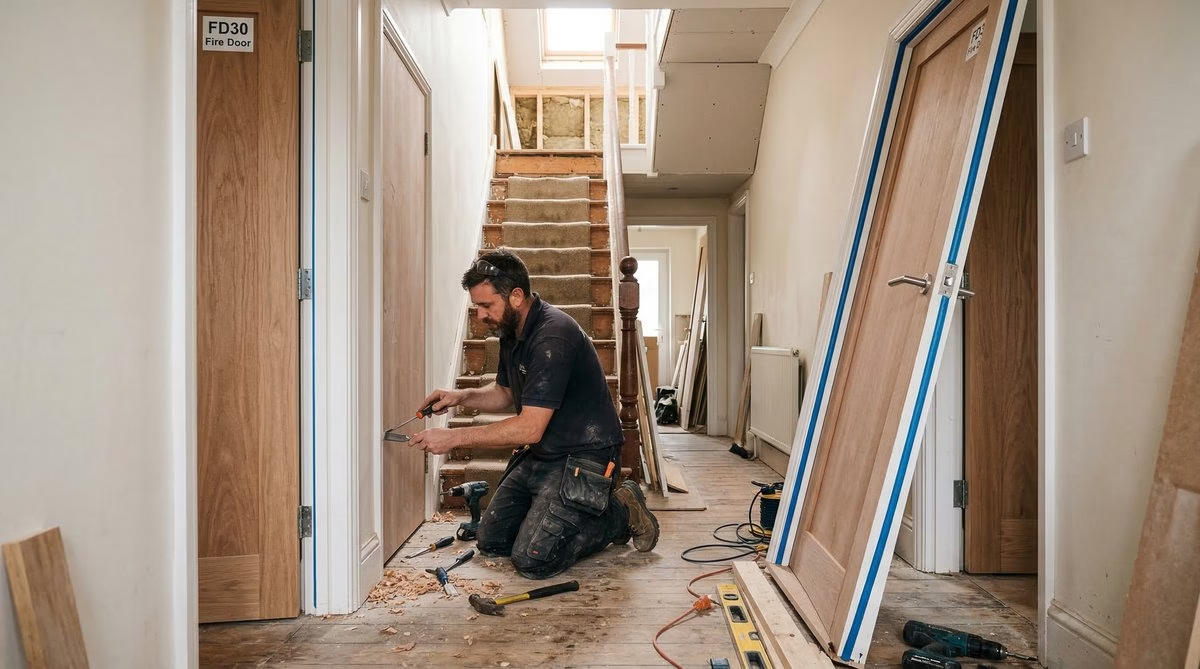
Every week we speak with homeowners who have received completely different answers from different builders about loft conversion fire doors FD30 building control UK requirements — and the confusion is entirely understandable. One contractor insists you need fire doors to every room on the first floor. Another says your existing solid doors will do. A third mentions FD20 but cannot explain why. Getting fire safety wrong does not just mean a failed inspection — it can mean expensive remedial work, delays, and a completion certificate withheld until everything is ripped out and redone. We have seen it, and we have helped homeowners avoid it. This article covers exactly what the regulations require, what Building Control actually inspects, and how we approach fire door compliance on every loft conversion we carry out across London.
What Approved Document B Actually Says About Fire Doors in Loft Conversions
The governing document for fire safety in residential properties in England is Approved Document B — the fire safety volume of the Building Regulations. For a loft conversion building regulations fire doors requirement, the relevant section is Part B1, which deals with means of warning and escape. When you add a habitable room at loft level, you are adding a storey to a dwelling. That changes the escape route geometry — and it is that change which triggers the fire door requirements most homeowners find confusing.
In a standard two-storey house, occupants can evacuate via the staircase if fire breaks out downstairs. Add a third storey — the loft — and that route becomes longer and more exposed. Approved Document B responds by requiring a protected escape route between the loft room and the final exit at ground level, achieved primarily through fire-resisting doors fitted to all habitable rooms that open onto the staircase hall or landing.
What many people miss is that the requirement is not simply to fit a fire door at the top of the new loft staircase. The entire circulation route — from loft level down to the front door — must be protected. The phrase Building Control officers use is “enclosure of the staircase” — and it is non-negotiable under Approved Document B for a loft conversion fire safety compliance sign-off.
On a loft conversion in Balham, we encountered a homeowner who had been quoted by another contractor for a single fire door at the top of the new loft staircase, with everything else left as it was. That approach would have failed inspection immediately — the ground floor and first floor doors all opened onto the main staircase, and without upgrading them, no protected route existed. We mapped the escape route storey by storey and produced a door schedule that matched what the Building Control surveyor would expect, saving the client a costly late-stage revision.
It is also worth noting that Approved Document B was updated in 2019. Some older quotes reference earlier editions. If advice you have received pre-dates 2019 — from a builder, architect, or neighbour who converted years ago — verify it against the current edition.
FD20 vs FD30 — What the Ratings Mean and Which One Your Project Needs
Fire door ratings measure how long a complete door assembly — door leaf, frame, hardware, and any glazing — can resist fire before failing. FD20 fire doors provide 20 minutes of fire resistance. FD30 fire doors provide 30 minutes. For domestic loft conversions, the relevant choice is almost always between these two.
For a standard loft conversion in a single-family dwelling, Approved Document B specifies FD20 doors for the protected escape route in most circumstances. This surprises homeowners who have been told by builders that FD30 is always required — FD30 is the commercial default and what suppliers prominently stock, but it is not automatically required for a domestic conversion.
There are specific circumstances where FD30 is required even in a domestic setting:
- Houses in multiple occupation (HMOs): If the property is licenced as an HMO, FD30 — and in some cases FD30S with smoke seals — becomes the minimum standard throughout.
- Three or more storeys with certain layouts: Where the staircase is the only escape route and the run to the final exit is unusually long, Building Control may require FD30 at specific points.
- Mixed-use buildings: If a floor is used for business, FD30 at the residential-commercial boundary is typically required.
- Local Building Control discretion: Some London boroughs interpret the guidance conservatively. Where a surveyor requests FD30 on a standard layout, we comply — the cost difference on a typical domestic job is not significant enough to contest.
We helped a homeowner in Finsbury Park navigate exactly this issue. Their builder had specified FD30 everywhere on the assumption it was always required. We confirmed with the relevant Building Control body that FD20 was acceptable for their layout and saved the client approximately £800 in unnecessary hardware costs — while still delivering a fully compliant installation.
When comparing doors, confirm that the rating applies to the complete assembly, not just the door leaf. A door rated FD30 fitted in a substandard frame, with incorrect hardware or missing intumescent seals, is not an FD30 installation — it is a failed one.
Tip: Always ask your supplier for a test certificate for the specific door-and-frame combination you are purchasing. Door leaves and frames from different manufacturers may not have been tested together, and Building Control can — and does — ask for this evidence on site.
Can You Keep Existing Solid Doors — and What Building Control Looks For
This is the question we hear most often, and the honest answer is: sometimes yes, but you need to know exactly what to look for. Existing solid doors loft conversion compliance is assessed case by case — there is no blanket rule that either permits or prohibits retaining them.
Approved Document B does not require every door on the escape route to be a new purpose-made fire door. It requires every door to achieve the required standard of fire resistance. A solid timber door with sufficient thickness and correct detailing can satisfy the requirement — the challenge is demonstrating that it does.
What Building Control looks for when assessing an existing door:
- Door leaf thickness: A minimum of 44mm solid timber is generally required for FD30 performance. Many older panel doors are 40mm or less, or are not fully solid — incorporating hollow sections or softwood cores that do not perform adequately under fire conditions.
- Frame condition and fit: The door must close into a well-fitting rebated frame. Gaps exceeding the permissible tolerances — typically 3mm at the sides and top, 8mm at the bottom — require remediation regardless of the quality of the door leaf itself.
- Intumescent seals: An existing door will almost certainly need intumescent strip and cold smoke seals retrofitted. These expand under heat to seal the gap and prevent smoke and fire passing around the door edge.
- Self-closing device: Every fire door on an escape route must be fitted with a self-closer that returns the door to the fully latched position. If the existing door lacks one, it must be added — and the door must be capable of supporting the additional weight.
- Glazing: Any glazing in the door must be fire-rated. Standard float glass is not acceptable and is a common failure point on older doors with decorative panels.
We worked with a family in Islington determined to retain their original Victorian four-panel doors. We commissioned a specialist fire door surveyor to produce a written assessment for the Building Control file. Three doors passed; two were replaced with period-appropriate fire door designs. Building Control accepted the submission without issue.
Tip: Commission a written assessment from a qualified fire door inspector before works begin — not during the Building Control inspection. A pre-inspection assessment gives you a defensible position and avoids the costly scenario of being told to replace doors after decoration is complete.
Common Fire Door Mistakes That Fail Inspection — Intumescent Strips, Self-Closers, and Gaps
A fire door is not a product — it is a system. The most expensive door leaf will fail a Building Control inspection if the surrounding components are wrong. We see the same mistakes repeatedly on projects where fire door installation was treated as an afterthought. Here are the failures that come up most often.
- Missing or incorrect intumescent strips: Many builders fit intumescent strip without cold smoke seals — but Approved Document B requires both in most domestic loft conversion scenarios. Using the wrong product or fitting it in the wrong location means the door does not perform as rated. Always use a combined intumescent and smoke seal strip confirmed compatible with the door certificate.
- Self-closer not fitted or incorrectly adjusted: Every fire door must be self-closing. A closer that does not fully return the door to the latch is a non-compliant installation. Self-closers must overcome the air pressure differentials in the specific property — easily underestimated in homes with open-plan ground floors or mechanical ventilation.
- Excessive gaps: At the sides and top, 3mm is the maximum permitted gap. At the bottom, 8mm to 10mm is acceptable only where a drop seal is fitted. Gaps beyond tolerance allow smoke and heat through before the intumescent seal activates — a 3mm gauge check before inspection will expose every one of them.
- Incorrect ironmongery: Hinges, latch, and self-closer must match the door certificate specification exactly. Using two hinges when three are required, or a latch bolt that does not engage fully, compromises the assembly rating.
- Non-rated glazing: Standard glass shatters quickly under fire conditions. Any glazing in a fire door must be Georgian wired glass, fire-rated toughened glass, or a purpose-made fire-rated unit — the maximum panel size is specified in the door certificate.
On a project in Tooting, we took over a loft conversion where the previous contractor had left the fire door installation incomplete. Every door lacked cold smoke seals, the self-closers were the wrong weight rating, and the gap at the latch side of one door was over 6mm throughout. None of it would have passed inspection. We resolved the issues and resubmitted the compliance documentation — but the remedial work added cost that a correct first installation would have avoided entirely.
Tip: Before Building Control carries out their final inspection, do your own walk-through with a 3mm gap gauge — a piece of flat timber the right thickness works perfectly. If it passes through the gap anywhere around any fire door, that door needs adjustment before the surveyor arrives.
How Fixiz Ensures Your Loft Conversion Passes Fire Safety First Time
Our approach to loft conversion fire door compliance London is built around eliminating late-stage surprises. Fire safety is designed into every project from the initial survey — not bolted on at the end.
The first step on every loft conversion is a full escape route assessment. We walk every floor, identify all rooms opening onto the staircase hall or landing, and produce a door schedule mapping current specification against Approved Document B requirements. This tells us immediately which doors need replacing, which can be retained with upgrades, and where self-closers and seals need adding. Where the project requires full plans approval, the schedule is included in the Building Regulations submission — no surprises at inspection stage.
We only fit fire doors carrying third-party certification — typically from the British Woodworking Federation (BWF) or the FIRAS scheme. Every door comes with a test certificate specifying the exact frame, ironmongery, and sealing system required for compliance. Our carpenters install to the certificate — not to general practice — and every installation is checked against gap tolerances before we move on.
We handle the full documentation trail. Every installation is supported by product certificates, installation photographs showing gap measurements, and a written sign-off from our site manager — submitted to Building Control as part of the final package. It is why our loft conversions consistently receive their Building Control completion certificate without remedial conditions.
A homeowner in Walthamstow came to us after two contractors declined their project because the layout — a narrow Victorian terrace with rooms opening directly onto a tight staircase — made the fire door specification complicated. We assessed the property, agreed the specification with Building Control before works began, and delivered a fully compliant installation. The completion certificate was issued within a week of the final inspection.
Frequently Asked Questions
Do I need fire doors on every room in the house for a loft conversion?
Not every room — but every habitable room that opens onto the protected escape route running from loft level to the final exit at ground floor. In a standard mid-terrace house this typically means the living room, kitchen, and bedroom doors on the first floor landing. Rooms that do not form part of the escape route are not required to have fire doors. Your Building Control surveyor will confirm the specific doors required for your layout.
Will Building Control accept FD20 or do I need FD30 throughout?
For a standard single-family house, Approved Document B specifies FD20 as the minimum standard for the protected escape route. FD30 is required for HMOs, certain mixed-use buildings, and may be requested by individual Building Control officers. Confirm the required specification with the Building Control body overseeing your project before purchasing doors.
Can I use a fire door without a self-closer?
No. Every fire door on a protected escape route must be fitted with a self-closing device that returns the door to the fully latched position without assistance. A fire door left open — even briefly — provides no protection. Electromagnetic hold-open devices releasing on fire alarm activation are permissible in some circumstances, but standard wedges and door stops are not.
My builder says my existing panelled doors are fine — should I trust that?
This depends entirely on the door. Some older solid timber doors can meet the required standard once upgraded with intumescent seals, cold smoke seals, a self-closer, and correct ironmongery. However, many apparent solid doors have insufficient thickness or frames that do not meet gap tolerances. A written assessment from a qualified fire door inspector is far safer than a verbal confirmation — if the door fails inspection, you will be replacing it after decoration is complete.
What happens if my loft conversion fails the Building Control fire inspection?
Building Control can withhold the completion certificate until defects are corrected, or issue it with conditions requiring remedial works. Where a property is sold without a completion certificate, this is flagged in conveyancing searches and can delay or prevent the transaction. Remedial fire door works after flooring and decoration are complete are far more expensive than getting it right first time. If you have already received a conditional notice, contact us — we have resolved many of these situations efficiently.
Ready to move from confusion to construction? Get in touch with Fixiz today for a no-pressure chat about your project and the fastest route to full compliance.