Physical address:
128 City Road, EC1V 2NX, London,UK

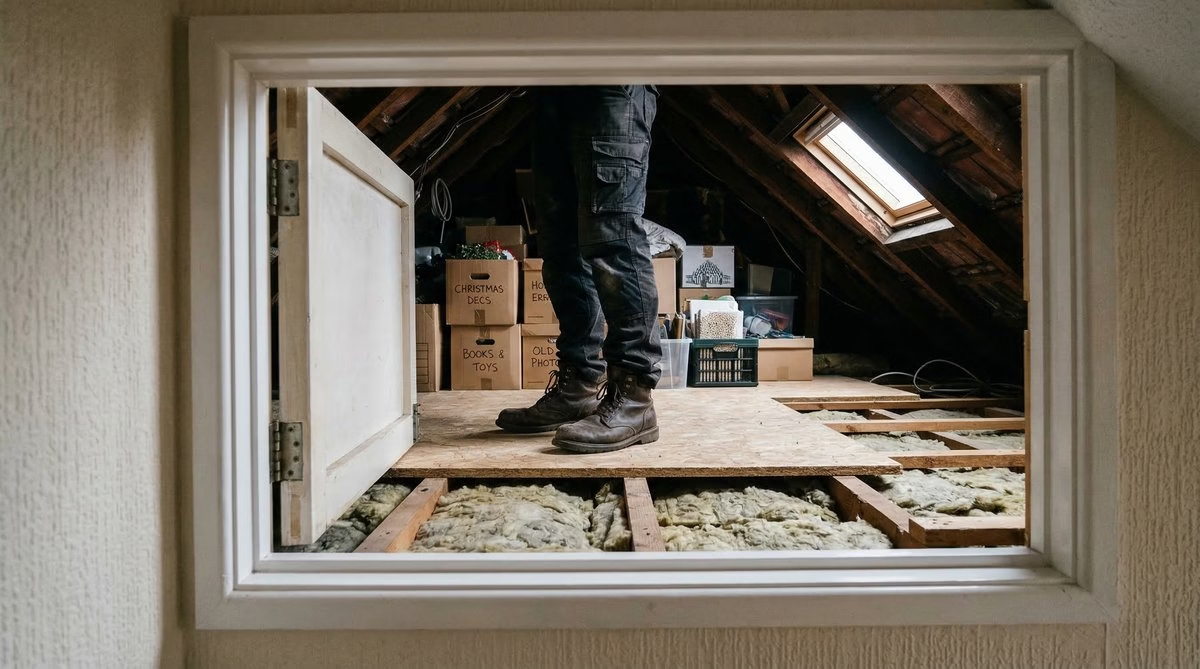
If you are searching for loft boarding vs loft conversion future-proof UK guidance, you are probably wondering how to get usable storage this month without spending money you will have to spend again in three years — and then a proper bedroom or office up there eventually. The question is: can you have both, in the right order, without doing everything twice? The answer is yes — if the work is scoped carefully. This article maps what to do now, what to leave alone, and where the real traps are.
Loft boarding for storage — what it involves and what Building Regs say (or don’t)
Loft boarding — laying a platform of boards over your existing ceiling joists so you can store items safely — is one of the most misunderstood areas of domestic building work in the UK. Some homeowners assume it is entirely unregulated; others assume it triggers a full Building Regulations application. The reality sits between those positions. In most cases, basic loft boarding is classed as permitted development and does not require planning permission or a formal application. You are not creating a habitable room, you are not altering the structure meaningfully, and as long as you stay within those limits, no formal consent process is required.
However, Building Regulations Part A (structural safety) and Part L (energy efficiency) remain relevant as underlying standards. Part A matters because the existing ceiling joists in almost every UK house were designed to carry nothing more than plasterboard and insulation — not the live loads of a storage platform. Part L matters because the standard cold loft arrangement insulates at floor level, and boarding directly over that insulation compresses it, reducing its thermal performance.
The professional solution is raised loft legs — purpose-made supports that lift the boarding platform 175mm to 250mm above the joists, allowing the insulation to breathe and maintaining its stated U-value. We use this approach as standard across London, from Victorian terraces in Hackney to Edwardian semis in Ealing, because it protects energy efficiency and keeps future conversion options firmly open.
One further point: the hatch position matters more than most people realise. A retractable ladder with an insulated, draught-proof hatch is sensible for storage. When you later apply for a full conversion, Building Control will require a fixed staircase, and the hatch position you choose now can either support or complicate where it lands. Thinking about the geometry early costs nothing. Done badly, loft boarding compromises your insulation and creates obstacles for the conversion you are planning. Done well — with raised legs, the right board specification, and a sensibly positioned hatch — it is entirely compatible with a future habitable room above your head.
What changes when a loft becomes habitable — joists, steels, insulation, and fire safety
The moment your loft transitions from storage to a habitable room — legally a space used for sleeping, living, or working — your project moves from something largely self-managed into a formal Building Regulations process. The structural, thermal, and fire safety requirements become substantive and non-negotiable. Understanding those changes before you spend a penny on boarding is the most valuable thing you can do for your budget.
Joists and structural loading
Your existing ceiling joists are almost certainly not adequate for habitable use. The standard imposed load requirement for a habitable floor is 1.5 kN/m². Ceiling joists — typically 47 x 97mm or 47 x 120mm timbers — were specified only to carry the ceiling below and light insulation. A full conversion requires new, larger floor joists (often 47 x 195mm C24 timber or engineered joists) installed alongside the existing ones. In many London Victorian and Edwardian terraces, steel beams are also required. A structural engineer calculates the specification. If you board now on loft legs without touching the joists, those legs and boards come out cleanly when the structural floor is installed. No work done twice.
Insulation — the cold loft to warm loft transition
When the loft becomes habitable, the entire thermal strategy must change. Cold loft insulation at floor level must give way to a warm loft approach — insulation installed between and below the rafters under Building Regulations Part L, achieving a U-value of 0.18 W/m²K or better. The floor-level insulation transitions to an acoustic layer between the new floor joists rather than being wasted. The main new cost is the rafter insulation, which cannot meaningfully be installed until the conversion design and Building Regulations application are in place.
Fire safety — the step change that catches people out
The most significant regulatory shift is in Building Regulations Part B (Fire Safety). A storage loft has no fire safety obligations. A habitable loft room triggers requirements that affect the entire escape route through the house below it. The escape route must resist fire and smoke for at least 30 minutes. In practice this means:
- All materials on the escape route — walls, ceilings, doors — must achieve at least 30 minutes’ fire resistance
- Every room leading off the escape route must have a FD30 fire door with a self-closing device
- Mains-wired, battery-backed, interlinked smoke alarms on every storey including the loft
- Each habitable loft room requires an escape window with a clear opening of at least 0.33 m², at least 450mm wide and 450mm high, sill no more than 1.1m from the floor
This work affects the rest of the house, not just the loft. Planning for it early means you can budget for it properly rather than discover it as a surprise when Building Control visits.
The work you’d do twice — and the smart shortcuts that save money in a staged approach
The most common concern about a staged approach is straightforward: what will need to be ripped out and redone? The overlap is smaller than most people fear — provided the boarding is done thoughtfully.
What you will not do twice: Raised-leg boarding does not impede the structural work — the legs and boards are simply removed when the new joist system is installed. A sensibly positioned hatch will not move. Basic loft lighting will be extended at first-fix, not removed. None of this is wasted.
What you might do twice if you are not careful: Boarding screwed directly to existing joists without raised legs will need to come off when the structural floor is installed. Plasterboard applied to the underside of rafters at boarding stage must be removed when rafter insulation goes in — a costly, messy addition. A Velux rooflight installed now in a position that conflicts with the eventual conversion design may need to be relocated. We have seen all three happen on projects where boarding was done without a conversion in mind.
We completed a project for a family in Islington — a late-Victorian terrace where the owners wanted storage now and a full conversion in a few years. Rather than simply pricing boards, we commissioned a structural engineer’s feasibility check that confirmed the joist requirements and flagged two timber repairs that would have been expensive mid-conversion discoveries. The boarding cost the same. The structural assessment cost a modest fee. The saving at conversion stage was considerable.
The principle is consistent: Phase One work is planned with Phase Two already drawn in the background. Decisions about hatch position, boarding method, and electrical layout are made with conversion geometry in mind from day one. That is how you avoid the most costly mistake in staged loft work — treating the two phases as unrelated projects that happen to share the same space.
A staged loft plan — what to invest in now, what to leave for later
A staged loft plan is a deliberate sequencing of work — not simply a decision to delay spending. The objective is to maximise the value of Phase One while ensuring nothing created now creates problems for Phase Two.
Invest in now — Phase One
A brief structural assessment. Before any boarding goes down, commission a quick check of the existing ceiling joists — size, span, and condition. It costs a fraction of what a mid-project structural discovery costs, and it tells you whether the conversion is feasible without major steelwork. We have seen homeowners board a loft, use it for two years, then discover the conversion requires a beam running through their primary storage area. Forty-five minutes with a structural engineer would have caught that.
Raised-leg boarding with properly maintained insulation. Quality raised legs (175mm or higher depending on insulation depth), moisture-resistant tongue-and-groove loft panels, and complete, uncompressed floor-level insulation beneath. This is money that does not get spent again.
A well-positioned, insulated, draught-proof loft hatch. Positioned with the future staircase in mind — typically off the landing. A good hatch reduces heat loss noticeably and is a permanent fixture.
Basic lighting on a spur circuit. A single light fitting or two LED downlights makes the space genuinely usable and is entirely compatible with the full electrical first-fix later.
An early Party Wall Act conversation. If you are in a terraced or semi-detached London property, party wall notices need to be served before structural work begins. Starting this process now — even informally — removes stress from the programme later.
Leave for later — Phase Two
New floor joists and steelwork. This is the structural heart of the conversion. It requires a full Building Regulations application, structural engineer calculations, and Building Control approval. It cannot and should not be pre-empted.
Rafter insulation. The warm loft thermal strategy is part of the conversion build. Attempting it at boarding stage, without the surrounding structural and fire safety work in place, would not satisfy Building Regulations.
Fire safety upgrades throughout the house. Fire doors, stairwell upgrades, mains-wired interlinked alarms — all phased into the conversion programme. They cannot be completed piecemeal without the full Building Regulations application.
Dormer or roofline works. Any alteration to the external roof envelope requires planning permission or permitted development confirmation and must be part of the conversion design — not a boarding-stage addition.
How Fixiz plans loft projects in stages — future-proofing built into every scope
At Fixiz, we work across inner and outer London — from period terraces in Lewisham and Walthamstow to larger semis in Barnet and Richmond. In a city where properties are dense and planning departments have strong views on roof alterations, a staged loft approach is often the most practical way to manage a project around real life.
When a homeowner comes to us wanting boarding now with a conversion in mind later, our process is deliberately different from a standard boarding quote. We ask: what is the joist size and span? Where is the water tank, and does it conflict with the staircase position? We completed a project for a family in Tooting — a classic late-Victorian end-of-terrace with a trussed roof — where the homeowners wanted storage urgently but had conversion ambitions within a few years. Our Phase One scope included a structural engineer’s feasibility check, raised-leg boarding on 200mm legs, a centrally positioned hatch aligned with the proposed staircase, and a single 5-amp lighting circuit. Nothing superfluous, and nothing that would need undoing.
What we deliberately did not include was a Velux rooflight the homeowners had initially considered — installed at boarding stage, it might have conflicted with the eventual dormer design. We flagged this, they agreed to wait, and the design freedom in Phase Two was well worth the patience.
We also work with homeowners who have had boarding done badly elsewhere. A homeowner in Peckham came to us after another company nailed T&G boards directly to the original joists — no legs, insulation compressed flat, hatch in the wrong position for a staircase. The boarding cost £1,800. The remediation cost more than double. Our commitment is simple: whether you are boarding today or converting today, the scope we write accounts for both phases. Every decision is made with the full picture in view.
Frequently asked questions
Do I need Building Regulations approval to board my loft?
In most cases, no formal Building Regulations application is required for basic loft boarding where no habitable room is created. However, the work must be structurally sound and must not compromise your insulation. Raised loft legs are strongly advisable and align with the intent of Part L. If you are installing a rooflight at the same time, that element does require Building Regulations sign-off and a permitted development notification.
Can my existing joists take the weight of a storage platform?
Possibly — but it depends on joist size, span, and condition. Most UK houses built before the 1960s have ceiling joists sized only for the ceiling load below and incidental storage. A quick structural assessment before boarding is the only reliable way to confirm this. Raised-leg boarding spreads the load more evenly than direct boarding, but does not replace a structural check for heavier storage use. On London properties — particularly Victorian terraces where spans are long — we almost always recommend this check as a first step.
What happens to my floor-level insulation when I do a full loft conversion?
Your current cold loft insulation will largely remain in place as an acoustic layer between the new structural floor joists and the ceiling below. The thermal work changes entirely — rafter insulation takes over the job of keeping the converted space warm, as required by Building Regulations Part L. This means the insulation installed during your boarding phase is not wasted; it transitions to a different role. The main new cost at conversion stage is the rafter insulation, which is installed as part of the building works.
Will I need to upgrade fire doors throughout my house when I do the conversion?
Yes. Building Regulations Part B requires a 30-minute fire-resistant escape route from the habitable loft to the ground-floor exit. All rooms leading off that route must have FD30 fire doors with self-closing devices, and mains-wired interlinked smoke alarms must be installed on every storey. This is non-negotiable and must be completed as part of the conversion programme. We factor it into every cost estimate we produce, so clients are never surprised.
Can I install a Velux rooflight now during boarding, and use it in the conversion?
Technically yes, but we advise caution. A rooflight installed at boarding stage locks in a roof position that may not be ideal for the eventual conversion design. If a future dormer or a different Velux configuration makes more sense for the habitable room, the early rooflight may need to be relocated. In most cases, we recommend holding off until the conversion design is fixed — doing it once correctly is significantly cheaper than doing it twice.
Ready to move from confusion to construction? Get in touch with Fixiz today for a no-pressure chat about your project and the fastest route to full compliance.