Physical address:
128 City Road, EC1V 2NX, London,UK

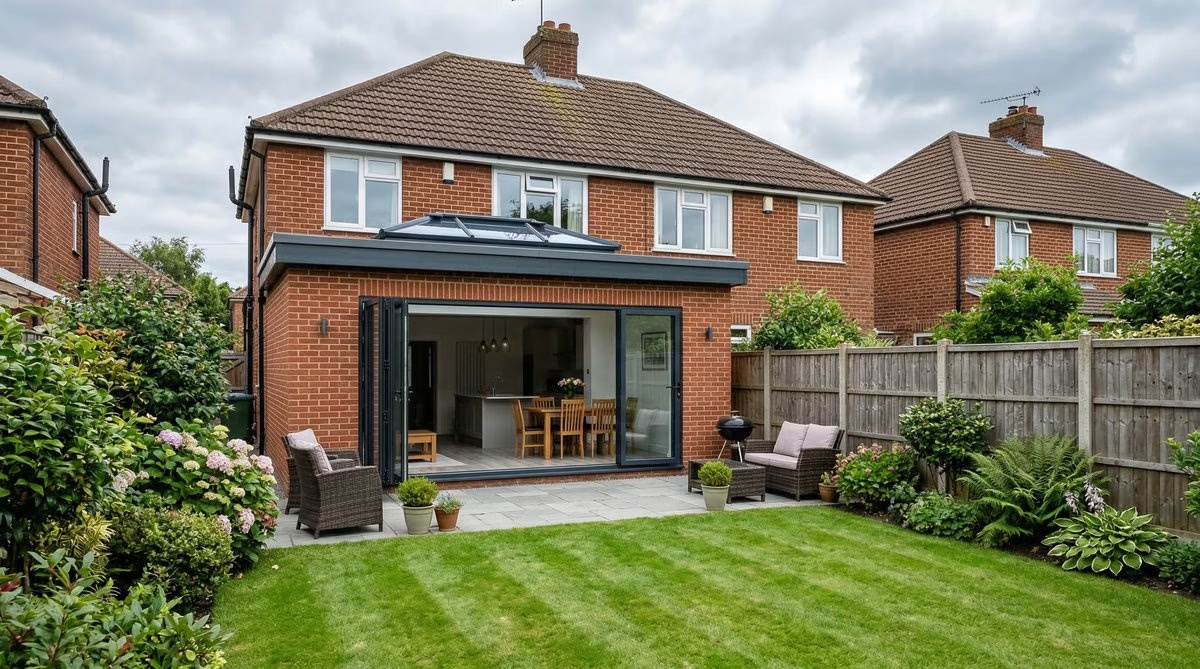
Most homeowners assume permitted development is a straightforward shortcut — build without planning permission, save months of waiting, and get on with life. For standard single-storey rear extensions, that assumption often holds. But the moment you want to push beyond the standard depth limits, the rules shift sharply. The neighbour consultation scheme 42 days larger rear extension permitted development procedure catches people off guard every week. Projects stall and budgets overrun — not because the extension was refused, but because the homeowner did not realise the consultation process existed at all. This article explains the larger PD route, how the 42-day rule works in practice, the depth limits that differ by property type, and what else can quietly strip away your rights before you break ground.
What “Larger” Permitted Development Actually Means — The Extended Limits and How They Differ
Under standard permitted development rights, a single-storey rear extension is limited to 3 metres deep for an attached house and 4 metres deep for a detached house. These limits apply without any formal notification or neighbour consultation — you proceed under permitted development, potentially using a Lawful Development Certificate for peace of mind.
The “larger home extension” route, introduced through the Town and Country Planning (General Permitted Development) (England) Order 2015, allows you to go significantly further. For attached properties you can extend up to 6 metres. For detached properties, the allowance rises to 8 metres. In many London terrace homes, the difference is transformational — a functional kitchen-diner versus a genuinely open-plan living space that changes how a family uses their home.
However, the larger route is not simply an upgraded version of standard permitted development. It triggers a completely separate legal process: the prior approval neighbour consultation scheme. Your local planning authority (LPA) must be formally notified before any work begins, your neighbours have a statutory right to object, and the LPA has up to 42 days to assess those objections and issue a prior approval decision. Only once prior approval is granted — or the 42-day period lapses without a decision — can work legally commence.
We helped a homeowner in Dulwich who wanted an 8-metre extension on their detached Victorian property. They came to us two weeks before their intended start date, unaware that without prior approval they would have been building unlawfully — exposed to enforcement action and an unmortgageable property. We submitted immediately, prior approval came through on day 38, and the project started on time. The lesson was stark: the larger PD route is not standard PD.
It is also worth understanding what the prior approval scheme does not change. Height, materials, and proximity to boundaries are still governed by standard PD conditions. The LPA’s role is limited — they cannot refuse prior approval on grounds of design preference or general planning policy. They can only assess the impact on the amenity of adjoining properties, principally overshadowing, loss of light, and outlook. Outright refusals on the larger PD scheme are relatively rare in London, but conditional approvals requiring design tweaks do occur.
The Neighbour Consultation Scheme — How It Works and What the 42-Day Rule Means for Your Timeline
The neighbour consultation scheme process begins the moment you submit a prior approval application to your LPA. Upon receiving your application, the LPA must notify the owners of adjoining properties — those physically touching your property. Neighbours then have 21 days to make representations. After that window closes, the LPA has the remainder of the 42-day period to assess objections and issue its decision.
The full 42-day clock begins from the date the LPA acknowledges your application as valid. If the LPA issues prior approval within that window, you have your answer. If it fails to issue a decision within 42 days, prior approval is deemed to have been granted automatically. In practice, we always recommend obtaining written confirmation of any deemed approval before starting work.
On a rear extension in Tooting, we worked with a family who had booked their contractor for a start date five weeks after they intended to submit their application. When we explained the 42-day rule, they submitted that same afternoon. Prior approval came through on day 38 and they started on time — a fortnight’s delay in understanding the rules would have cost them their contractor slot.
Key practical points about the 42-day prior approval process:
- Validity of application: The 42-day clock only starts when the LPA confirms the application is valid. An incomplete submission delays the start of the clock by days or weeks.
- No work before the clock expires: You cannot begin construction while the period is running, even if no neighbours have objected. Starting early is an enforcement risk.
- Three-year validity: Once granted, prior approval is valid for three years from the date of approval. If your build is delayed, you need not restart the process provided you begin within that window.
- Documenting deemed approval: If 42 days expire without a decision, write to the LPA immediately requesting written confirmation to protect yourself if the position is challenged later.
Tip: Submit your prior approval application before you have finalised contractor quotes — so the 42 days are running while you are completing procurement, not blocking your start date.
Where neighbours do object, the LPA assesses whether the objection raises genuine amenity concerns — typically loss of daylight to a neighbouring kitchen or loss of outlook from a rear window. The LPA may refuse prior approval or grant it with conditions such as a reduced depth or alternative roof pitch.
Depth Limits That Catch People Out — Detached vs Semi-Detached vs Terraced
The depth limits under the larger home extension route are deceptively simple on paper but generate more confusion than almost any other aspect of the scheme. The headline figures: for a detached house, the maximum depth is 8 metres. For an attached house — semi-detached or terraced — the limit is 6 metres. Both are measured from the original rear wall as it existed when the house was originally built, or as it stood on 1 July 1948 for older properties.
The “original rear wall” measurement is where many people go wrong. If your property has had a previous extension, the depth of that existing extension does not reduce your remaining allowance. The measurement is always from the original structure. This is genuinely good news for homeowners who bought a property with a small rear addition — they may still have the full 6 or 8 metres available.
However, prior extensions can affect your PD rights in other ways. If a previous owner obtained planning permission for an extension — rather than building under permitted development — that permission may have included a condition removing future PD rights. We have encountered this on several projects in Lewisham and Bromley, where a 1990s planning permission included a standard condition stating that no further development shall be carried out under the General Permitted Development Order. In those cases, the larger PD route was simply unavailable, and a full planning application was required instead.
- Detached house: Maximum depth of 8 metres from the original rear wall under the larger PD scheme, subject to prior approval.
- Semi-detached or terraced house: Maximum depth of 6 metres from the original rear wall, subject to prior approval.
- Height limits: Maximum 4 metres with a dual-pitched roof, or 3 metres in any other case — and not higher than the eaves of the original dwelling.
- Original rear wall measurement: Always taken from the wall as originally built — not from any existing extension.
Tip: Before commissioning detailed drawings, establish the position of your original rear wall precisely — by reference to original planning documents, old Ordnance Survey maps, or a measured survey. Getting this wrong can invalidate your prior approval application.
Other Conditions That Can Kill Your PD Rights — Article 4 Directions, Conservation Areas, and Prior Extensions
Even where the depth limits appear to allow a larger rear extension, several site-specific conditions can remove those rights entirely. This is the area where the gap between general internet advice and professional site-specific guidance is most dangerous — and where we see the highest rate of costly mistakes.
Article 4 Directions are the most common culprit in London. An Article 4 Direction withdraws specified permitted development rights from a defined area. They are used extensively in London’s residential conservation areas to preserve the character of a street. If your property sits within an Article 4 Direction that withdraws Class A permitted development rights, you cannot use the larger home extension route. You must apply for full planning permission.
Article 4 Directions do not appear on your deeds and are not consistently flagged in standard searches. You must check with your specific borough — ideally before any design work begins, to avoid abortive cost.
We worked with a homeowner in Streatham who was certain their property was in a conservation area and therefore assumed they needed full planning permission. In fact, their specific plot fell just outside the conservation area boundary — we verified this using the council’s GIS mapping tool — and they were fully within their rights to use the larger PD route. Prior approval came through on day 31, saving approximately four months compared to a full planning application timeline.
Other conditions that can affect PD rights include:
- Listed buildings: Permitted development rights do not apply to listed buildings. Any works require Listed Building Consent in addition to any planning permission.
- Flats and maisonettes: Class A PD rights apply to houses only. If your property is a flat or maisonette, no PD rights for extensions exist under this class.
- Planning conditions on previous permissions: Conditions attached to prior planning permissions can withdraw future PD rights. A planning history review is essential before relying on PD.
- Total depth already used: If a previous extension already reaches 6 metres on a semi-detached, no further rear extension is permitted under PD regardless of when the previous work was completed.
Tip: Commission a planning history review and Article 4 check before spending any money on design. These checks are inexpensive and can save thousands in abortive costs if PD rights turn out to be unavailable.
How Fixiz Navigates Permitted Development for Stress-Free Rear Extensions
Most homeowners come to us not knowing what they do not know. The permitted development rules for rear extensions involve enough complexity that a confident assumption is often the most dangerous starting point. Our job is to remove that uncertainty, so that by the time a single brick is laid, every procedural and legal box has been ticked.
Our initial consultation covers site-specific PD eligibility as a priority. We check Article 4 Directions, conservation area status, listing, planning history, and the original rear wall position before discussing design. If PD rights are available, we confirm the maximum allowable depth and establish whether the project requires prior approval under the larger home extension neighbour consultation scheme. If PD rights are restricted, we explain the full planning application route and set a realistic approval timeline.
Where prior approval is required, we handle the application entirely — preparing the submission, ensuring the 42-day clock starts without delay, and monitoring the consultation period. If neighbour objections are received, we review them against the statutory amenity test and engage with the planning officer where representations have real merit.
On a recent project in Clapham — a 5.8-metre extension on a Victorian semi-detached — one neighbour objected on grounds of loss of light to their rear kitchen. We commissioned a basic daylight assessment, presented the findings to the planning officer, and demonstrated the extension comfortably passed the BRE daylight guidance officers typically apply. Prior approval was granted on day 28. The client started work within the week.
Our construction approach adds a further layer of assurance. We document the original rear wall position at the outset, maintain an on-site file of the prior approval notice, and ensure the build precisely matches the approved dimensions. Variations from an approved prior approval — even minor ones — can create complications when selling the property or obtaining a Lawful Development Certificate retrospectively. We do not leave that risk open.
Frequently Asked Questions
Do I need planning permission for a larger rear extension, or does prior approval replace it?
Prior approval under the neighbour consultation scheme sits within the permitted development framework — it is not a planning application. The LPA can only assess the impact on the amenity of adjoining properties; it cannot impose design or general policy conditions. If prior approval is granted or deemed granted after the 42-day period, you can proceed without any further consent.
What happens if my neighbour objects during the 42-day consultation period?
A neighbour’s objection does not automatically block the extension. The LPA must assess whether the objection relates to a material impact on amenity — specifically the effect of the increased depth on outlook, light, or overshadowing. Objections based on aesthetics or property values carry no weight. If the objection raises a genuine amenity concern, the LPA may refuse prior approval or grant it with conditions. If it does not meet the amenity threshold, prior approval will be granted regardless of the neighbour’s opposition.
Can I start building once the 42 days have passed without a decision?
Yes — if the 42-day period expires without the LPA issuing a decision, prior approval is legally deemed to have been granted. You are entitled to proceed. However, obtain written confirmation from the LPA before starting work. This protects you if the matter is ever challenged by a future buyer’s solicitor or a building control officer querying the legal basis for the works.
Does a previous extension reduce the depth I can build under the larger PD scheme?
The depth limit is always measured from the original rear wall of the dwelling, not the current rear wall. This means a previous small extension does not automatically reduce your allowance. However, if a previous extension was built under a planning permission that included a condition removing future PD rights, the larger home extension route may be unavailable entirely. We always recommend a planning history review to establish the precise position before relying on any PD depth allowance.
Are the depth limits the same across all London boroughs?
The depth limits — 6 metres for attached properties and 8 metres for detached — are set nationally and apply uniformly across England. What varies by borough is the presence of Article 4 Directions, which can withdraw Class A PD rights entirely in certain areas. Some London boroughs have applied Article 4 Directions across large portions of their residential stock. Check whether an Article 4 Direction affects your specific property before assuming the national limits apply.
Ready to move from confusion to construction? Get in touch with Fixiz today for a no-pressure chat about your project and the fastest route to full compliance.