Physical address:
128 City Road, EC1V 2NX, London,UK

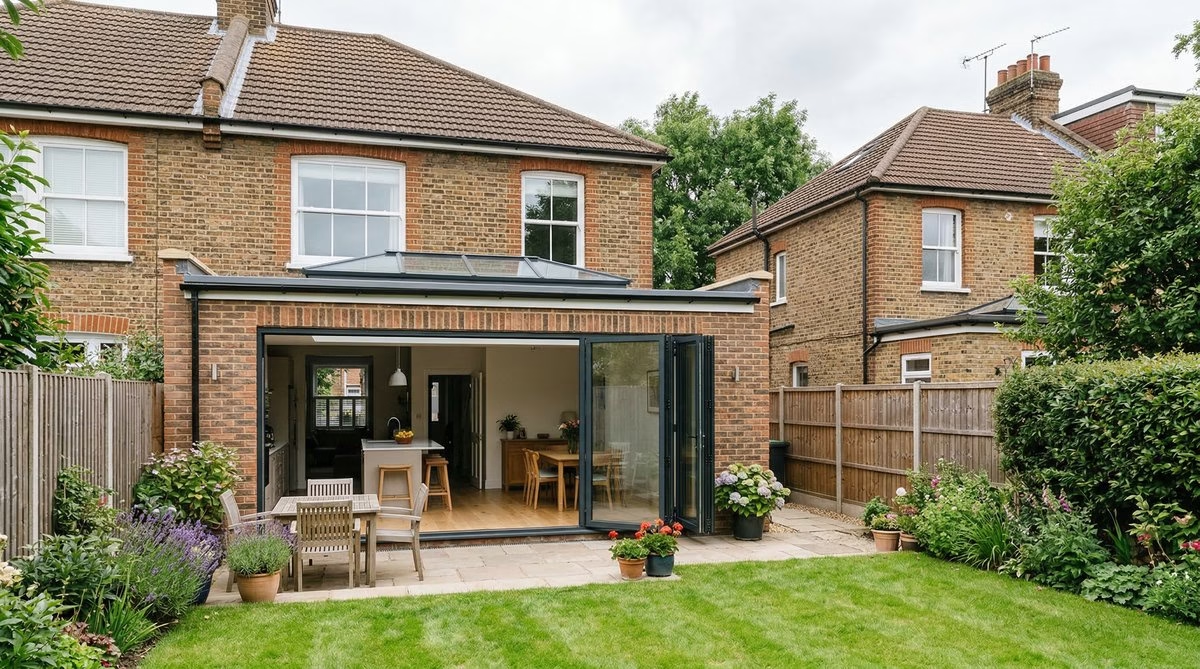
The ability to build a larger single-storey rear extension without full planning permission is one of the most useful — and most misunderstood — aspects of the UK’s permitted development regime. Understanding how the neighbour consultation scheme 42 days larger rear extension permitted development process works is essential before you start any project that exceeds the standard PD depth limits, because the procedural pitfalls can add months to your timeline and, if handled incorrectly, can render your extension unlawful. This guide explains the rules clearly, walks through the consultation process step by step, and sets out the limits that most frequently catch homeowners out.
Standard permitted development limits — and why they’re not enough for many projects
Under the standard permitted development rights for householders (Schedule 2, Part 1, Class A of the Town and Country Planning (General Permitted Development) (England) Order 2015), a single-storey rear extension can be built without planning permission up to:
- Detached dwellings: A maximum depth of 4 metres beyond the original rear wall of the house.
- Semi-detached and terraced dwellings: A maximum depth of 3 metres beyond the original rear wall of the house.
These standard limits apply universally and unconditionally (subject to the other PD conditions such as height and materials). They do not require any notification to the local planning authority and do not trigger any consultation period.
The problem is that 3 metres is simply not enough for many rear extensions. A typical Victorian terrace already has a rear addition (scullery, bathroom, or coal store) that itself extends 1.5–2 metres, meaning the additional useful depth achievable within the 3-metre PD limit is limited. Homeowners understandably want to go further — and the law does allow them to do so, but through a procedurally more complex route.
The larger home extension scheme — what it allows
Through a process formally known as prior approval for larger home extensions (or colloquially as the “neighbour consultation scheme”), homeowners can build single-storey rear extensions up to:
- Detached dwellings: Up to 8 metres depth beyond the original rear wall.
- Semi-detached and terraced dwellings: Up to 6 metres depth beyond the original rear wall.
These are the maximum permitted depths. The extension must still comply with all the other PD conditions for Class A — maximum height of 4 metres at ridge (or 3 metres within 2 metres of the boundary), eaves height no more than 3 metres within 2 metres of the boundary, and materials that match or complement the existing house.
Critically, the larger home extension route is not automatic. It requires the homeowner to notify the local planning authority (LPA) before work starts, and the LPA must carry out a neighbour consultation before it can confirm whether prior approval is required or granted.
The prior approval process — a step-by-step guide
Step 1 — Submit a prior approval application
You must submit a prior approval application to the local planning authority before any work begins. This is a formal application — not a courtesy notification. Most councils now accept these applications through the Planning Portal (planningportal.co.uk). The application must include:
- Proposed dimensions: The depth of the extension, the maximum height, and the height of the eaves.
- Description of appearance: The materials proposed and how they relate to the existing house.
- A plan and elevation: Showing the proposal in relation to the existing house and the boundaries.
There is a fee for the application — currently £206 in England (as of 2025). The application must be made before any work starts; it cannot be applied for retrospectively to regularise an extension already built beyond the standard limits.
Step 2 — Neighbour notification (the 42-day rule)
Once a valid prior approval application is received, the LPA must notify the owners or occupiers of any adjoining properties — specifically, those that share a boundary with the application site. Neighbours have 21 days to submit objections.
The LPA then has 42 days from the date the valid application was received to decide whether prior approval is required. This is the “42-day rule” that homeowners often misunderstand. The 42 days is not the consultation period — it is the total window within which the LPA must make its decision.
Tip: If the LPA fails to notify you of its decision within 42 days of receiving the valid application, the development is treated as permitted by default — you may proceed without prior approval. However, do not rely on this in practice without written confirmation; keep records of the application submission date and chase the LPA proactively from day 35.
Step 3 — What the LPA can and cannot consider
This is the most important limitation of the neighbour consultation scheme, and the one that surprises people most: the LPA can only consider the impact of the extension on the amenity of adjoining properties. It cannot refuse on grounds of design, materials, impact on the character of the area, or any other planning policy consideration. The only relevant question is: does the proposal impact neighbours?
Specifically, the LPA considers factors such as:
- Overshadowing: Whether the extension significantly reduces light to a neighbouring habitable room or garden.
- Overlooking: Whether any windows in the extension create an unreasonable loss of privacy to neighbours.
- Overbearing effect: Whether the bulk and proximity of the extension is oppressive in relation to a neighbour’s property.
It cannot consider parking, drainage, noise during construction, or any impact on non-adjoining properties. A neighbour who objects purely on design grounds will have that objection set aside — it is outside the scope of the assessment.
Step 4 — Decision outcomes
The LPA can reach one of three outcomes:
- Prior approval not required: The LPA is satisfied the proposed extension does not impact neighbours’ amenity. You may proceed as proposed.
- Prior approval granted: The LPA may require modifications — for example, reduced depth or repositioned windows — as a condition of approval. You must build in accordance with the approved plans.
- Prior approval refused: The LPA is satisfied that the extension would unacceptably impact neighbours’ amenity. You cannot proceed under PD and would need to apply for full planning permission (which opens up broader policy considerations) or revise the scheme.
The limits that catch people out
The “original rear wall” measurement
The depth limit for a PD extension is measured from the original rear wall of the dwelling as built — not from any subsequent addition. If the Victorian terrace had a rear outrigger added in 1960, that outrigger is part of the existing building, not the “original” building. The 6-metre (or 8-metre) depth limit is measured from the rearmost original wall of the main dwelling, which may be significantly further forward than the current rear face of the house. This is a source of considerable confusion and, in some cases, results in a proposed extension being non-compliant at a depth well below the apparent maximum.
Article 4 Directions
A local planning authority can remove permitted development rights within a defined area through an Article 4 Direction. These are particularly common in conservation areas, but some authorities have also applied Article 4 Directions to wider residential areas where there are character concerns. If your property falls within an Article 4 area, permitted development rights — including the larger home extension route — may be curtailed or removed entirely, requiring full planning permission even for works that would normally be PD. Check with your LPA before proceeding.
Listed buildings
Permitted development rights do not apply to listed buildings — any extension to a listed building requires listed building consent, regardless of size. The neighbour consultation scheme does not apply to listed buildings.
Properties in designated areas
In National Parks, Areas of Outstanding Natural Beauty (AONB), the Broads, and World Heritage Sites, the standard PD limits are more restrictive for some types of extension. Always confirm the applicable limits with the LPA for the specific property.
The 42-day clock starting point
The 42 days runs from the date the LPA receives a valid application — not the date you submitted it. If the LPA considers the application invalid (because a required document is missing or the fee is incorrect), the clock does not start until the deficiency is remedied. This can add weeks to the process. Submit a complete application to avoid delay.
Tip: Before submitting a prior approval application, telephone your LPA’s planning duty officer to confirm the required documents for this application type. Requirements vary slightly between authorities, and a brief call can prevent a validation failure that costs you two to three weeks.
How Fixiz manages prior approval applications
At Fixiz we handle prior approval applications as part of our pre-construction planning service. We prepare the dimensioned plans and elevations to the standard expected by planning officers, handle the submission, and manage the LPA relationship during the 42-day period — including chasing for a decision and escalating if the authority is approaching the deadline without issuing a determination.
We also carry out the initial measurement exercise to confirm the “original rear wall” baseline — which requires checking historical planning records, OS mapping, and sometimes photographic evidence to establish what was original to the dwelling and what was a later addition. Getting this right before the application is submitted is critical; getting it wrong results in an extension that exceeds PD limits, even if the application was approved.
Where a proposed extension is close to a boundary or is likely to attract neighbour objections on amenity grounds, we advise on adjustments to the scheme that reduce the risk of refusal — whether through modifications to eaves height, setback from boundaries, or window positioning. A refused prior approval application does not prevent a fresh submission, but it does add time and cost that is easily avoided with proper preparation.
Frequently asked questions
Can I start building while the 42-day consultation period is running?
No. Work cannot start until prior approval has been granted, prior approval has been confirmed as not required, or the 42-day period has elapsed without a decision (in which case you may proceed, but should obtain written confirmation of the lapse and keep all application records). Starting work before the process is complete is a breach of planning control and can result in an enforcement notice.
Do I need Building Regulations approval separately from prior approval?
Yes. Prior approval under the neighbour consultation scheme deals only with planning considerations. You will still need to comply with the Building Regulations — specifically Part A (structure), Part B (fire safety), Part C (moisture), Part F (ventilation), and Part L (thermal performance) — and will need either a full plans application or a building notice submitted to Building Control before or alongside the start of construction.
What happens if I build beyond the standard PD limits without going through the prior approval process?
You will have carried out unlawful development. The LPA can issue an enforcement notice requiring demolition of the non-compliant part of the extension. There is a 4-year time limit for enforcement action on operational development (reduced to 10 years in some cases from 2024 onwards under changes introduced by the Levelling-up and Regeneration Act 2023), but a property with an unresolved enforcement notice or without a lawful development certificate is very difficult to sell. Do not proceed without the correct authorisation.
Can neighbours stop the extension altogether?
Neighbours can object, and their objections on amenity grounds are formally considered. However, a prior approval application cannot be refused simply because neighbours object — the LPA must be satisfied that the extension materially impacts amenity in the specific respects it is entitled to consider. Many extensions within the permitted development limits and setbacks will proceed despite neighbour objection if the technical assessment supports this.
Ready to move from confusion to construction? Get in touch with Fixiz today for a no-pressure chat about your project and the fastest route to full compliance.