Physical address:
128 City Road, EC1V 2NX, London,UK

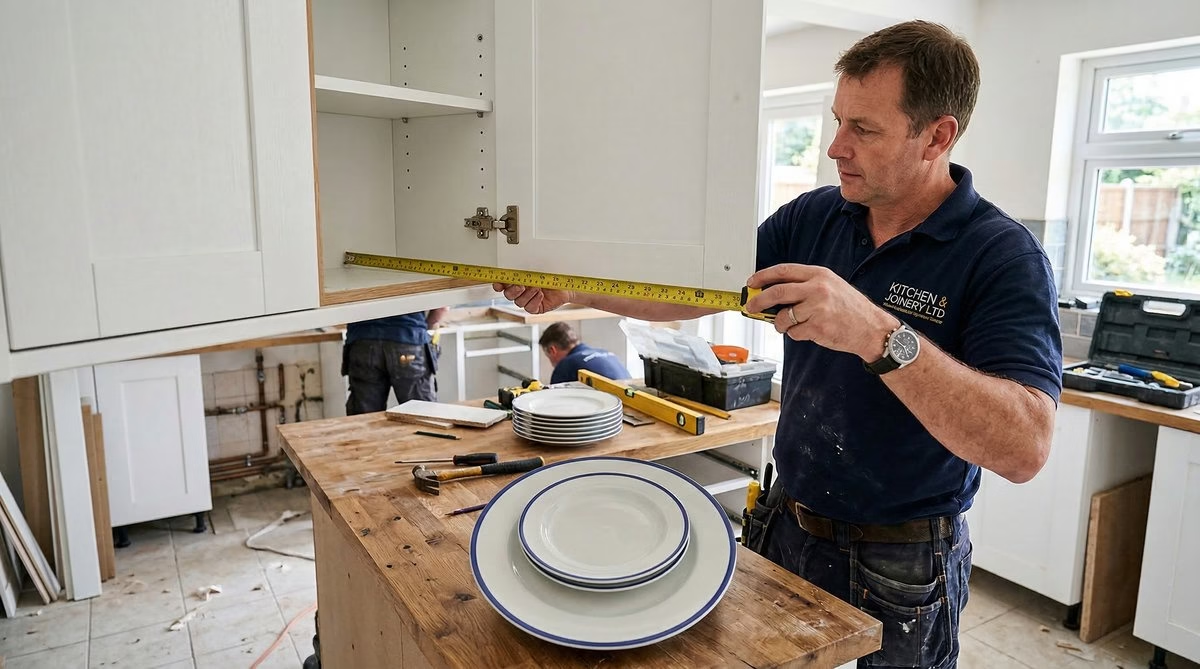
You’ve chosen your doors, your worktop, and your handles. The kitchen planner has signed off the layout. Then — somewhere between the fitter unboxing the first carcass and your first cup of tea in the new space — you open a wall unit and realise your dinner plates won’t stand upright inside it. If you’ve ever searched kitchen wall cabinet depth plates don’t fit UK, you already know the sinking feeling. We see it regularly on jobs across London — in Clapham, in Islington, in Chiswick — and almost every time, the homeowner tells us exactly the same thing: nobody mentioned the depth.
This article explains why it happens, what the actual numbers are, how to catch the problem before you spend a penny on materials, and what can be done if you’re already mid-installation. We also set out how Fixiz approaches kitchen planning so that our clients in London never end up with a row of beautiful cabinets that can’t hold their crockery.
Standard UK cabinet depths — wall units, base units, and the numbers nobody tells you
Walk into any mainstream UK kitchen showroom — Howdens, IKEA, Wren, DIY Kitchens — and you’ll see wall cabinets lined up looking substantial and generously proportioned. What the display rarely makes obvious is the single measurement that determines whether your plates and appliances actually fit: depth.
The industry standard for UK kitchen wall units is 300mm external depth, excluding the door. Howdens, for example, lists their ready-assembled wall cabinets at 290mm body depth — once you add a door, you’re looking at roughly 310–320mm overall protrusion from the wall. That internal usable depth, once you account for the back panel (typically 3mm HDF) and the door rebate, comes down to somewhere between 265mm and 280mm of actual shelf space.
Some premium ranges — and certain deeper-specification lines — offer wall units at 350mm or even 390mm external depth. Howdens also lists a 390mm deep wall cabinet range for those who specifically request it, but it is not the default option presented in most installer quotes, and it costs more. Unless you or your designer explicitly ask for it, the 290–300mm box is what arrives on site.
Base units follow an entirely different standard. The norm for UK base cabinets is 560mm depth (excluding the door) — rising to around 600mm once the door is included. This depth is deliberately matched to standard worktops and integrated appliances like dishwashers and under-counter fridges, which are typically 600mm deep. The gap between base unit depth and wall unit depth — 560mm versus 300mm — is by design: the wall unit is meant to sit above your head while you work at the worktop below, so it doesn’t protrude far enough to hit you.
Tall larder and tower units occupy a middle ground, typically running at 560–575mm deep to match base units and accommodate integrated ovens and fridge-freezers.
Here is the critical point that kitchen plans almost never state plainly: a standard UK dinner plate is 26–28cm in diameter (roughly 10.5–11 inches), and many modern sets — including widely-sold ranges from Wedgwood, Portmeirion, and other mainstream brands — run to 28–30cm. A plate laid flat in a 265mm-deep shelf either doesn’t fit at all or hangs out over the front edge. A plate stood upright needs at least 270mm of clear internal depth, ideally more. On most standard wall units, that margin simply isn’t there — especially once you factor in a plate rack, a liner, or any shelf edging.
We have seen this issue on jobs in Wandsworth and Hackney where homeowners had spent upwards of £8,000 on their cabinets before anyone raised the question of whether the plates they’d owned for years would actually store in them. The numbers are public knowledge, but they’re almost never surfaced in the planning conversation.
The appliance trap — microwaves, plate sizes, and extractor ducting that don’t fit as planned
Plates are one problem. Built-in microwaves are another — and in some ways a more expensive one, because they involve both the cabinet and the appliance costs.
A standard built-in microwave in the UK requires a niche depth of 450–550mm for a full-size model, or around 300–390mm for a compact model. The distinction matters enormously. If a homeowner purchases a standard built-in microwave — expecting it to sit in a tall tower unit or a dedicated appliance cabinet — and the kitchen design hasn’t accounted for that depth, the appliance physically cannot be recessed into the cabinet. At best it protrudes. At worst, the door won’t close.
There is a narrow category of “slim depth” integrated microwaves — such as the Montpellier MWBI17 range — that are specifically engineered for a 300mm niche depth, allowing them to fit in standard-depth wall units. These are a useful solution, but they are compact (typically 17-litre capacity with a 245mm turntable), and homeowners who aren’t aware of the depth issue in advance rarely think to buy one. They buy the microwave they want, then discover the cabinet won’t accommodate it.
Extractor hoods create a third dimension of the same problem. A chimney extractor needs a duct route from the canopy up through the ceiling or out through the wall. In kitchens where wall units run right to the ceiling or where the duct path was never marked on the plans, fitting the extractor becomes a significant on-site problem — sometimes requiring a cabinet to be removed, repositioned, or replaced entirely. Recirculating extractors avoid the duct issue but require a carbon filter replacement schedule and are less effective than ducted versions, a trade-off many clients only learn about after the extractor is already installed.
Plate racks in wall units present a subtler version of the same trap. Wire plate racks — the kind fitted inside a wall cabinet to keep plates organised — themselves take up around 30–40mm of internal depth. On a 265mm internal shelf, that leaves 225–235mm for the plate. A 27cm plate doesn’t fit. The rack either goes unused or has to be removed, which means the homeowner has paid for a feature they can’t actually use.
On a project in Battersea, we were called in as a second contractor after another firm had installed a run of wall units without accounting for either the extractor duct or the homeowner’s existing microwave dimensions. The duct needed re-routing, one wall cabinet had to be replaced with a deeper unit, and the overall kitchen was delayed by three weeks. The original saving from choosing a budget installer evaporated entirely in remediation costs.
How to sanity-check your kitchen design before ordering — a pre-order clearance checklist
The good news is that every one of these problems is entirely preventable. The information you need is all publicly available; it just requires someone to ask the right questions before materials are ordered. We use a pre-order clearance process on every kitchen project, and we’d encourage any homeowner to apply the same logic whether they’re working with us or with another installer.
Check the actual internal depth of every wall unit. Don’t rely on the external dimension in the spec sheet. Subtract the back panel (typically 3–6mm), the door rebate (typically 15–20mm), and any shelf liner or fitting you plan to use. Is the remaining clear depth greater than the diameter of your largest dinner plate? If not, you need deeper units.
Measure your existing plates and bowls before you finalise the design. This sounds obvious but is almost never done. Take a tape measure to your crockery. If your dinner plates are 28cm in diameter, you need at least 285mm of clear internal shelf depth to lay them flat. If you want to stand them upright in a plate rack, you need the same measurement plus the rack thickness.
Confirm your microwave model and its required niche dimensions before ordering cabinets. If you already own a built-in microwave, check the installation guide for the required niche depth. If you plan to buy one, decide on the model first and then specify the cabinet around it — not the other way around. The appliance manufacturer’s installation instructions will state the minimum niche depth, height, and width.
Ask your kitchen designer or supplier to annotate cabinet depths on the plan. Most 2D kitchen plans show widths and heights very clearly. Depths are frequently omitted or shown only in small print in the specification table. Ask for them to be called out explicitly — particularly for wall units, microwave housings, and any appliance tower.
Check extractor duct routing before finalising wall unit positions. If you’re planning a ducted extractor, confirm where the duct exits — ceiling, rear wall, or side wall — and make sure the wall unit layout leaves a clear route. Mark it on the plan. A chimney extractor’s duct is typically 125–150mm in diameter; it needs to go somewhere, and that somewhere can’t be through a solid cabinet carcass.
Consider deeper wall units as a design upgrade rather than an exception. Specifying 350mm or 390mm deep wall units on a full-height kitchen adds modest cost but eliminates the entire category of depth-related problems. For clients who store a lot of crockery in wall cabinets, it is almost always worth the additional spend — considerably less expensive than remediation after installation.
Confirm filler panel positions and service voids. Howdens and similar suppliers include a service void in their wall unit specs — typically 20mm — to allow for uneven walls. On an older London property with plaster walls that aren’t perfectly flat, this void can be critical for a clean install. But if the wall void reduces the effective internal cabinet depth further, that needs to be factored into your depth calculation.
Practical fixes without a full rip-out — re-hanging, deeper units, open shelving, and appliance relocation
If you’re reading this because your kitchen is already installed and the problem has already emerged, don’t despair. A full rip-out and reinstall is rarely necessary. There are several targeted remediation options that depend on how far the installation has progressed and what your specific issue is.
Replacing individual wall units with deeper versions is the most direct fix where depth is the problem. If one or two cabinets are the issue — typically the ones you were planning to use for plates or appliances — those units can often be removed and replaced without disturbing the rest of the kitchen. The key requirement is that the wall has sufficient structural support and that the replacement unit’s external depth doesn’t project so far into the kitchen that it creates a new clearance problem at head height. In most London kitchens we’ve worked on, there’s enough room to go from 300mm to 350mm without any issue.
Re-hanging existing units forward on the wall is occasionally possible where the original fixing position allows the cabinet to be moved outward slightly — adding a few millimetres of internal clearance — but this only works if the depth deficit is small (under 15mm) and should only be done by someone who can properly re-anchor the fixings into solid wall structure. Wall units carry significant weight and an improper rehang is a safety risk.
Converting one or more wall cabinets to open shelving is an aesthetically popular option that also solves the depth problem neatly. Removing the doors from a wall unit — or replacing the unit entirely with floating shelves at 350–400mm depth — gives you unrestricted access to the shelf and eliminates the door-rebate depth loss. Deeper floating shelves at 350mm are readily available from most UK timber or shelving suppliers and can be fitted by any competent joiner. Fixiz installs bespoke painted timber shelving as part of kitchen fit-outs regularly, and it’s one of our more common remediation solutions for clients in Victorian and Edwardian terrace houses across south and east London where kitchen footprints are tight.
Relocating the microwave to a dedicated appliance shelf or base unit housing is usually easier than modifying wall cabinet depth. A purpose-built microwave shelf in a base unit — sometimes called a microwave low unit — is available from most UK kitchen suppliers at 560mm depth, fully compatible with a standard built-in microwave. Moving the microwave from a wall position to a lower housing also improves ergonomics for shorter users and families with children.
Switching to a countertop microwave and gaining back the wall cabinet space is sometimes the simplest answer of all. Countertop microwaves require no niche, no special depth, and no structural modification. The downside is that they occupy worktop real estate — a significant trade-off in a smaller kitchen — but for clients whose primary concern is cost and disruption, it’s a genuinely practical option.
How Fixiz designs and installs kitchens that actually work — measurements before materials
At Fixiz, we are a London-based property works company and we specialise in the kind of careful, measurement-first approach that prevents depth problems from ever reaching site. Our process is straightforward but deliberately thorough.
Every kitchen project we take on starts with a site survey — not a showroom visit, not a video call, but a physical visit to the property. We measure every wall, record every service position (water, waste, gas, electrical spur), note every existing appliance that the client wants to retain, and check ceiling height and plasterwork condition. For older properties — which account for the majority of our work in areas like Brixton, Peckham, and Stoke Newington — walls are rarely straight or square, and the only way to know that is to be in the room with a laser measure.
Before we specify any cabinet, we confirm the client’s crockery situation. This isn’t a trivial question. A household with a set of 28cm dinner plates, a built-in microwave, and a cast-iron casserole collection has completely different cabinet depth requirements than a household with side plates, a countertop microwave, and minimal cookware. We treat the contents as part of the brief — because they are.
We annotate depth on every plan we produce. Width and height are called out as a matter of course; so is depth. Where a standard 300mm wall unit is specified, it is noted and the reason is clear (typically: clearance above the worktop, or aesthetic preference for shallower projection). Where deeper units are specified, the depth is stated in the cabinet schedule and cross-referenced with the appliance specs.
We also present clients with a written pre-order clearance summary — the same checklist logic we’ve described above — before any materials are ordered. The client signs off on it. If there’s a discrepancy between what the plan shows and what the client’s appliances require, it gets resolved at that stage. Not on site. Not after the cabinets have arrived on a van and the old kitchen has already been stripped out.
That process isn’t complicated. It just requires the discipline to do it, and the experience to know which questions to ask. We’ve built our reputation on exactly that kind of detail — and we take genuine pride in handing over kitchens that work as well as they look.
Frequently asked questions
What is the standard depth of kitchen wall cabinets in the UK?
The standard depth for UK kitchen wall units is 300mm external depth, excluding the door. Howdens, one of the most widely used trade suppliers in the UK, lists its ready-assembled wall cabinets at 290mm body depth. Once you add the door and account for the back panel and rebate, the usable internal shelf depth is typically 265–280mm. Deeper options — 350mm and 390mm — are available but must be specifically requested and will cost more.
Will standard dinner plates fit in UK wall cabinets?
Not reliably. A standard UK dinner plate is 26–28cm in diameter, and many modern sets run to 28–30cm. The usable internal depth of a standard 300mm wall unit is 265–280mm — meaning a 28cm plate laid flat will be tight or will not fit at all. If you plan to store full-size dinner plates in wall units, you should specify units with a minimum 350mm external depth, giving roughly 310–320mm of clear internal shelf space.
Can I fit a standard built-in microwave in a wall cabinet?
Only if the wall cabinet is deep enough. A full-size built-in microwave typically requires a niche depth of 450–550mm. A compact built-in microwave requires 300–390mm. Standard 300mm deep wall units cannot house a full-size built-in microwave and will be marginal even for compact models. If you want a built-in microwave in a wall position, you either need a dedicated deeper appliance cabinet, a slim-depth model specifically rated for a 300mm niche, or a microwave tower at base-unit depth (560mm).
What is the easiest fix if my wall cabinets are too shallow?
The least disruptive option depends on the severity of the problem. If one or two cabinets are affected, replacing them with 350mm deep units is often straightforward and cost-effective. If the depth deficit is modest (under 15mm) and fixing positions allow, a careful rehang may recover some space — but this should only be done by a qualified fitter. Converting affected wall units to open shelving at greater depth is a practical and aesthetically popular alternative that also eliminates the door-rebate depth loss. For microwaves specifically, relocating to a base-unit microwave housing or switching to a countertop model avoids the need for any structural work.
Why don’t kitchen plans show cabinet depths?
Most kitchen plans are drawn and presented as 2D elevations, which show width and height clearly but don’t always call out depth. Depth is sometimes listed in a separate specification table in small print, or it’s assumed to be “standard” without the standard figure being stated. This is a systemic gap in how kitchens are sold and planned, rather than a deliberate omission — but the practical effect is that homeowners frequently don’t know the internal depth of their wall units until the cabinets are on site. Always ask for depth to be explicitly noted on every unit in your kitchen plan before you approve the order.
Are there deeper wall cabinets available in the UK?
Yes. Most major UK kitchen suppliers — including Howdens, DIY Kitchens, and Wren — offer wall units at 350mm or 390mm depth as part of their standard range. They are not the default option presented in most quotes, so you need to ask specifically. Bespoke joinery is another route: a fitted kitchen carpenter can make wall units to any depth you require, which is especially useful in London period properties where the available wall space or ceiling height doesn’t suit off-the-shelf dimensions.
Ready to move from confusion to construction? Get in touch with Fixiz today for a no-pressure chat about your project and the fastest route to full compliance.