Physical address:
128 City Road, EC1V 2NX, London,UK

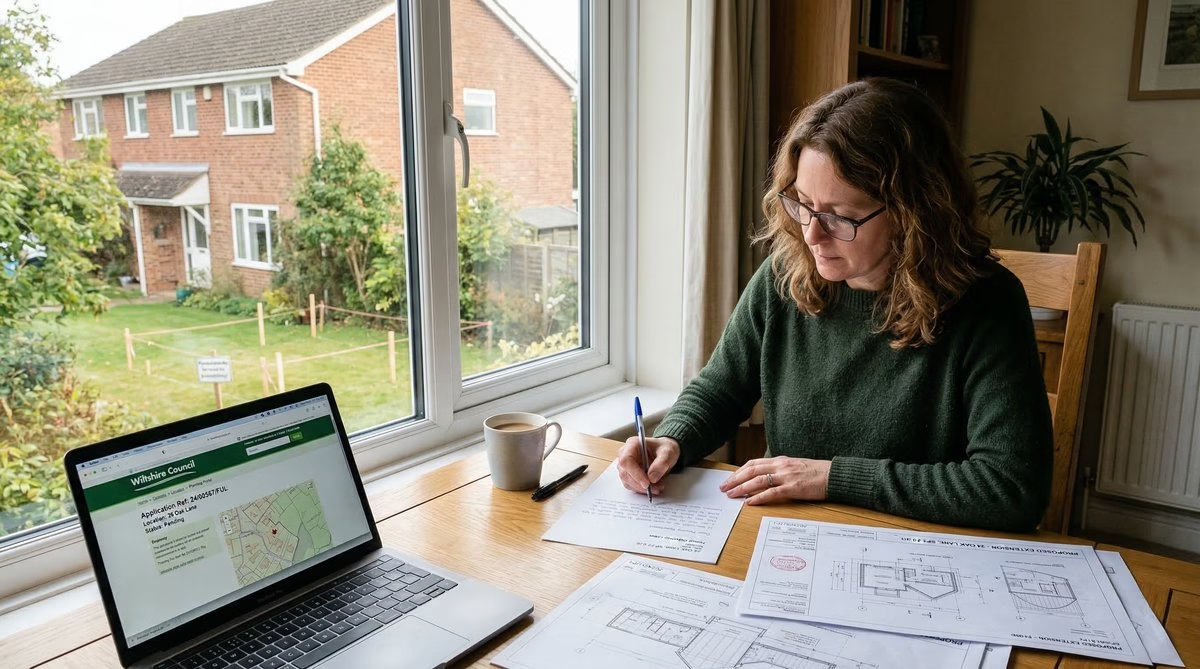
You have watched the scaffolding go up next door. The drawings are on the council’s planning portal, and the proposed rear extension looks — from your kitchen window — like it will block every scrap of afternoon light from your garden. You want to object. But you have no idea what to write, whether your concerns actually count, or how to stop your letter from being quietly filed in the bin. At Fixiz Ltd, we sit on both sides of this conversation — we design and build extensions across London and we regularly help homeowners understand how planning actually works. Knowing how to write planning objection material considerations UK planning officers are obliged to take seriously is a skill — and this guide will give you it.
What Planning Officers Can and Cannot Consider — Material vs Non-Material Considerations
Before you write a single word, understand the most important concept in planning objection law: the distinction between material and non-material planning considerations. A planning officer’s job is not to act as a neighbourhood referee — it is to assess whether a proposal complies with planning policy. They can only weigh evidence directly connected to the planning merits of the application — what the law calls material planning considerations.
According to the Planning Portal, the official UK government planning resource, material considerations include: overlooking and loss of privacy; loss of light or overshadowing; parking and highway safety; noise; effect on a listed building or conservation area; layout and density; design, appearance, and materials; government policy; disabled access; and nature conservation. Each of these relates to how the built environment affects the wider public interest — not just your personal experience of a situation.
What cannot be considered is equally important to understand. Loss of view from a private window is not a material consideration — there is no planning right to an unobstructed outlook over another person’s land. The effect on property values is explicitly excluded. Personal grievances between neighbours — boundary disputes, old feuds, damage claims — have no place in a planning objection. The applicant’s motives and personal characteristics are entirely off limits.
We recently worked with a client in Islington whose neighbour had submitted a four-page objection. Nearly three pages concerned property prices, the applicant’s “development agenda,” and old grievances. The planning officer dismissed almost all of it — because almost all of it was non-material. One brief paragraph mentioning overlooking of a rear bedroom window was the only element the officer engaged with. The lesson was stark: length is not influence. Relevance is influence.
The National Planning Policy Framework (NPPF), updated in December 2024, reinforces that all planning decisions must be made in accordance with the development plan unless material considerations indicate otherwise. Your objection carries most weight when it identifies a direct conflict between the proposal and a specific Local Plan policy or NPPF paragraph — not when it expresses a general sense of grievance.
How to Structure Your Objection Letter — the Format That Gets Read, Not Binned
A planning officer handling a busy London borough caseload may be dealing with dozens of applications simultaneously. An objection letter that is clear, professional, and policy-focused will always receive more substantive engagement than one that reads like a venting exercise. Structure is not a courtesy — it is a tactical tool.
Begin with essential administrative information: the full planning application reference number, the application site address, your own name and address, and the date. Without the reference number, there is a real risk your letter is not linked to the correct file.
Open with a single sentence stating that you object, and briefly state your relationship to the site (for example: “as the owner of the immediately adjoining property at [address]”). Then organise your grounds as numbered points, each corresponding to a single material consideration. Write each ground as a factual statement, not a complaint. “The proposed two-storey rear extension will project beyond the 45-degree line from the centre of my ground-floor kitchen window, a test applied by this council under its residential design guidance, and will cause an unacceptable loss of daylight” is a planning argument. “This extension will ruin my kitchen” is not.
For each ground, follow this pattern: state the issue, reference the relevant policy or guidance, provide your specific evidence, and explain the harm. Keep your language measured and your tone impersonal. Planning officers respond to evidence, not emotion. Aim for two sides of A4 at most — brevity signals confidence and focus. Close with a clear statement that you formally object and ask to be notified of the decision. Get to the point, stay on the point, and stop.
At Fixiz, when we are designing extensions in areas with active neighbours — and Hackney, Lambeth, and Southwark all have vocal local planning communities — we always advise clients to engage in pre-application consultation precisely so that the objections that eventually arrive tend to be shorter and more easily addressed. But that same insight works in reverse: a focused, well-structured objection is harder to dismiss than a sprawling one.
Adding Evidence That Carries Weight — Distances, Angles, Photos, and Policy References
The difference between an objection that gets considered seriously and one that gets noted and set aside almost always comes down to evidence. A planning officer cannot act on an assertion; they need material they can reference in their delegated report or committee paper. Your job is to give them that material.
Start with measurements. The most widely used test for overshadowing is the 45-degree rule — applied by most London boroughs and councils across England. A line is drawn at 45 degrees from the centre of the nearest habitable-room window on your property on a plan view. If the proposed extension projects beyond that line, there is a prima facie case for unacceptable loss of daylight. You can apply this test yourself using the drawings on the council’s planning portal. If the breach is clear, state it precisely: “The extension as drawn projects [X] metres beyond the 45-degree line drawn from the centre of my kitchen window at ground-floor level.”
For taller proposals, there is also a vertical version of the test — the 25-degree test from BRE Report BR 209. From the midpoint of your window, a line at 25 degrees above the horizontal is projected toward the proposed building. If the roofline breaches that line, daylight impact is likely significant. Reference BR 209 explicitly when raising this — it is the benchmark most planning officers and Local Plan policies point to.
Photographs are powerful. Document your garden and kitchen in current conditions — showing available light, existing outlook, and any structures already affecting your amenity. If the proposal includes first-floor windows or a raised terrace with a direct sightline into your habitable rooms, photograph those rooms from the approximate angle of the proposed overlooking. A planning officer reviewing photos of your living room in direct line of sight from a proposed window will give that far more weight than a written description alone.
Policy references transform your letter from a personal statement into a planning argument. Every London borough has a Local Plan, and most have residential design supplementary planning documents (SPDs) with specific extension standards — minimum boundary distances, maximum ridge heights, outlook and privacy rules. In Lewisham, for instance, the council’s design guidance specifies minimum distances between rear-facing windows. If the proposal conflicts with a policy standard, quote it by name and paragraph: “Policy DM1 of the Lewisham Local Plan states that rear extensions should not project beyond the 45-degree line from the nearest habitable window of an adjacent property. The proposal as submitted breaches this standard.” That is the kind of statement that demands a planning officer’s response.
The Common Mistakes That Get Objections Dismissed — Emotion, Property Value, and “I Don’t Like It”
Understanding what not to write is as important as knowing what to include. Planning officers are experienced at identifying non-material content and setting it aside. If your letter is mostly non-material, most of it will be ignored. Worse, a poorly framed objection can make the valid points you do raise seem weaker by association.
The most common mistake is leading with emotion. Phrases like “I am devastated” or “this will destroy our quality of life” signal to the officer that they are reading a grievance rather than a policy argument. Keep your register factual, precise, and professional throughout — channel any frustration into the quality of your evidence, because that is where it does useful work.
Property values are the most consistently misunderstood non-material consideration. The Planning Portal explicitly states that loss of value cannot be considered, and it is among the first things a planning officer will filter out. Do not mention it — not as context, not as a footnote. The moment it appears, it signals to the officer that the objector may not understand planning law, which casts a shadow over every legitimate point in the same letter.
Construction disruption — noise, dust, lorries, working hours — is another common mistake. These are controlled by environmental health legislation, not planning law. A planning officer cannot refuse permission on the basis that building work will be noisy. Raising it flags that you have not read the guidance.
Personal comments about the applicant — their history in the street, their motives, their previous disputes — are not only non-material, they can actively harm your objection. A letter with personal content may have all of its material points questioned for impartiality. We saw this with a project in Wandsworth: a neighbour’s objection ran to three pages of personal criticism, and the one legitimate point — that the proposed side extension reduced the gap between buildings below the council’s SPD guidance — was buried and nearly missed entirely. Had that single point led the letter, it would have carried real weight.
Finally, do not submit a template letter. Planning officers immediately recognise template objections, and they receive little weight because they suggest no direct or specific harm to the individual submitting them. Write in your own words, about your specific situation, referencing the specific drawings and policy documents that apply to your case.
How Fixiz Designs Extensions That Minimise Objection Risk — So Fewer Letters Get Written in the First Place
At Fixiz Ltd, we work across London — from terraced Victorian houses in Peckham to Edwardian semis in Muswell Hill — and every project we take on begins with the same question: how does this design affect the people next door? That is not just a gesture of goodwill. It is the most reliable way to get planning permission faster, with fewer complications and fewer objection letters landing in the case officer’s inbox.
Our design process incorporates the 45-degree test from the first sketch. Before fixing any dimensions, we plot the 45-degree lines from neighbouring habitable windows and work within those parameters. We check the vertical 25-degree test for two-storey proposals and assess site orientation — a large rear extension to the north of a neighbour’s garden is almost always less impactful on sunlight than the same structure to the south. We also check Local Plan policies for every borough before we put pen to paper. Different London councils apply different standards — the permitted development thresholds, neighbour notification rules, and residential design criteria vary more than most homeowners realise. A rear extension that is perfectly acceptable in Bromley may require more justification in Islington, where density is higher and amenity considerations are weighed more tightly.
Early neighbour engagement is something we actively encourage. A brief conversation before submission — showing the plans, addressing concerns informally — frequently prevents formal objections being lodged at all. When objections do arrive despite careful design, a well-prepared application with a thorough design and access statement already anticipating material concerns gives the planning officer everything they need to approve with confidence.
We were brought in on a rear extension project in Stoke Newington after the original architect’s application received seven objections. We redesigned the scheme — reducing the ridge height by 300mm, stepping the rear wall back to clear the 45-degree line, and adding privacy screening to a proposed first-floor terrace. The resubmission received one comment, supporting the revised design. Planning permission was granted eight weeks later. The difference was not luck. It was understanding what objectors needed to see resolved, and resolving it in the drawings.
Frequently Asked Questions
How many objections are needed to stop a planning application?
There is no set number. A single well-evidenced objection raising a genuine material consideration carries more weight than a hundred template letters making non-material points. A high volume of objections — typically ten or more, though this varies by council — may trigger a committee decision rather than a delegated officer ruling, increasing public scrutiny. But it does not automatically lead to refusal. The decision is still made on planning merits.
Can I reference what happened with a previous application on the same site?
Yes — previous planning decisions, including appeals, are material considerations. If a similar extension was refused on the same street, or a planning inspector upheld a refusal on appeal, that is a relevant precedent. Reference the application number and the reason for refusal. Be aware that if a previous scheme was approved, the applicant may cite that precedent too — know the site history before arguing from it.
What happens to my objection after I submit it?
Your letter is logged on the public planning file and considered by the case officer when preparing their assessment report. Officers must demonstrate they have considered all representations received. If the application goes to committee, the officer’s report will summarise objections and explain how they were weighed. Your letter — if material — becomes part of the formal record and can be referenced if the decision is challenged on appeal.
Can I object to permitted development work that doesn’t need planning permission?
No — permitted development requires no planning application, so there is nothing to object to. However, larger extensions may go through a prior approval process under the Neighbour Consultation Scheme. Under this process, adjoining owners can raise concerns about amenity impact — specifically overlooking and loss of light. If you receive a notice, respond within 21 days and focus exclusively on those two material matters.
Should I hire a planning consultant to write my objection?
For a straightforward objection to a domestic extension, a well-researched letter from a thoughtful homeowner can be entirely effective — provided it stays focused on material considerations and includes specific evidence. Professional help adds most value where larger developments, conservation area designations, listed buildings, or complex planning history are involved. A planning consultant can identify policy conflicts you might miss and frame arguments in the technical language officers respond to most readily.
Ready to move from confusion to construction? Get in touch with Fixiz today for a no-pressure chat about your project and the fastest route to full compliance.