Physical address:
128 City Road, EC1V 2NX, London,UK

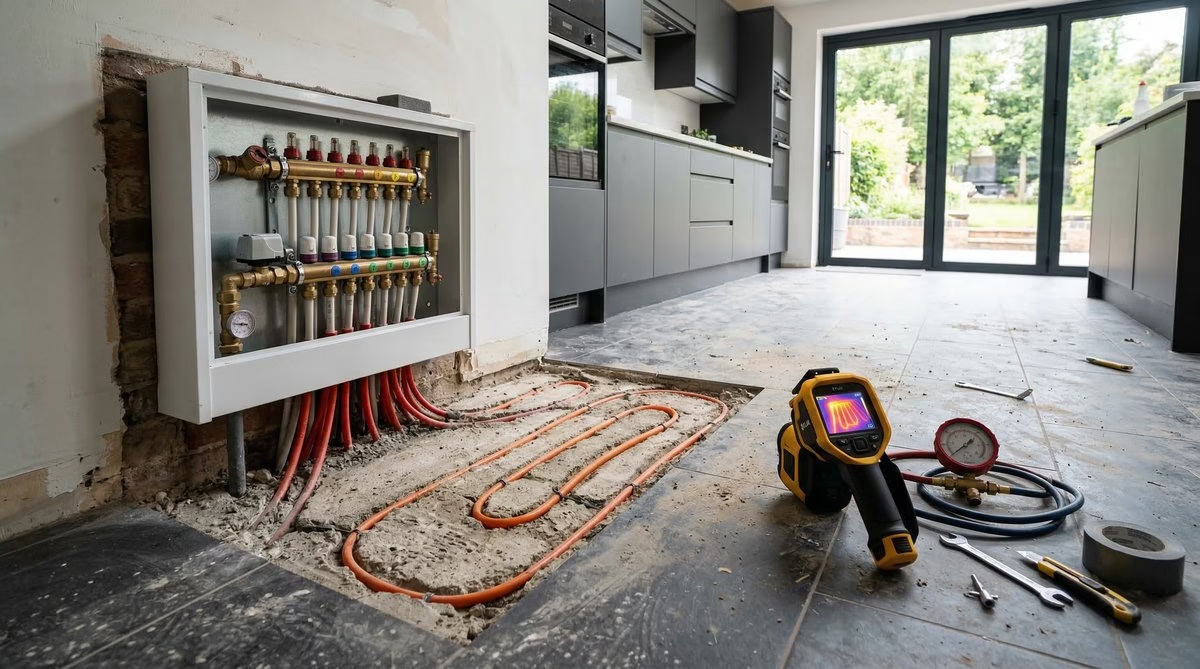
A boiler that keeps losing pressure is more than annoying — it’s a sign that something is wrong, and after building work it often triggers the big fear: a hidden leak under floors. We get calls from homeowners who can’t see a drip anywhere, but they’re topping up daily and worrying about ripping up their new tiles. This is exactly where professional leak detection under screed saves money.
Why your heating pressure is dropping — the most common UK causes
Before anyone starts lifting floorboards, we step back and confirm what system you have and what “pressure loss” actually means in that context. A combi boiler sealed system behaves differently to open-vented systems, and the diagnostic approach changes.
In UK homes, the most common causes of repeated pressure loss are:
- Visible leaks: Radiator valves, towel rails, pipe joints, and the pressure relief discharge pipe outside.
- Boiler-side faults: Expansion vessel problems, faulty pressure relief valve, or internal leaks.
- Hidden pipe leaks: Pipes under floorboards, within walls, or buried under screed — often after renovations or extensions.
- Air and topping-up issues: Not the main cause of major drops, but can confuse the picture if the system was recently drained/refilled.
Tip: Don’t assume it’s under the floor just because you can’t see water. Boiler-side faults can mimic a leak and are cheaper to fix — so we always rule them out early.
What makes underfloor and under-screed leaks so difficult
When pipes are buried, the water doesn’t always show up where the leak is. It can track along insulation, sit under membranes, or soak into a subfloor slowly. Sometimes the first sign is a cold patch, a smell, or a stain on a wall that’s nowhere near the leak.
We also see “intermittent” leaks — pressure drops more when the system is cold or hot, or after the heating cycles. That can happen because a tiny gap opens and closes with thermal expansion.
- Water travels: The wet patch might be metres away from the pinhole.
- Modern floor build-ups hide it: Underlay, insulation, membranes, and finishes can trap or redirect moisture.
- New finishes raise the stakes: Nobody wants to break out a brand-new kitchen extension floor.
Our least-destructive process for locating leaks before you start digging
Leak finding should be methodical. The goal is to narrow down the area so any opening-up is targeted, not a guessing game.
Here’s how we approach it in a typical London home.
- System check: Confirm boiler type, check expansion vessel/PRV symptoms, and inspect discharge routes for evidence of dumping pressure.
- Isolation testing: Where possible, isolate zones or loops (underfloor heating manifolds, separate circuits) to identify which section loses pressure.
- Pressure testing: Controlled tests can confirm whether the system is losing water versus losing pressure due to component issues.
- Thermal imaging: Used properly, it can highlight unusual heat patterns when the system is running — sometimes pointing toward a leak area.
- Moisture mapping: We check adjacent walls, thresholds, and skirtings to track where moisture is actually accumulating.
Tip: If you have underfloor heating, identifying the leaking loop first is often the biggest win. It turns “the whole extension floor” into “a specific zone”.
When you do have to open the floor — how to minimise damage
Sometimes opening-up is unavoidable. The key is to do it once, in the right place, and to reinstate properly. We plan around what finish you have (tiles, LVT, engineered timber) and what subfloor build-up is likely underneath.
- Choose the access point: We target the most likely area based on tests, not convenience.
- Protect finishes: Where possible, we lift rather than smash, and we keep spares/extra tiles in mind.
- Repair to standard: A pipe repair is only half the job — the floor must be reinstated so it doesn’t crack, squeak, or become a cold bridge.
- Prevent recurrence: We look for why it failed — poor jointing, movement, inadequate protection, or previous workmanship issues.
How Fixiz can help — leak detection plus proper reinstatement
Homeowners often get stuck between trades: a heating engineer who can test, a builder who can open up, and a floor fitter who can patch. We coordinate the full process so you don’t spend weeks guessing and calling different people.
- One plan: Diagnose first, then open up only when evidence points to a location.
- Clear options: We explain what we can confirm, what’s likely, and what would be wasteful to do next.
- Controlled opening-up: We minimise disruption and protect your finished surfaces.
- Quality reinstatement: Floors and finishes restored properly, not left as a “temporary patch”.
FAQ — heating pressure loss and hidden leaks
How do I know if my boiler is losing pressure because of a leak or a boiler fault?
We look for evidence of discharge, expansion vessel issues, and whether the pressure loss correlates with heating cycles. A proper check can prevent unnecessary floor damage.
Can a tiny leak under screed really drop pressure that fast?
Yes. Even a small leak can cause regular pressure loss, and it may not show visibly for some time depending on the floor build-up.
Is thermal imaging always reliable for leak detection?
It’s a tool, not a magic wand. Used alongside isolation and pressure testing, it can be very helpful. Used alone, it can mislead.
Should I keep topping up the boiler while I wait?
Occasional topping up may be necessary short-term, but frequent topping up can introduce fresh oxygenated water that accelerates corrosion. We recommend diagnosing promptly.
Ready to move from confusion to construction? Get in touch with Fixiz today for a no-pressure chat about your project and the fastest route to full compliance.