Physical address:
128 City Road, EC1V 2NX, London,UK

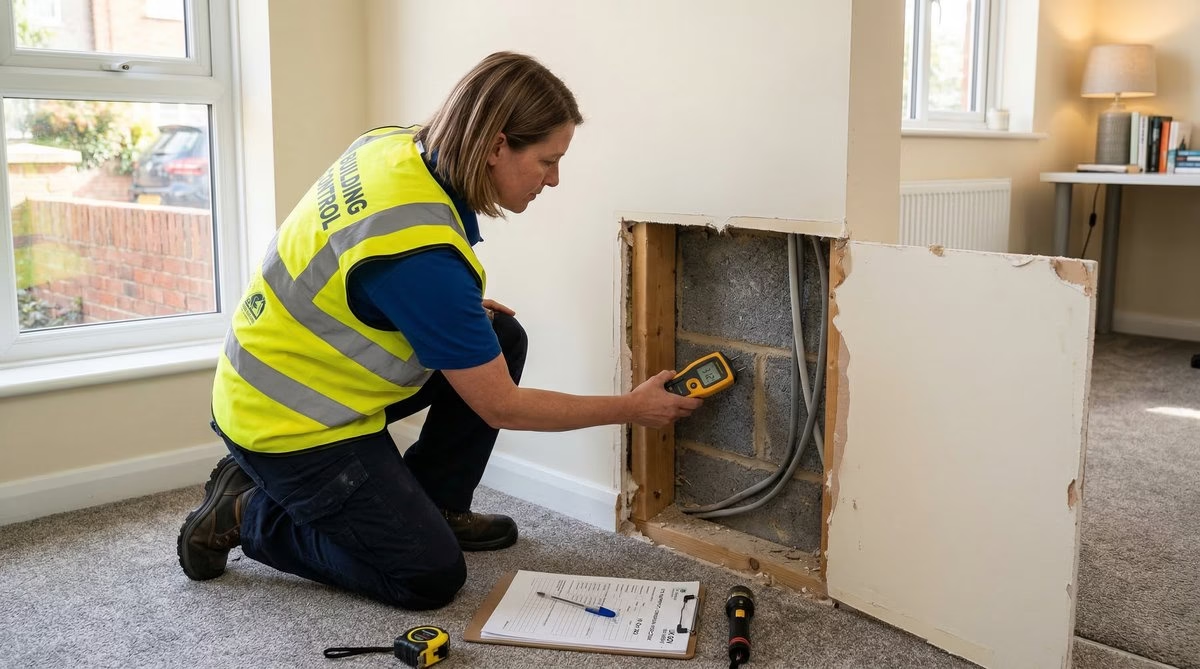
You have found the house. The layout works, the price is right, and the converted garage gives you the extra room you need. Then your solicitor asks: “Where are the Building Regulations completion certificates?” The seller shrugs — “it was done years ago, it’s fine.” A garage conversion no building control sign off regularisation UK situation is one of the most common hidden defects we encounter at Fixiz — and far more serious than most sellers appreciate. This article explains what it means, what dangers lurk behind the plasterboard, and how to resolve it.
Planning permission vs Building Regulations — why having one doesn’t mean you have the other
One of the most persistent myths in UK property is that planning permission and Building Regulations are the same thing. They are entirely separate legal frameworks, administered by different departments — and the confusion between them is at the root of countless problems we see on properties across London, from Lewisham to Enfield.
Planning permission controls whether a development is appropriate in terms of appearance, land use, and its impact on the surrounding area. Building Regulations set the minimum technical standards ensuring a building is structurally sound, thermally efficient, fire-safe, and healthy to occupy. You can have full planning permission for a garage conversion and still have no Building Regulations approval for the actual construction work.
The critical context here is that most garage conversions do not require planning permission at all — the vast majority fall under Permitted Development. This is perfectly legal, but it creates a dangerous false sense of reassurance. Because no planning application was required, the homeowner assumed no official process was needed. The Building Regulations notification — always required when converting a garage to habitable space — simply never happened.
According to the Planning Portal, the conversion of a garage into habitable space will normally require Building Regulations approval regardless of the planning position. A building control officer must inspect the work at key stages — foundations, damp-proofing, insulation, structural elements, fire separation, ventilation, and electrical installations — and issue a final completion certificate. Without that process, there is no independent verification that any of those elements were ever installed correctly, or installed at all.
There is also a separate document worth knowing about: the Lawful Development Certificate. This confirms a development was lawful in planning terms — it is not the same as a Building Regulations completion certificate and does not confirm construction quality. We regularly see sellers reference it as though it resolves all compliance questions — it does not. Always ask separately for both documents.
Tip: If the seller conflates planning permission with Building Regulations approval, treat that as a red flag requiring further investigation.
The absence of a completion certificate creates a permanent cloud over a property’s title — resurfacing at every future sale, remortgage, or insurance claim.
The risks hiding behind the plasterboard — insulation, damp, fire separation, and electrics
When a garage conversion proceeds without building control oversight, there is no stage-by-stage inspection to catch problems before they are buried under finishing materials. We have attended properties in Croydon and Walthamstow where what appeared to be a perfectly habitable room concealed a catalogue of non-compliant work — none of it visible until we opened up sections of wall and floor. These are the most common defects we encounter, and why each one matters:
- Missing floor insulation and damp-proof course (DPC): A garage floor sits directly on the ground. For habitable use, it needs a damp-proof membrane, insulation to meet Part L requirements, and typically a raised finished floor level. Without these, damp will rise through the screed — leading to mould, cold floors, and deteriorating finishes. This is the single most frequent defect in un-notified conversions.
- Absent wall and ceiling insulation: Part L specifies minimum U-values for walls, floor, and roof of any new habitable space. A conversion that skips building control often skips proper insulation too — and the occupant pays the price in energy bills and thermal discomfort for years.
- No fire separation between the garage and the dwelling: Part B requires fire-resisting construction in the walls and ceiling separating an attached garage from the house, plus a fire door between them. In a conversion carried out without oversight, this fire-resisting element is often simply plastered over or removed entirely — leaving the rest of the house dangerously exposed.
- Inadequate ventilation: Part F specifies minimum ventilation for habitable rooms. A converted garage with no openable windows and no extract provision will accumulate moisture and carbon dioxide, leading to mould growth, respiratory issues, and structural timber decay.
- Un-notified electrical installation: Part P requires electrical work to be carried out by a registered competent person or notified to building control. In an un-signed-off conversion, neither check has occurred — leaving no verification that the wiring is safe, circuits are correctly protected, or the consumer unit meets current standards.
- Structural inadequacy: Garage walls are not built to the same standard as dwelling walls. Without a Part A structural assessment, a marginal wall may have been plastered over and left in place.
The absence of building control approval can also directly affect insurance. Insurers may decline to pay out for damage in an uncertified room — burst pipes, leaks, fire damage — on the basis that the space was never certified as habitable.
Tip: Commission a full structural and damp survey of the converted area before exchanging contracts. Do not rely on the seller’s assurance that nothing has gone wrong.
How to get retrospective approval — the regularisation process explained step by step
An un-signed-off garage conversion is not automatically a dead end. Local authorities in England and Wales offer a formal route to retrospective Building Regulations approval called regularisation. The LABC confirms it is available where work was completed without the required approval — resulting in a Regularisation Certificate if the work complies or can be brought into compliance. The application must demonstrate compliance with current regulations, not those in force at the time of construction, which can make older conversions more challenging.
- Contact your local authority building control department. The application goes to building control — not the planning department. You submit a Regularisation Application. Some councils charge a premium over standard fees for the additional inspection work involved.
- Prepare documentation and drawings. You will need drawings showing what was built (which may need to be produced from scratch), photographs if available, and any certificates in existence — such as an Electrical Installation Condition Report.
- Building control inspection. A building control surveyor visits the property, assessing what is visible and accessible. They identify which elements they can verify without opening up the structure, and which concealed elements require exposure.
- Open-up works. If the surveyor cannot confirm compliance of hidden elements — most commonly floor construction, wall insulation, or the electrical installation — they will request that sections are opened up. A borescope survey (small camera through a drilled hole) can sometimes be used as a less invasive alternative.
- Remedial works if required. If exposed elements do not comply, the surveyor specifies what is needed before the certificate can be issued — perhaps a new damp-proof membrane and floor insulation, an upgraded electrical installation, or additional fire-resisting construction.
- Regularisation Certificate issued. Once the surveyor is satisfied that the work — as corrected — complies with the regulations, they issue the Regularisation Certificate. This resolves the compliance question and can be provided to future buyers, mortgage lenders, and insurers.
One important nuance: where portions of work cannot be fully assessed even after opening up, the council may issue a certificate with caveats — confirming no enforcement action, but not guaranteeing full compliance. A structural engineer’s intrusive survey may then be the only route to genuine peace of mind.
Tip: Regularisation applications should be submitted by the current owner, not a buyer. If you are purchasing, ask the seller to initiate the process as a condition of the sale — or negotiate a price reduction reflecting the cost of dealing with it after completion.
Buying a property with an un-signed-off garage conversion — due diligence checklist
We work alongside buyers and their solicitors on a regular basis — particularly in Hackney, Islington, and Southwark where older terraced houses with integral garages are frequently converted informally. The due diligence process for an un-certified conversion must be systematic.
- Request all compliance documentation upfront: Before exchange, ask for the Building Regulations completion certificate, any structural engineer’s reports, the Electrical Installation Certificate, and the Lawful Development Certificate if applicable. If none are available, treat the conversion as un-certified.
- Commission a specialist survey: A standard HomeBuyer Report will flag the absence of documentation but not reveal what is hidden behind the plasterboard. Commission a specific structural and damp survey of the converted area — typically £300–£600, minimal against the potential remedial bill.
- Check the title for restrictions: Some properties have covenants or planning conditions requiring that a garage be maintained as parking. Your solicitor’s title search should reveal these — and a conversion carried out in breach of a covenant is more complex to resolve than a simple regularisation application.
- Treat indemnity insurance with caution: Indemnity insurance is widely used to keep transactions moving. It protects against enforcement action — not unsafe construction. For any regularly occupied room, it is not a substitute for regularisation.
- Negotiate on price or conditions: If the survey reveals non-compliant work and the seller refuses to regularise, negotiate a price reduction that reflects the full cost of open-up works, remedial construction, electrical certification, and building control fees.
- Check with your mortgage lender early: Lenders vary in how they handle un-certified conversions. Their valuer will flag the issue, and they may require regularisation or indemnity insurance as a condition of the mortgage offer.
Tip: If the seller claims the council won’t take action because it was done years ago, ask them to provide the Regularisation Certificate that proves it. Without that document, the assertion is worthless.
How Fixiz handles garage conversion regularisation — inspect, evidence, submit
At Fixiz, we have developed a structured approach to garage conversion regularisation that delivers the fastest, least disruptive route to a Regularisation Certificate — while being honest about cases where more substantial remedial work is unavoidable. Much of our regularisation work comes from buyers and solicitors who have flagged a problem during a transaction and need a reliable contractor to assess the position quickly.
Phase 1 — Inspect. We carry out a detailed initial inspection of everything accessible without opening up the structure. We check floor levels relative to external ground levels (a key indicator of damp-proof membrane risk), assess visible wall construction, look for condensation or damp, examine the electrical installation visually, check ventilation, and review fire separation elements. We then provide a written assessment of the likely compliance position and a provisional scope for the regularisation application.
Phase 2 — Evidence. Where our inspection suggests hidden elements are likely compliant, we proceed directly to the application. Where there is uncertainty — particularly around floor insulation and damp-proofing — we carry out targeted open-up works to gather the evidence the building control surveyor will need, using borescope surveys where possible to minimise disruption. If non-compliant work is found, we carry out the remedial works before the surveyor’s visit. We have completed this process on properties in Lewisham, Walthamstow, Croydon, and Hackney — and the consistent finding is that early, honest assessment saves significant time and money compared with discovering problems mid-inspection.
Phase 3 — Submit. We prepare and submit the regularisation application — all drawings, photographs, structural calculations where required, and supporting certificates — and liaise directly with the local authority building control team throughout. We attend the site inspection with the surveyor to address any queries in real time, with the aim of getting the Regularisation Certificate into the client’s hands as quickly as the authority’s processing times allow.
We are also transparent about cases where regularisation is genuinely difficult. If a conversion cannot be brought into compliance without major reconstruction, we will say so clearly. Our job is to give clients accurate information — not to sell them a process that will not achieve the outcome they need.
Frequently asked questions
Can I sell a house with a garage conversion that has no Building Regulations sign-off?
Yes — it is not illegal, but you are legally required to disclose the absence of Building Regulations approval to the buyer. Their solicitor will identify the gap during conveyancing. The sale can proceed via a regularisation certificate, Building Regulations indemnity insurance, or a negotiated price reduction. The buyer’s mortgage lender may have a view on which option they will accept, so their requirements should be established early.
How long does the regularisation process take?
For a straightforward conversion where the work is largely accessible and compliant, the process from application to certificate can take six to eight weeks. Where open-up works and remedial work are required, three to four months is a realistic expectation in London boroughs. Planning ahead is essential if you are working to a conveyancing timetable.
Is Building Regulations indemnity insurance a substitute for regularisation?
Not in terms of safety. Indemnity insurance protects against the financial consequences of enforcement action — it does not verify that the work is structurally sound, thermally adequate, or fire-compliant. It is also only available where the local authority is not already aware of the works. If a regularisation application has previously been made, or if the council has been in contact about the conversion, indemnity insurance is no longer an option. For any regularly occupied room — particularly a bedroom — regularisation is always the preferable route.
What happens if the garage conversion cannot be brought into compliance?
If a building control surveyor determines that the work cannot be brought into compliance without major reconstruction, they will not issue a Regularisation Certificate. Options in that scenario include: carrying out the reconstruction required to achieve compliance; ceasing habitable use of the space; or — if the local authority has not been formally contacted — exploring indemnity insurance to manage the legal risk. This outcome underlines why independent investigation before purchasing is so important. Inheriting the problem after completion is always more costly than identifying it beforehand.
Does a garage conversion need both planning permission and Building Regulations approval?
Not necessarily both — but almost always Building Regulations approval. Most conversions fall under Permitted Development and require no planning application. Building Regulations approval is required for virtually all garage-to-habitable-space conversions, covering structural integrity (Part A), fire safety (Part B), ventilation (Part F), energy efficiency (Part L), and electrical safety (Part P). Conversions in Conservation Areas, listed buildings, or properties with specific planning conditions may also require planning permission — which is why checking with the local authority before starting work is always the right approach.
Ready to move from confusion to construction? Get in touch with Fixiz today for a no-pressure chat about your project and the fastest route to full compliance.