Physical address:
128 City Road, EC1V 2NX, London,UK

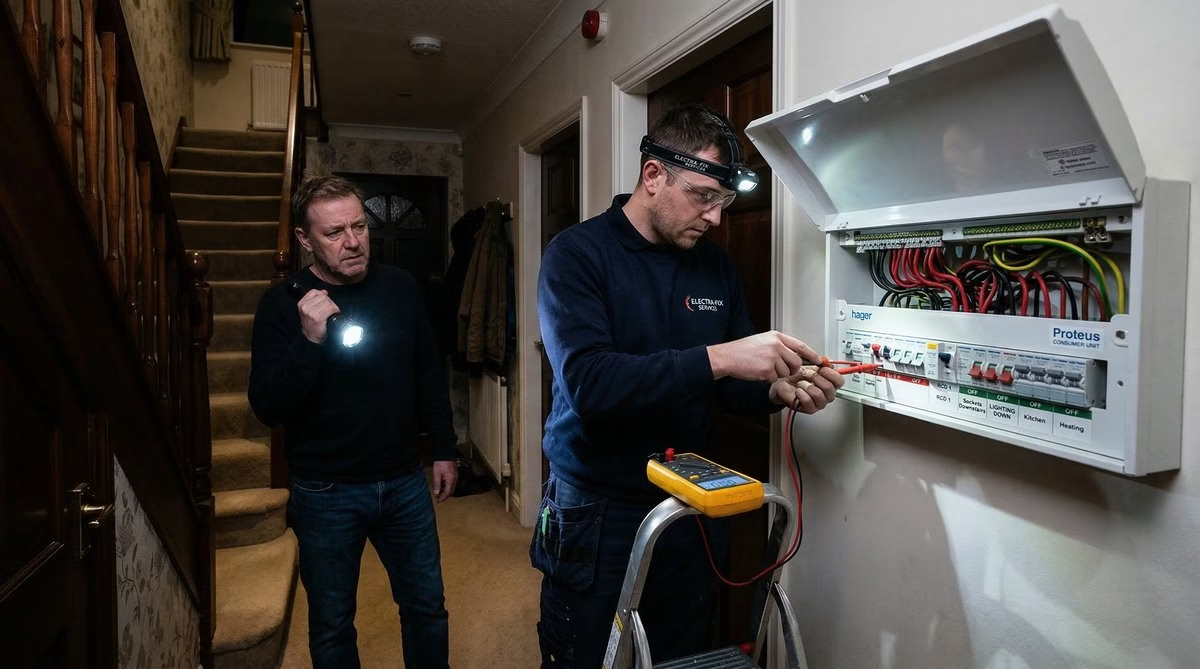
If your fuse board keeps tripping and cutting power to half the house — the lights, the fridge, the router, all of it — you are not dealing with a dramatic electrical emergency. You are almost certainly dealing with a design limitation baked into millions of older UK homes: the split-load RCD consumer unit. We work on properties across London every week, and RCD nuisance tripping is one of the most common frustrations we encounter — and one of the most straightforward problems to resolve once you understand the root cause.
Why your fuse board trips everything at once — how split-load RCD boards work (and fail)
To understand why your board trips half the house when one appliance misbehaves, you need to understand how a split-load consumer unit is structured. A typical split-load board installed in UK homes from the 1990s through to the mid-2010s contains a master switch, two RCDs (Residual Current Devices), and a row of MCBs (Miniature Circuit Breakers). The MCBs protect individual circuits against overloads and short circuits. The RCDs sit upstream of the MCBs and protect against earth leakage — the dangerous kind of fault that could cause a fire or a fatal shock.
The critical word is upstream. In a split-load board, each RCD sits above a bank of multiple circuits. One RCD might protect your upstairs sockets, the bathroom, and two lighting circuits simultaneously. When that RCD detects a fault — any fault, from any one of those circuits — it does the only thing it can do: it kills power to every circuit it is responsible for. All at once. The RCD has no way to distinguish which circuit triggered the trip, because it is monitoring all of them through a single lens.
The 30 milliamp threshold is the key figure. A standard domestic RCD trips when it detects an imbalance of 30 mA or more between live and neutral conductors — a sign that current is leaking to earth. In a genuine fault, this is life-saving. The problem arises when that sensitivity, combined with the architecture of a split-load board, means that small non-dangerous leakage from multiple healthy appliances adds up to an unwanted trip. Your board is doing its job — with a very blunt instrument.
We recently upgraded a board in a Victorian conversion in Clapham where the homeowner had been resetting the same RCD two or three times a week for over a year. Every previous electrician had recommended replacing the tumble dryer. The dryer was replaced. The tripping continued. The real cause was cumulative background leakage from six circuits tipping over the threshold. An RCBO board resolved it immediately.
The most common nuisance trip triggers — appliances, moisture, old wiring, and cumulative leakage
When a homeowner reports a nuisance tripping RCD, we work through the same checklist before recommending any hardware change. Some triggers are fixable without touching the board at all. Others point to a board that has reached the end of its practical life.
Faulty or ageing appliances
The most common single-appliance cause of nuisance trips is a failing motor or heating element — most often in a washing machine, tumble dryer, dishwasher, or electric shower. As internal insulation ages, small amounts of current leak to earth. The appliance may work perfectly otherwise, but its background leakage climbs until it tips the RCD. Fridges with ageing compressors and electric ovens with degraded element insulation can do the same. The appliance may not be dangerous in isolation — but it is enough to push a 30 mA RCD over threshold, especially if other circuits are also contributing background leakage.
Moisture ingress
External sockets, garden lighting circuits, bathroom extractor fans, and any cable run through damp walls or floor voids are all entry points for moisture. Even a small amount of water bridging live and earth conductors inside a fitting can generate enough leakage to trip an RCD. This kind of trip is characteristically intermittent — appearing after rain or cold spells and seeming to resolve as things dry out. That pattern makes it genuinely difficult to diagnose without proper testing equipment.
Cumulative leakage from modern electronics
This is the trigger that most surprises homeowners, because it involves no fault at all. Modern switch-mode power supplies — used in laptops, phone chargers, smart TVs, LED lighting drivers, and virtually all contemporary electronics — generate a small but measurable amount of earth leakage during normal operation. A laptop charger might leak 0.5 mA. A smart TV perhaps 1–2 mA. On an RCBO board, each circuit carries its own 30 mA threshold and the modest leakage from a handful of devices never gets close to triggering it. On a split-load board, contributions from six or eight circuits are summed under a single 30 mA threshold. A home with fifteen networked devices might have combined background leakage of 20–25 mA. One additional appliance pushes it over. The trip is genuine — even though every single appliance is working correctly.
Old or degraded fixed wiring
PVC insulation has a finite working life. In properties wired in the 1960s, 70s, or early 80s, insulation behind plaster and under floors may have become brittle or porous. Very minor degradation can produce persistent earth leakage without any other visible fault. We diagnosed exactly this in a period property in Islington — 1970s cables beneath the kitchen floor generating consistent background leakage of 22–24 mA, well below dangerous levels but easily enough to trip when the dishwasher’s heating cycle added another few milliamps.
A worn RCD itself
RCDs are electromechanical devices and they age. An RCD in service for fifteen or twenty years may develop a reduced effective trip threshold — tripping at 20 mA rather than 30 mA — or may become sensitive to the transient spikes that occur when large motors start. An old RCD is not automatically unsafe, but it can become increasingly prone to spurious trips with no clear cause and no obvious fix short of replacement.
How RCBOs solve the problem — individual circuit protection explained simply
An RCBO (Residual Current Breaker with Overcurrent protection) combines the functions of an MCB and an RCD into a single device, fitted to a single circuit. Where a split-load board uses one RCD to monitor eight circuits simultaneously, an RCBO board gives every circuit its own dedicated 30 mA threshold — independently. The kitchen ring, the upstairs sockets, the bathroom circuit, the outdoor supply — each has its own RCBO watching only that circuit.
If the washing machine develops an earth fault, the kitchen ring RCBO trips. The kitchen loses power. The upstairs lights stay on. The fridge stays on. The router stays on. You reset the one circuit, investigate the one appliance, and resolve the one issue — rather than plunging half the house into darkness and working through a process of elimination in the dark.
There is also a structural benefit regarding cumulative leakage. Because each RCBO monitors only its own circuit, background leakage from electronics on other circuits is entirely invisible to it. The trigger that made the split-load board trip — the summation of normal leakage across multiple circuits — simply cannot occur on an RCBO board by design. This is not a marginal improvement; it is a fundamentally different architecture that eliminates the problem at source rather than managing it around the edges.
RCBO boards also make fault-finding faster and cheaper. When a trip occurs, you immediately know which circuit is involved. On an older RCD board, a trip requires unplugging everything on the entire bank before you can begin narrowing down the cause — a process that can take an hour or more if the fault is intermittent. Under BS 7671 (18th Edition), individual circuit protection aligns closely with modern best-practice guidance, and we specify RCBO configuration for all new consumer unit installations at Fixiz.
Is an RCBO upgrade worth the cost — realistic scenarios where it pays for itself
The honest answer depends on your specific situation. Here is how we assess it — without defaulting to a blanket recommendation that suits us commercially rather than you practically.
Persistent nuisance tripping with no clear cause
If your board has tripped more than three or four times in six months without a clear identified cause, an RCBO upgrade almost always pays for itself. Fault-finding alone — a qualified electrician spending several hours with testing equipment on an intermittent leakage issue — can run to £200–£400. A full RCBO consumer unit installation in a typical three-bedroom London property costs £600–£900 including parts, labour, testing, and certification. If you have already paid for two or three inconclusive visits, the upgrade is cheaper than continued investigation.
Rental properties and EICR compliance
For landlords, nuisance tripping carries costs beyond inconvenience. Tenants who lose power to the fridge or heating controls at 11pm will call you. An RCBO board also tends to produce better outcomes at EICR inspections, which are mandatory for all rental properties in England. The investment is defensible on both operational and compliance grounds.
Combining with other electrical work
If you are already planning a kitchen rewire, EV charger installation, heat pump supply, or any other significant circuit addition, the marginal cost of upgrading to a full RCBO configuration at the same time is considerably lower than returning for a dedicated upgrade later. We frequently advise clients in this position to combine works — the incremental cost of the upgrade within an existing visit is typically £400–£600 rather than the full job price standalone.
When an upgrade may not be urgent
If your existing board is under ten years old, has never produced a nuisance trip, and no other electrical work is planned in the near future — there may be no compelling reason to upgrade right now. A well-maintained split-load board with properly tested RCDs and sound wiring is not a safety hazard. We will always tell you this honestly rather than manufacture a problem that does not exist.
How Fixiz diagnoses tripping problems and upgrades boards — test first, upgrade smart
We do not arrive at a nuisance tripping call with a new consumer unit in the van and a predetermined conclusion. Our standard approach starts with diagnosis, because the right solution depends on understanding what is actually causing the trips — and sometimes the answer is one faulty appliance rather than a board architecture problem.
We begin with a thorough visual inspection of the consumer unit — checking for overheating, loose terminations, water ingress, and the condition of the RCDs and MCBs. We then carry out insulation resistance tests on each circuit to identify persistent leakage in the fixed wiring, and measure earth leakage current using a clamp meter to build a quantitative picture of background leakage per circuit. If the combined total across an RCD bank sits at 22–26 mA under normal load, we know the board is close to its trip threshold and will continue to trip regardless of whether any single appliance is faulty.
If a single appliance is clearly the problem, we will tell you that first. Replace the appliance and the tripping stops — a better outcome than an unnecessary board upgrade. If diagnosis points to cumulative leakage, degraded wiring, or a worn RCD, we will present the case for an upgrade clearly and honestly, including what it will cost and what the alternatives are.
When we carry out a consumer unit upgrade, the work is notifiable under Part P of the Building Regulations and we issue a full Electrical Installation Certificate on completion. All work is carried out by our NICEIC-registered engineers. A recent job in Hackney is typical — a 2006 split-load board producing intermittent downstairs trips for over a year, always at random, never with an obvious cause. Leakage measurements showed 23 mA of cumulative background leakage on the downstairs bank under normal evening load. Wiring sound, no appliance individually faulty. We upgraded to a full RCBO board in a single day and the trips stopped.
Frequently asked questions
How do I know if I have a split-load RCD board or an RCBO board?
Open your consumer unit cover. On a split-load board, you will see a main switch at one end and one or two wide RCD switches roughly in the middle, with rows of narrower MCBs on either side. On an RCBO board, you will see one main switch and then a row of identically sized breakers — each labelled with a circuit name. If you are unsure, send us a photograph and we will confirm immediately.
Can I just replace the RCD rather than the whole board?
In some cases, yes — if the RCD itself is worn and has become oversensitive, replacing it can reduce spurious trips. However, a new RCD does not resolve cumulative leakage problems, old wiring degradation, or the fundamental architecture of a shared-protection board. If your board is more than fifteen years old and has been tripping persistently, a full RCBO upgrade is usually the more cost-effective long-term solution. We will always give you an honest assessment of which approach makes sense for your situation.
Will an RCBO upgrade affect my home insurance or EICR certificate?
A professionally installed RCBO consumer unit — completed with a valid Electrical Installation Certificate and notified to Building Control under Part P — is a positive factor for both. Insurers increasingly ask about the age and type of consumer unit when assessing risk, and an RCBO installation demonstrates a modern, compliant electrical installation. At EICR, individual RCBO protection is regarded more favourably than older split-load arrangements, and installations with good circuit separation are less likely to attract observations requiring remediation.
How long does a consumer unit upgrade take, and will I be without power all day?
A standard upgrade in a three-bedroom London property typically takes four to seven hours for two engineers. Power is isolated for the duration of the work. We coordinate timing to minimise disruption and ensure the installation is fully energised and certified before we leave. We do not leave a property without a functioning, tested installation at the end of the working day.
Does an RCBO upgrade future-proof my home for EV charging or solar panels?
Yes. An RCBO consumer unit is significantly better placed to accommodate new circuits for EV chargers, solar PV inverters, battery storage, and heat pumps than an older split-load board. Adding a new circuit is clean and straightforward — a new RCBO is fitted in a spare way and the circuit is run and certified independently. On an ageing split-load board, new circuit additions can be complicated by limited capacity, incompatible breaker types, and an already-busy RCD bank. If you are planning any energy upgrade in the next three to five years, an RCBO board is a sound foundation investment.
Ready to move from confusion to construction? Get in touch with Fixiz today for a no-pressure chat about your project and the fastest route to full compliance.