Physical address:
128 City Road, EC1V 2NX, London,UK

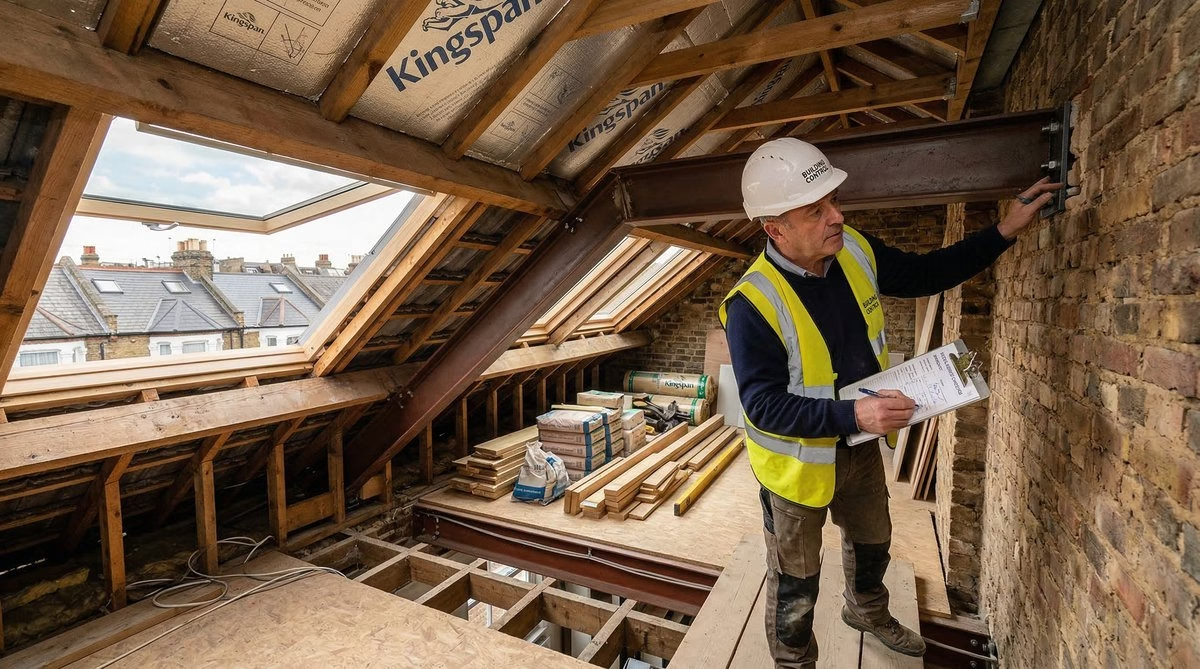
You have priced up a full loft conversion — and the quotes have come back eye-watering. The temptation to roll up your sleeves, watch a few tutorials, and take on as much of the work yourself as possible is entirely understandable. Some parts of a loft conversion genuinely are within reach of a confident, experienced DIYer. But DIY loft conversion building regs approval UK is a subject that trips up even capable homeowners, because the regulations are detailed, the inspections are unforgiving, and the downstream consequences of getting them wrong — to your insurance, your mortgage, your ability to let the property, and your eventual sale — can cost far more than the contractor savings you were chasing. At Fixiz, we work with London homeowners every week who are trying to find the right balance between doing it themselves and calling in the professionals. This guide gives you an honest map of that territory.
What Building Regulations Actually Require for a Loft Conversion
Every loft conversion in England requires Building Regulations approval — regardless of size or whether planning permission is needed. There is no permitted-development equivalent that bypasses building control. A Building Control inspector will visit at multiple stages, not just at the end.
Structure and floor loading (Part A): Most loft floors are built as ceiling joists — designed to carry plasterboard below, not people and furniture above. To create a habitable floor, you almost certainly need new or sistered structural timbers capable of handling an imposed load of at least 1.5 kN/m². Your application must include structural calculations produced by a qualified structural engineer. C24 graded timber is generally specified; the C16 common in older roofs does not usually meet the standard without increasing joist depth or frequency.
Fire safety and means of escape (Part B): The staircase serving the loft must be enclosed in 30-minute fire-resisting construction, and all doors opening onto that escape route must be upgraded to FD20 or FD30 fire doors with intumescent strips and cold smoke seals. Mains-wired, interlinked smoke alarms are required on every storey. The ceiling assembly between the loft and the room below must also provide 30 minutes’ fire resistance — commonly achieved by overlaying with 12.5mm fire-rated board.
Staircase geometry: A fixed staircase is mandatory — a loft ladder does not satisfy Building Regulations for a habitable room. The pitch must not exceed 42 degrees, minimum headroom is 2 metres (1.8 metres at the sides under a sloping roof), and a handrail between 900mm and 1,000mm high is required. These rules often create real planning challenges in Victorian terraced houses — something we encounter regularly with clients in Hackney and Stoke Newington, where rear-bedroom layouts leave very little room for a new staircase without proper design input.
Thermal insulation (Part L) and electrics (Part P): Roof insulation must achieve U-values of 0.18 W/m²K or better — typically 270mm of mineral wool in a cold-roof build, or a thinner rigid board in a warm-roof approach. Ventilation must be maintained to prevent condensation. All new electrical installations must be carried out by a registered competent person (NICEIC or NAPIT) or notified separately to Building Control. Any en suite or WC will additionally engage drainage and water regulations under Part H and Part G.
What a Competent DIYer Can Realistically Handle — and Where the Risks Multiply
There is genuine scope for a skilled, time-rich DIYer to contribute meaningfully and reduce overall costs — but it depends entirely on which elements you are talking about, and whether you engage correctly with Building Control throughout.
The works where an experienced DIYer can add real value include non-structural first-fix carpentry once the structural work is inspected and signed off, installing insulation between and below rafters (with the specification confirmed with Building Control first), boarding out non-load-bearing partitions after the structural frame is complete, painting and decorating, and the final fix of skirting, architrave, and joinery. These are areas where your labour saves real money without creating regulatory liability, provided the work sits downstream of the stages that require inspection.
The areas where DIY risk multiplies — and where we routinely see expensive problems — are the following:
- Structural alterations to the roof: Cutting through rafters or purlins without calculated, specified steelwork or engineered timber replacements is one of the most common ways a loft project ends in a dangerous structure notice. Without a structural engineer’s input, you are guessing at load paths that have been carrying your roof for decades.
- Fire door installation: A fire door is only compliant if correctly hung, with a solid continuous frame, correctly specified intumescent strips, and a cold smoke seal fitted. An incorrectly installed FD30 door provides almost no additional protection — the gaps around the frame are where the fire gets through. Building inspectors examine this closely.
- Floor joist work: Sistering or installing new joists looks straightforward until you need to demonstrate the calculations. A DIY floor built without structural sign-off is the single element most likely to fail a regularisation inspection later — proving compliance after the fact may require destructive investigation.
- Mains-wired smoke alarm circuits: Connecting interlinked smoke alarms to the mains requires Part P notifiable work. Without registration, you will need a qualified electrician to sign it off retrospectively — or it becomes a gap in the Building Control record.
We worked with a homeowner in Tottenham last year who had done a creditable job on most of the visible elements — good boarding, tidy stud walling, well-fitted Velux windows — but had not replaced the ceiling below with fire-rated board and had not upgraded any of the landing doors. When Building Control visited, the entire escape route had to be redone at significant additional cost, purely because the fire safety requirements had not been understood at the outset.
The Sign-Off Problem — Insurance, Lettings, and Resale Without a Completion Certificate
A completion certificate issued by Building Control at the end of a compliant project is not just a piece of paper — it is the document that determines whether your loft conversion exists, legally speaking, as a habitable room. Without it, the consequences extend in three directions.
Insurance
Home insurance policies almost universally require you to notify the insurer of material changes to the property, including the addition of a habitable room. If you complete a loft conversion without Building Regulations sign-off and then make a claim — particularly a structural or fire-related claim — the insurer has grounds to decline on the basis of material non-disclosure. As the HomeOwners Alliance notes, indemnity insurance policies also become invalid if any approach is made to the local council about the lack of a building regulation certificate. You can find yourself in a position where both your buildings insurance and any indemnity policy are void simultaneously.
Lettings
A loft room without a completion certificate cannot lawfully be marketed or used as a bedroom for lettings. As SAM Conveyancing sets out, placing a tenant in a non-compliant loft room exposes you to legal liability, particularly if they suffer any injury. Fire safety and habitable-room standards are exactly what landlord licencing inspections look for.
Resale
When you sell, your solicitor must disclose all material facts. A loft conversion without a completion certificate will be identified by the buyer’s surveyor or in the local authority search during conveyancing. You cannot legitimately describe the space as a bedroom. Buyers with mortgages will find their lender requires either retrospective regularisation or indemnity insurance. Indemnity insurance protects against enforcement action costs but does not protect against structural failure, and — as the LABC has noted — does not make an unsafe structure safe. Transactions fall apart. Prices are renegotiated. Chains collapse.
We have seen this scenario play out at exactly the wrong moment — a client in Islington whose sale stalled for six weeks while a regularisation application was assessed, at a cost of several thousand pounds and a price reduction to reflect remaining uncertainty. The original saving from skipping Building Control sign-off was entirely consumed and then some.
Common DIY Loft Conversion Mistakes That Fail Building Control Inspection
Building Control inspectors see a consistent pattern of failures on DIY and part-DIY loft conversions. Understanding these in advance is genuinely valuable — whether you are building or buying.
Inadequate structural calculations with the application
A building notice application is not appropriate for a loft conversion — a full plans application with structural drawings and engineer’s calculations is required. Homeowners who submit without proper calculations find the application rejected or inspections refused, creating delays that cost more in total than commissioning the engineer properly at the outset.
Incorrect floor joist sizing or specification
Using reclaimed or unspecified timber, failing to sister existing joists to the correct centres, or installing joists at the correct depth but in the wrong timber grade are all common failures. After the floor is boarded and decorated, demonstrating compliance may require lifting it entirely — an expensive and disruptive exercise that is entirely avoidable with correct specification at the start.
Fire doors installed without correct hardware
An FD30 fire door in the wrong frame, without intumescent strips, or with a non-compliant closer is not a fire door for regulatory purposes. We have seen projects in Walthamstow where every door on the escape route was replaced, but the frames were the original Victorian softwood — not continuous, not solid, and not compliant. The doors had to come out and the frames be rebuilt.
Smoke alarms battery-only or not interlinked
Battery smoke alarms, even modern radio-frequency interlinked models, do not satisfy Part B requirements for a new loft conversion. The alarms must be mains-wired with battery backup, interlinked so that any activation triggers all alarms throughout the dwelling. This is Part P notifiable electrical work.
Missing or incomplete final inspection notification
A common and avoidable mistake: the work is completed but the homeowner forgets — or delays — calling for the final inspection. If no final inspection is called, no certificate is issued, and the project sits in regulatory limbo indefinitely. This is the sole reason some otherwise fully-compliant conversions end up without documentation for years.
How Fixiz Bridges the Gap — Professional Oversight Without Full-Contractor Pricing
At Fixiz, we work with London homeowners who want to contribute their own labour without sacrificing the compliance that protects their investment. We start with one honest conversation: which elements of your project are DIY-appropriate, and which carry regulatory or structural risk that warrants professional input?
In practice, this means we can provide structural design and engineer’s calculations to support your full plans application — giving you an approved set of drawings you can build from. We manage Building Control notifications, attend the staged inspections, and ensure that what you have built at each stage is documented correctly before you proceed to the next. For the elements that genuinely require a competent person — fire door installation and certification, Part P electrical work, structural steel and joist installation — we provide those at a rate that reflects a targeted scope rather than a whole-project markup.
The result is that homeowners who want to do their own boarding, insulation fitting, plasterboarding, and decoration can do so with confidence — because the critical sign-off path is managed correctly. We have worked this way across Hackney, Tottenham, Stoke Newington, and inner north and east London more broadly. The pattern is consistent: homeowners who try to manage Building Control entirely alone run into problems at the stages they did not anticipate, while those who engage professional oversight for the structural and fire elements complete with their certificates intact.
We are also experienced in regularisation applications — the retrospective approval process for conversions already completed without sign-off. The route is more expensive and more disruptive than getting it right first time, but it is available where the structure is fundamentally sound. A regularisation certificate from a local authority building control body is the correct outcome to pursue — not an indemnity policy, which does not make an unsafe structure safe.
Ready to move from confusion to construction? Get in touch with Fixiz today for a no-pressure chat about your project and the fastest route to full compliance.
Frequently Asked Questions
Can I act as my own project manager and contractor for a loft conversion?
Yes — as the property owner you are legally the client and can manage subcontractors, carry out works yourself, and submit your own Building Regulations application. There is no requirement to use a main contractor. What you cannot do is skip the Building Regulations process. You must submit a full plans application with structural calculations, notify Building Control at each inspection stage, and obtain a completion certificate. Managing the compliance path is the critical responsibility — the physical labour is secondary.
Do I need a structural engineer even if I am doing the work myself?
Almost certainly yes. Your full plans application must include structural drawings and calculations demonstrating that the new floor and any structural alterations meet Part A requirements. Building Control will not approve plans without this documentation, and it must be produced by a qualified structural engineer. For a standard London loft conversion, that typically costs £500–£1,500 — modest relative to the consequences of proceeding without it.
What is a regularisation certificate and when do I need one?
A regularisation certificate is retrospective Building Regulations approval for work carried out without prior consent. It is available from local authority building control bodies — not private approved inspectors — and covers work carried out after 11 November 1985. An inspector will assess the existing conversion, which may require opening up parts of the structure. If the work does not meet the regulations in force at the time it was done, remedial work must be completed first. Where structural or fire safety defects are significant, the cost of remediation can be substantial.
Will an indemnity insurance policy protect me if my loft conversion has no Building Regs sign-off?
Only in a very narrow sense. A building regulations indemnity policy protects against local authority enforcement action — a Section 36 notice requiring alteration or removal of non-compliant works. It does not protect against structural failure, does not restore your buildings insurance position, and becomes void if any approach is made to the local authority about the lack of certification. Indemnity policies are widely used in conveyancing to unblock transactions, but they are a workaround for an existing problem, not a substitute for compliance.
How long does Building Regulations approval take for a loft conversion?
A full plans application should receive a decision within five weeks, or two months with your consent. London local authority departments often take closer to eight weeks in practice; private registered building control approvers typically turn approvals around in one to two weeks. Per GOV.UK guidance, the completion certificate should follow within eight weeks of a satisfactory final inspection. Calling for that final inspection promptly is something homeowners often forget — leaving them without documentation for months.