Physical address:
128 City Road, EC1V 2NX, London,UK

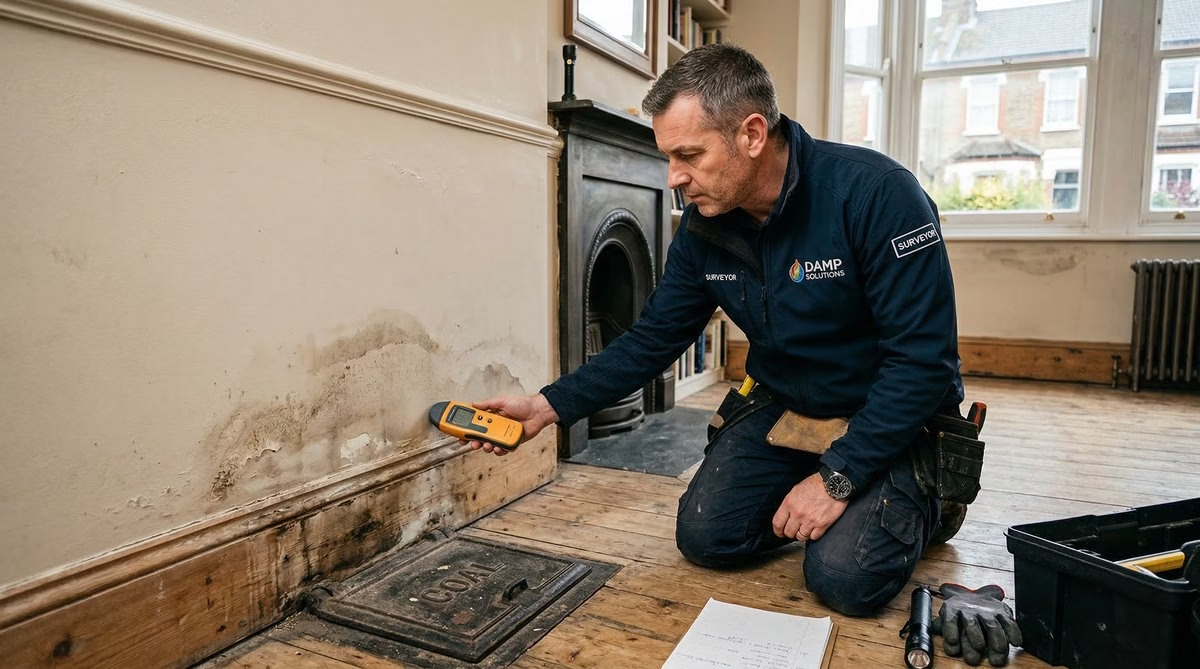
If you have been trying to damp smell ground floor room diagnose moisture source UK — chasing that intermittent musty odour that appears after rain, lingers on still mornings, then seems to vanish — you are not imagining things. That pattern is one of the most diagnostically useful clues we encounter. Ground-floor damp in older UK properties rarely has a single obvious cause. Moisture can enter through a forgotten coal hatch beneath the front path, a post-war concrete slab without a damp-proof membrane, a partially infilled subfloor void, or simply a pair of blocked air bricks leaving stagnant, moisture-laden air with nowhere to go. At Fixiz, we work across London and the South-East, and this is among the most common complaints we investigate. This article walks you through why it happens, how we find the source, and what actually fixes it.
Why ground-floor rooms develop a musty smell — and why it comes and goes
The intermittent quality of a ground-floor damp smell is what makes it so frustrating. On a dry Tuesday morning the room smells fine; by Thursday evening after two days of rain, there it is again — that faint, earthen smell sitting somewhere between old soil and wet cardboard. Understanding why this happens means looking at how ground-floor moisture moves through a building.
Most London Victorian and Edwardian terraces were built with a suspended timber floor over a void above bare earth or basic rubble fill. Air circulated freely through terracotta air bricks in the external walls, keeping the void dry and the joists well-ventilated. This worked as long as air bricks remained clear, ground levels outside did not rise above them, and nobody blocked the void from inside.
Over the decades, several things tend to go wrong. Soil accumulates and blocks air bricks. Extensions cut off cross-ventilation. Concrete screeds seal the void without resolving the moisture below. Any of these interventions can tip the balance from a ventilated void to a damp, stagnant one — and stagnant air carrying evaporated ground moisture finds its way up through gaps around skirting boards and between floorboards.
The smell comes and goes because ground moisture levels fluctuate with rainfall, season, and temperature. In dry summer weather, soil beneath the slab or void dries out and evaporation slows. After sustained autumn rain, the water table rises and evaporation into the void accelerates. A cold floor surface over a relatively warm, moist void also creates condensation on the underside of floorboards even on otherwise dry days.
We investigated a Victorian terrace in Peckham where the owner had chased this pattern for three years, with two previous specialists finding nothing significant during summer visits. When we attended in November after a wet October, moisture readings in the void exceeded 85% relative humidity and three joists showed early-stage wet rot. The cause was a completely blocked pair of air bricks hidden behind a later timber-framed utility room. This is why timing matters so much when trying to diagnose a moisture source in a ground-floor room.
Coal hatches, old concrete infills, and covered voids — the usual suspects
Once we establish that a ground-floor room has a recurring damp smell with no obvious surface condensation or rising damp staining on the walls, we turn our attention to what we call the structural moisture pathways — features of the building’s fabric that create a route for ground moisture to reach the interior air. In London’s older housing stock, several appear repeatedly.
Coal hatches are perhaps the most overlooked. In Victorian and Edwardian terraces, coal was delivered through a small hatch set into the front path, leading into a brick-lined bunker beneath the front room floor. When coal heating was abandoned, most hatches were sealed at surface level with a concrete lid or paving slab. The brick bunker almost always remains, it is rarely filled, and the hatch cover — now perhaps seventy or eighty years old — is frequently cracked or partially open. Water infiltrates during every heavy shower, collects in the void, and evaporates upward into the room above.
On a recent job in Lewisham, the homeowner assumed the bay window corner smell was rising damp in the party wall. When we opened the floorboards, we found a coal bunker void roughly 1.2 metres deep with around four centimetres of standing water at the base and algae on the lower brickwork. The hatch cover outside was a 1970s concrete slab that had cracked diagonally, leaving a gap of roughly 15 millimetres.
Old concrete infills are the second major culprit. During the post-war period and through to the 1980s, it was common to infill suspended timber floors with a concrete slab for levelling or draught reduction. A slab poured directly over earth without an adequate damp-proof membrane will transmit ground moisture upward by capillary action indefinitely. When only part of the floor is infilled, the transition zone between the concrete and the remaining suspended section is frequently the point of highest moisture reading and strongest smell.
Covered subfloor voids — created when extensions are built over the original air brick line — produce a related problem. The extension’s foundation cuts off cross-ventilation, the void becomes effectively sealed, humidity builds, and the first sign is almost always that familiar musty odour in the room above. We also see this where debris from wall removals has been left in the void rather than cleared, giving moisture a substrate to amplify from.
How we diagnose the real moisture path — damp meters, thermal imaging, and calcium chloride tests
Accurate diagnosis is everything in ground-floor damp work. The wrong diagnosis leads to the wrong treatment — money spent on remediation that misses the source, or a problem that worsens because moisture is redirected somewhere new. Our diagnostic process at Fixiz is methodical and evidence-based.
The first tool we reach for is a calibrated resistance-type damp meter. We insert pins into timber floor joists, skirting boards, and sub-floor timbers, taking readings in a grid pattern and mapping the results. A moisture content of 20% or above in timber indicates active damp; 15%–20% signals elevated risk. This grid map often reveals a moisture gradient pointing clearly toward the source. For concrete slabs and plaster, a non-invasive capacitance meter screens large areas without damage.
Thermal imaging cameras detect surface temperature differences as small as 0.1°C. Wet materials cool by evaporation and appear as colder areas on a thermal image, allowing us to map moisture distribution across large floor areas and check wall-floor junctions for bridging. It is a screening tool rather than a definitive diagnostic, but it significantly reduces the area requiring invasive investigation.
For concrete slabs specifically, we use the calcium chloride test to quantify moisture vapour emission. Anhydrous calcium chloride is sealed in a dish on the slab surface for 60 to 72 hours; the weight gain on retrieval gives us an emission rate in grams per square metre per 24 hours — confirming whether the slab needs treatment and specifying the correct DPM system.
Tip: Schedule your damp survey during or immediately after a period of wet weather. Readings taken during dry spells are almost always an underestimate of the real problem.
We also inspect subfloor voids directly wherever access allows, leaving a data logger in place for at least 48 hours. On a survey in Herne Hill, we retrieved a logger to find relative humidity had peaked at 94% over the preceding weekend — well above the threshold for fungal growth on timber. The homeowner had been told the void was “probably fine”. Our data told a different story. Where the source remains unclear, we lift a floorboard or cut a small inspection hole in the screed to examine conditions directly — always making good afterwards.
Fixes that actually last — from ventilation to tanking to slab replacement
Treatment options vary enormously depending on the cause. There is no universal solution, and any contractor who recommends the same treatment regardless of what diagnosis reveals should be viewed with scepticism. Here is how we approach the most common scenarios.
Where the primary issue is inadequate subfloor ventilation, the most effective fix is to restore or augment air brick provision — clearing blockages, replacing damaged bricks, or adding new ones to walls that were previously solid. In properties where the void geometry makes natural cross-ventilation difficult, a low-energy sub-floor fan actively draws moist air out rather than relying on passive airflow, and can reduce void humidity to acceptable levels within a few weeks.
Where a coal hatch is the entry point, the external cover is replaced with a properly sealed unit bedded on hydraulic mortar. The bunker void is pumped out, cracks in the brick lining repaired with waterproof render, and the void is either filled with clean dry aggregate or left clear but fully sealed and connected to the subfloor ventilation system.
Concrete slab moisture vapour is treated based on emission levels. For slabs emitting below approximately 75 g/m²/24h, an epoxy DPM applied to a prepared surface is usually adequate. For higher emission rates — common beneath unprotected post-war infills — we specify a two-coat polyurethane system capable of tolerating greater hydrostatic pressure. Surface preparation is critical in both cases: shot-blasting or grinding removes laitance and provides the key the membrane needs. A membrane applied to an unprepared surface will fail within months.
Where a slab is fundamentally compromised — cracked, friable, or laid over decomposing organic material — we recommend full slab removal and replacement. A correctly constructed replacement consists of compacted hardcore, a sand blinding layer, a 1200-gauge polythene DPM lapped up and bonded to the wall DPC, and a minimum 100mm reinforced concrete slab. We also address any drainage issues outside the room, since even a correctly built slab laid into a waterlogged subbase will fail in time. Where the suspended timber floor is retained, we inspect every accessible joist for wet rot, replacing any with compromised structural integrity and treating early-stage growth with a boron-based preservative before reinstating the boards.
How Fixiz handles ground-floor damp — honest diagnosis before any remedial work
We are a property works company, not a damp-proofing specialist with a single set of products to sell. Many homeowners who contact us have already had visits from companies whose business model depends on recommending proprietary systems. Those systems are not always wrong, but the incentive is not aligned with finding the most proportionate or affordable solution for your specific situation. We have no such conflict — our interest is in accurate diagnosis first.
Our process begins with a pre-visit conversation covering the property’s age, known alterations, and the pattern of the smell. On site, we follow the diagnostic sequence described above, document every reading with photographs, and set out what we found, what we believe is causing it, and — critically — what we remain uncertain about. We charge separately for our diagnostic survey and our remedial works, so you are never in the position of having paid for a survey that is only valid if you also accept the same company’s quote for the work.
On a survey in Brockley, our initial assessment pointed strongly toward a failed concrete DPM under a kitchen extension. When we lifted the screed, the DPM was intact — the moisture was coming from a cracked drain leaking slowly beneath the slab. Had we simply tanked the surface, the tanking would have failed within a year or two as hydrostatic pressure built behind it. The actual fix was a pipe lining — nothing to do with the slab. Only open-minded diagnosis gets you to that answer.
We work across all of London — from Southwark and Lewisham to Haringey and Ealing — covering Victorian terraces, Edwardian semis, post-war estates, and contemporary conversions. Ground-floor damp does not follow neat rules, and neither does our approach to it.
Frequently asked questions
What does a damp smell in a ground-floor room actually indicate — is it always rising damp?
Not at all. Rising damp accounts for a relatively small proportion of ground-floor damp complaints. More commonly, a musty smell indicates moisture evaporating from the ground via a subfloor void or a slab without a damp-proof membrane. True rising damp typically presents with visible tide marks, salt crystallisation, and peeling paint on the lower walls — not just a smell. If you have the smell without these visible signs, rising damp in the walls is probably not your primary problem.
How do I know if my ground-floor room has a coal hatch?
The most obvious sign is a covered opening in the front path or garden — sometimes marked by different paving material or a square concrete or metal cover. Coal bunkers were almost always located beneath the front reception room, so if the damp smell is concentrated there — particularly near the bay window — a coal hatch is a strong suspect. We can carry out an endoscopic inspection through a small drill hole to confirm without major disruption to your floors.
Can I fix ground-floor damp by improving ventilation alone?
Sometimes, yes — if blocked air bricks are the root cause rather than a structural moisture pathway. If diagnostic testing shows an overly humid subfloor void with no standing water and no compromised slab or hatch, restoring adequate cross-ventilation can reduce void humidity to acceptable levels within weeks. However, ventilation will not resolve moisture entering through a cracked hatch cover, a slab without a DPM, or a leaking pipe. Attempting to ventilate your way out of a structural ingress problem reduces the smell but does not stop the moisture or prevent ongoing timber decay.
How long does ground-floor damp remediation typically take, and how disruptive is it?
The answer depends on what we find. Clearing and replacing air bricks or resealing a coal hatch are quick jobs — typically one to three days with minimal disruption. Full slab removal and replacement in a single room takes around five to seven working days and requires at least 28 days of curing time before the DPM and screed are applied. Joist replacement and subfloor remediation sits somewhere in between. We provide a detailed programme of works with every quote so you know exactly what to expect.
Is a damp smell from a ground-floor room a health risk?
Persistent damp and the mould growth it encourages carry genuine health implications, particularly for people with respiratory conditions or allergies. A musty smell without visible mould indicates elevated moisture and biological activity in hidden locations — and while less immediately concerning than widespread visible mould, it is not benign. UK public health evidence consistently associates damp indoor environments with increased incidence of respiratory illness. We always recommend addressing the source rather than masking it.
Ready to move from confusion to construction? Get in touch with Fixiz today for a no-pressure chat about your project and the fastest route to full compliance.