Physical address:
128 City Road, EC1V 2NX, London,UK

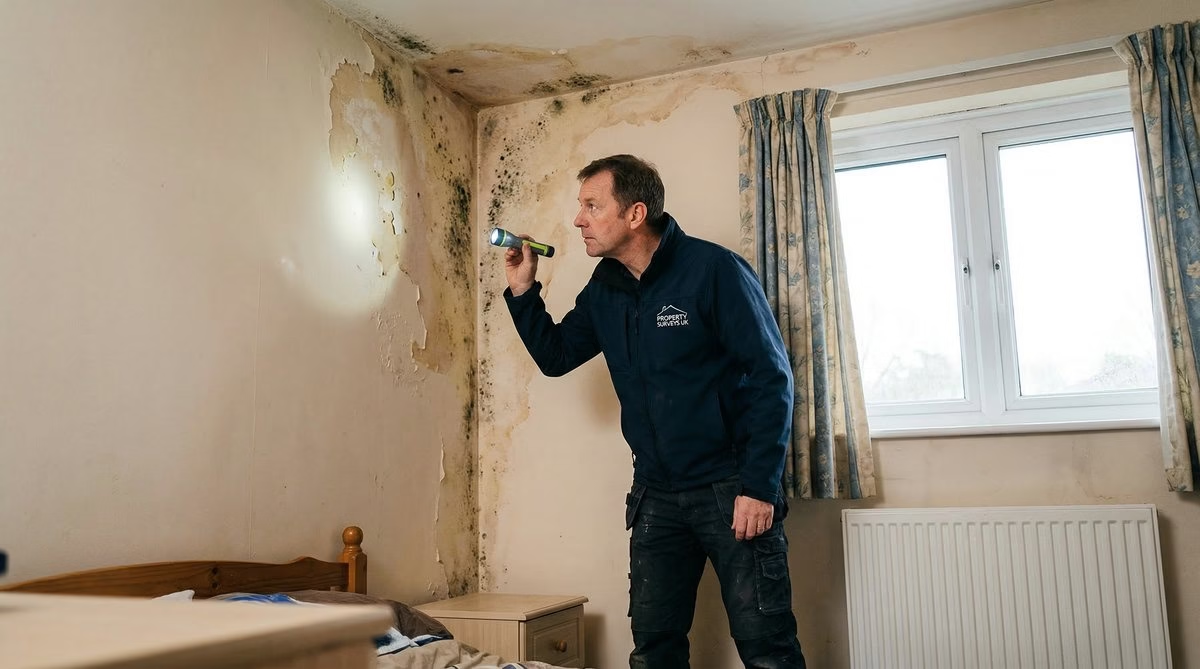
If you have repainted the corner of your bedroom only to watch the stain — and that unmistakable musty odour — creep back within weeks, you are not imagining things and you are certainly not alone. The problem of a damp smell bedroom corner keeps coming back UK is one of the most common complaints we hear at Fixiz, and it is almost always a sign that something structural or environmental is driving the moisture — something that no tin of paint will ever cure. In this article we walk through exactly why it keeps happening, how to identify the root cause, and what a proper fix actually involves.
Why bedroom corners are damp magnets — cold bridges, poor ventilation, and hidden paths
Bedroom corners occupy a very particular place in the physics of a building. Where two external walls meet — or where an external wall meets a ceiling or floor — you have a junction that is geometrically difficult to insulate, structurally prone to gaps, and thermally vulnerable in a way that flat wall surfaces simply are not. The result is what building surveyors call a cold bridge: a localised area where heat escapes rapidly from the interior, the surface temperature drops below the dew point of the indoor air, and water vapour condenses directly onto the wall or ceiling plaster.
We surveyed a flat in Brixton where the tenant had repainted the rear bedroom corner three times in eighteen months. Each time, the mould returned within six weeks. When we carried out a full thermal imaging inspection, the junction between the party wall and the external rear wall was sitting at 8°C on a mild November evening — a full 11°C below the room air temperature. That temperature differential was enough to condense moisture on every damp day of the year, regardless of how well the room was heated.
Beyond cold bridges, bedroom corners suffer because they are typically the zones with the least air movement in a room. Natural convective currents in a heated room tend to circulate air across open floor and wall areas; corners get bypassed. Stagnant air that sits against a cold surface will deposit its moisture there — slowly, invisibly, and persistently. Add to this the fact that most UK bedrooms are ventilated by nothing more than a trickle vent in a double-glazed window (if that), and you begin to understand why the corner is perpetually struggling.
There are also hidden moisture paths that homeowners rarely suspect. A cracked or deteriorated mortar joint on the external face of a wall — invisible from inside — can allow wind-driven rain to penetrate the masonry. That water does not necessarily flow in a straight line; it migrates along mortar beds, around lintels, and across cavity closers until it finds a cold or porous surface to express itself on — which, again, is frequently the bedroom corner. Similarly, a poorly fitted or blocked cavity wall tie can create a drip path that bridges the cavity and delivers moisture directly into the inner leaf of blockwork.
Flat roofs and parapet walls immediately above a bedroom are another underappreciated culprit. Even a minor split in felt or a hairline crack in render allows rainwater to track horizontally across a roof deck and then vertically down a wall cavity, presenting as dampness in the ceiling-wall junction of the room below — which is, again, the corner. We see this pattern repeatedly in converted Victorian terraces and 1970s purpose-built flats across South London, where flat roof maintenance has been deferred for years.
Tip: On a cold, still evening, hold the back of your hand close to the corner in question — not touching the surface. If it feels noticeably colder than the middle of the same wall, you are almost certainly dealing with a thermal bridging issue that no surface treatment will resolve.
Condensation vs penetrating damp vs rising damp — how to tell them apart in a bedroom
One of the most damaging misconceptions in the UK property maintenance world is the assumption that all bedroom dampness is condensation. It is a convenient diagnosis because it implies the solution is behavioural — open a window, buy a dehumidifier, stop drying clothes indoors — rather than structural. But condensation, penetrating damp, and rising damp have distinct causes, distinct patterns, and require completely different remedies. Treating the wrong type is exactly how homeowners end up repainting the same corner every year.
Condensation tends to be widespread rather than localised, though it concentrates on cold surfaces. In a bedroom, it typically appears first on window reveals, external wall corners, and behind large items of furniture pushed against external walls. The tell-tale signs are a distinctive black spot mould (Cladosporium and Aspergillus species) that wipes off relatively easily, a musty smell that is worse in the morning after a night of breathing and body heat in a closed room, and — crucially — a pattern that worsens in winter and eases in summer.
Penetrating damp follows moisture paths from outside. The staining is typically tidemarked (you can see the historic high-water marks of previous episodes), often yellowish or brown rather than pure black mould, and localised to areas that correspond to an external defect — a failed render, a cracked coping stone, a defective valley gutter. Penetrating damp can appear at any height and is directly correlated with rainfall events; if you notice the damp smell is notably worse after a period of heavy rain, especially with westerly or south-westerly winds, penetrating damp should be your first suspicion.
A homeowner in Streatham called us after spending over £800 on a damp-proofing injection course for her ground-floor front bedroom, which she had been told had rising damp. When we inspected the property, the damage was confined to a two-metre section of wall below a bay window where the lead flashing had lifted away from the brickwork. Rainwater was tracking down the cavity and wicking into the plaster — a classic penetrating damp scenario. The injection course did nothing because there was no rising damp present; what had been identified as a tide mark was simply the furthest extent of the water migration from above.
Rising damp proper — capillary movement of ground moisture up through masonry — is relatively rare compared to the frequency with which it is diagnosed. It is characterised by a very specific tide mark pattern, usually no higher than one metre above floor level, white salt efflorescence as ground salts are carried up in the moisture, and damage that is present on both internal faces of an external wall simultaneously. It does not appear in upper-floor rooms under any circumstances. If your damp bedroom corner is on the first floor or above, rising damp is not the cause — full stop.
- Smell profile: Condensation mould has a sharp, earthy, fungal smell; penetrating damp often produces a heavier, more mineral or clay-like odour as masonry salts and timber decay become involved.
- Timing pattern: Worse after rain suggests penetrating damp; worse in cold weather regardless of rain suggests condensation; year-round and unvarying near the floor suggests rising damp.
- Touch test: Condensation surfaces feel cold and slightly tacky; penetrating damp walls feel wet through, and the plaster may be soft or hollow-sounding when tapped.
- Salt deposits: White crystalline efflorescence or brown staining strongly suggests moisture is carrying dissolved salts — a sign of ground contact (rising damp) or prolonged masonry saturation (penetrating damp).
Tip: A professional moisture meter reading is not the end of the diagnostic process — it is the beginning. A reading in isolation tells you there is moisture; it does not tell you where it came from or which direction it is travelling. Always combine meter readings with a physical inspection of the external envelope.
The cycle of painting over damp — why cosmetic fixes always fail
We understand why homeowners reach for the paintbrush. The stain is visible, the smell is embarrassing, and a tin of damp-seal paint feels like doing something concrete about the problem. The paint goes on, the wall looks clean, and for a few weeks — sometimes a few months — everything seems fine. Then the bubble appears under the paint film. Then the corner darkens again. Then the smell returns, often stronger than before, because the source of moisture has not been addressed and the sealed surface has simply forced the vapour to find a new path or accumulate behind the paint layer.
Damp-seal paints work by creating a physical barrier. They are entirely reliant on that barrier remaining intact — which it will not do if there is any ongoing moisture pressure behind it, any thermal movement in the substrate, or any residual salts crystallising as moisture continues to migrate. Anti-mould paints contain biocides that suppress the immediate mould growth on the treated surface, but those biocides do not penetrate into the plaster or masonry behind, and they have a finite life. The mould returns because the substrate — wet, cold, mineral-laden — is still a perfect growth medium just millimetres behind the treated face.
There is also a diagnostic problem with repeated overpainting. Each layer of damp-seal or stain-blocking paint makes it harder to read what the wall is actually doing. Salt patterns get obscured. Tide marks get covered. The visual clues that a surveyor would use to differentiate between damp types are progressively erased, making accurate diagnosis — and therefore accurate remediation — more difficult and more expensive the longer the cycle is allowed to continue.
We attended a property in Camberwell where the landlord had instructed contractors to paint over the damp corner in a first-floor bedroom on four separate occasions over three years. By the time we were called in, the plaster had absorbed so much moisture — with no drying cycle ever being allowed — that it was actively crumbling away from the wall. What might have been a £300–£400 repair when the problem first emerged had become a full replaster of that wall face, external repointing, and a new extractor fan installation — a job costing significantly more and taking three days rather than one.
The structural consequences of sustained dampness go well beyond aesthetics. Moisture in masonry accelerates freeze-thaw spalling in exposed brickwork, destroys the lime or gypsum binder in historic plaster, rots embedded timber elements including floor joists, window lintels, and built-in furniture, and creates conditions that encourage wood-boring insects. In a bedroom specifically, the sustained presence of mould spores in the air is a genuine health concern — particularly for occupants with asthma, allergies, or compromised immune systems. The NHS guidance on damp and mould is unambiguous: mould in living spaces is a health hazard, not merely a cosmetic issue.
Tip: If you have already painted the corner, mark the date on the back of the architrave or skirting board. Tracking exactly how long the cover-up lasts before the stain reappears gives a surveyor enormously useful information about the severity and nature of the moisture source.
Proper remedies that break the cycle — ventilation, insulation, and addressing the source
Fixing recurring bedroom damp properly means addressing the actual cause — which requires accurate diagnosis first — and then delivering a solution that either removes the moisture source, changes the thermal conditions so condensation cannot form, or both. There is no single universal fix; the right solution for condensation in a poorly ventilated room is completely different from the right solution for penetrating damp through a failed parapet wall.
Where condensation is the primary driver, the remediation strategy focuses on three levers: raising the surface temperature of cold corners, reducing the moisture load in the room air, and increasing air exchange to dilute humid indoor air with drier outdoor air. Raising surface temperatures is typically achieved through insulation — either external wall insulation on the outside face, internal wall insulation (carefully detailed to avoid creating new cold bridges at the edges), or for ceiling-wall junctions, a carefully applied insulating plasterboard system. A well-insulated corner that stays at or above the dew point simply cannot condense moisture, regardless of indoor humidity levels.
Ventilation improvements for bedrooms need to be proportionate to the problem. A basic trickle vent upgrade may be sufficient for mild cases. For persistent condensation, we typically specify a Positive Input Ventilation (PIV) unit or, for flats and rooms without loft access, a single-room Heat Recovery Ventilation (HRV) unit. These systems continuously introduce fresh, filtered air at a positive pressure that gently pushes stale humid air out through natural leakage points, preventing the stagnant moisture-laden air pockets that condensation depends on.
Where penetrating damp is identified, the external defect must be repaired before any internal work is carried out — no exceptions. This might mean repointing deteriorated mortar joints, replacing failed window or door flashings, repairing or replacing a defective roof or parapet, rerendering a wall face, or installing or resealing cavity trays above openings. Once the entry point is sealed and the masonry has had time to dry out fully (which can take several weeks to months depending on the severity of saturation), internal plaster can be replaced with a renovating plaster formulation that tolerates residual salts and allows controlled drying of the wall.
- Cavity wall insulation assessment: Blown cavity wall insulation that has settled, voided, or become water-retentive in the cavity is a frequently overlooked cause of persistent damp — a borescope inspection takes fifteen minutes and can definitively confirm or rule this out.
- Extract ventilation in adjacent rooms: A bathroom or kitchen that exhausts into the ceiling void rather than directly outside can drive moisture into adjacent bedrooms; always trace the extract duct route when diagnosing bedroom damp.
- Ground levels and drainage: External ground levels that have risen above the damp-proof course — through paving, rendered finishes, or soil build-up — can create rising damp conditions even where none previously existed; lowering the ground level away from the wall base is often the cheapest and most effective intervention.
- Timber frame inspection: In rooms where the corner is formed by a timber stud wall rather than masonry, the cavity within the stud may be harbouring moisture from a roof or plumbing leak that is tracking down the frame silently; a thermal camera will show this as a cold stripe that moves with the frame members.
A homeowner in Clapham contacted us about a persistent damp smell in the corner of their main bedroom — a room on the first floor of a late-Victorian terraced house. The corner in question was directly below the valley gutter between the main roof slope and a rear outrigger extension. We cleared a significant accumulation of moss and debris from the valley, relined it with modern GRP, and sealed the abutment flashing. The bedroom was dry within one heating season and has remained so for over two years. No replastering was needed — the existing plaster dried out and stabilised once the water ingress stopped.
Tip: Allow a proper drying period before applying any finish to a wall that has been affected by penetrating or rising damp. Using a moisture meter to confirm readings below 20% WME (Wood Moisture Equivalent) in the plaster before repainting is standard good practice — rushing this stage is the single most common reason repairs fail.
How Fixiz diagnoses and fixes recurring bedroom damp — no guesswork, no wasted money
At Fixiz, we believe that the inspection is the most important part of any damp remediation project — not the treatment. A correctly diagnosed problem, addressed with the right targeted remedy, will stay fixed. A misdiagnosed problem treated with a broad-brush product will cost more in the long run and cause more disruption to the occupants. This is the philosophy that drives how we approach every bedroom damp call-out in London.
Our inspection process begins before we touch the internal wall. We carry out a full external survey of the building envelope — checking flashings, mortar joints, render condition, gutters, downpipes, roof abutments, window and door perimeters, and any extensions or outbuildings that share a structural connection with the affected room. We photograph every finding and note its location on a simple property sketch. This external audit takes time but it routinely reveals defects that an internal-only inspection would miss entirely.
Inside, we use a combination of calibrated pin-type and non-invasive capacitance moisture meters, a thermal imaging camera, and — where the pattern of damage suggests a hidden path — a borescope to inspect cavities without destructive investigation. We check both faces of the affected corner, the floor-wall junction, the ceiling-wall junction, and — if accessible — the wall immediately behind any built-in furniture or wardrobes, where condensation is often worst and least visible. We also ask the occupants a structured set of questions about when the smell and staining first appeared, how the room is heated and ventilated, and how the pattern has changed over time. This occupant history frequently contains the single most diagnostic piece of information in the whole inspection.
We encountered a case in Tooting where a bedroom corner had been treated twice by another contractor for what had been diagnosed as condensation. Our inspection revealed a blocked weep hole in the external cavity closer immediately above the corner, which was causing water to pond on the cavity tray and overflow into the inner leaf during heavy rain. The room’s ventilation was actually adequate; the issue was entirely structural. A thirty-minute repair to the external masonry — clearing the weep hole and resealing the tray — resolved a problem that two rounds of internal treatment had completely failed to address.
Once we have a confirmed diagnosis, we provide a written scope of works that details exactly what will be done, why, and in what sequence. We do not upsell unnecessary treatments — if a single external repair is the right answer, that is what we recommend, not a full internal damp-proof course. Our teams are directly employed rather than subcontracted, which means quality control stays in-house from inspection through to final decoration. We also provide a written guarantee on our remediation work, because we only recommend treatments we are confident will last.
For London homeowners dealing with the frustrating cycle of a bedroom damp corner that keeps coming back, the most important step is breaking the cycle of cosmetic fixes and getting an accurate diagnosis. Everything else follows from that. We offer a no-obligation inspection visit where we walk through the property with you, explain our findings in plain language, and give you a clear picture of the options before any commitment is made.
Frequently asked questions
Why does my bedroom corner smell damp even when the wall looks dry?
A damp smell without visible staining is a reliable indicator that moisture is present behind the plaster or finish — not on the surface you can see. Masonry and plaster can hold a significant quantity of water in their pore structure without showing obvious surface wetness; the odour comes from microbial activity (mould and bacteria) in the substrate, from the characteristic smell of wet mineral salts, or from the decay of embedded organic materials such as timber battens or old lath. A non-invasive moisture meter will typically detect elevated readings even when the surface appears completely dry to the eye. Do not be reassured by a visually dry corner — if it smells damp, it is damp somewhere behind the surface.
Can I fix bedroom damp myself, or do I need a professional?
Some contributing factors can be addressed by a diligent homeowner — improving ventilation by upgrading trickle vents, clearing blocked gutters and downpipes, or reducing indoor humidity sources. However, accurately diagnosing whether the problem is condensation, penetrating damp, or rising damp — and identifying the specific defect driving it — requires specialist equipment and experience. Misdiagnosis leads to wasted money and a problem that continues to worsen behind whatever treatment has been applied. We would always recommend a professional inspection before committing to any remediation spend above the level of minor maintenance; the cost of a proper diagnosis is almost always less than the cost of a second round of incorrect treatment.
How long does it take for a bedroom wall to dry out after the damp source is fixed?
Drying time depends on the severity of the saturation, the type of masonry or substrate, the thickness of the wall, the ambient temperature and relative humidity, and the ventilation conditions in the room. As a general guide, moderately saturated brick or block masonry in a well-ventilated room with reasonable heating will dry to a decoratable moisture level in six to twelve weeks. Severely saturated walls — particularly those built with dense cement render or multiple paint layers that inhibit evaporation — may take considerably longer. We always advise against redecorating until moisture meter readings confirm the plaster is at or below the threshold for the chosen finish. Rushing this stage is, without exception, the most common reason freshly decorated walls develop new damp staining within months.
Does cavity wall insulation cause damp in bedroom corners?
Cavity wall insulation can be a contributing factor in some cases, but it is not always the cause and should not be assumed to be the culprit without investigation. Failed or degraded cavity wall insulation — particularly older urea-formaldehyde foam or poorly installed mineral wool that has settled or become saturated — can bridge the cavity and transfer moisture from the outer to the inner leaf, worsening penetrating damp in wet weather. However, well-installed, intact cavity insulation in a property with an undamaged external envelope generally does not cause damp. If you suspect cavity wall insulation is involved, a borescope inspection through a small drill hole in the outer leaf will confirm the condition of the fill without requiring any destructive opening-up work.
Why does the damp smell in my bedroom corner get worse in winter?
Winter brings a convergence of conditions that intensify every form of bedroom damp. Outdoor temperatures fall, which lowers the surface temperature of external wall corners further below the dew point of the room air — worsening condensation risk. Indoor moisture production increases as occupants spend more time inside with windows closed, use heating that drives moisture from materials into the air, and generate more body heat and breath moisture during sleep in a sealed room. Simultaneously, winter rainfall is heavier and more persistent in the UK, increasing the driving rain pressure on any external defect and sustaining penetrating damp paths that might be dry in summer. The combination means that a corner which seems manageable in July can be noticeably wet and odorous by January — not because the problem has suddenly worsened, but because the seasonal conditions have shifted in a direction that makes it visible.
Ready to move from confusion to construction? Get in touch with Fixiz today for a no-pressure chat about your project and the fastest route to full compliance.