
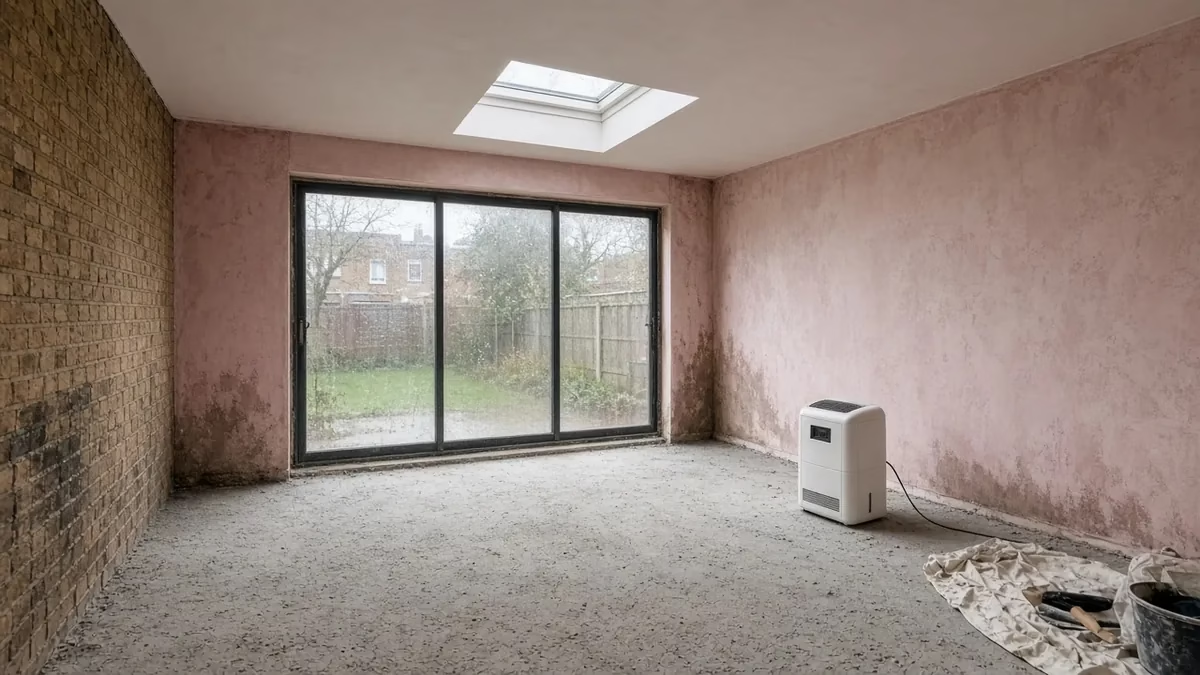
You’ve waited months for the new kitchen extension, and in its first autumn you notice streaming glass in the mornings, a musty smell, a patch of paint that won’t dry, or a dark line where the new wall meets the old house. Damp in a new extension is a common worry, and the honest answer is that it can be completely normal or a sign that something has been built wrong. The trick is telling the two apart early.
Here’s what’s normal while a new extension dries out, the signs that point to a defect, and what to do about each.
Why a new extension is wet to begin with
Building puts a lot of water into a structure. Concrete foundations and slabs, screed floors, blockwork, mortar, plaster and paint are all mixed or laid wet, and the shell often gets rained on before the roof goes on. NHBC’s guide Moisture in New Homes says up to 8,000 litres of water may go into the materials of a new home during construction. An extension is much smaller than a whole house, but the principle is the same: that water has to leave, and much of it leaves into the room.
For a new home, NHBC says you should expect it to reach a moisture-balanced state within 18 months to two years. A modern extension is also much more airtight than the old house it’s attached to, so moist air from cooking, showers and drying washing has fewer ways out.
What’s usually normal in the first year
- Condensation on the glazing, especially on cold mornings in the first winter, spread fairly evenly over glass and frames.
- A “new building” smell and slightly higher humidity than the rest of the house.
- Fine shrinkage cracks in new plaster and at joints between new and old work as materials dry. See our guide to the crack between an extension and the house for when a crack is more than that.
- White powder on new brickwork outside. That’s efflorescence, salts left behind as the bricks dry, and on new brickwork it usually fades with time and rain.
The key test is direction: normal drying-out damp gets steadily better over the months. It doesn’t get worse after rain, and it doesn’t stay concentrated in one spot.
Signs that point to a defect
A damp patch where the extension meets the house
The junction between a new roof and the existing wall is a classic weak point. Water can get in if the flashing is missing or poorly dressed, or if a cavity tray wasn’t fitted where it was needed above the new roof. Clue: the damp appears or spreads after rain, often near the ceiling on the old wall side.
Damp after rain around rooflights, lanterns or doors
Upstands and seals around rooflights and roof lanterns, and thresholds of bifold or sliding doors, are details that have to be right first time. Water marks, drips or swollen boards close to them after rain suggest a leak, not drying out. See roof lanterns vs skylights.
Damp along the bottom of the walls or floor edges
The damp-proof course in the new walls has to link up with the damp-proof membrane under the floor and with the DPC of the old house. If they don’t, or if a patio or path outside has been laid too high, moisture can get past. Our guides to a patio higher than the damp proof course and a step down into an extension cover the floor-level side.
Mould in one corner, along a beam line or on a flat-roof ceiling
Mould in one place, while the rest of the room is fine, usually means a cold spot: insulation missing or interrupted at a corner, around a steel beam or at the junction with the old wall. Mould across a flat-roof ceiling can also mean moist air getting into the roof build-up and condensing inside it. Our guide to mould on the ceiling explains how to tell condensation, cold spots and leaks apart.
A wet patch on the floor that doesn’t follow the weather
Underfloor heating or a water pipe in the screed can leak. If the heating system keeps losing pressure or the damp is in the middle of the floor, the plumbing needs checking.
What to do in the first few months
- Keep the heating on steadily at a moderate level rather than blasting it in short bursts. NHBC’s guide advises keeping a new home well heated in cool or cold weather, and steady heat dries materials more evenly than short bursts.
- Ventilate. Keep trickle vents open, run the cooker hood and any extract fans, and open windows for a few minutes when you can. If an extractor isn’t venting outside, see extractor fans not vented outside.
- Limit moisture. Avoid drying clothes on radiators in the extension and keep pan lids on.
- Don’t rush the decorating. New plaster needs to dry before it’s painted with a finish that can trap moisture. Paint applied too early is a common reason for blistering and patches.
- Keep a simple log. Photograph the same spots weekly and note the weather. If a patch grows after rain, or doesn’t improve over a couple of months, you have useful evidence.
- A dehumidifier can help speed things up, but don’t use it to mask a leak. Steady, gentle drying is better than forcing it.
If you think it’s a defect
- Tell your builder in writing as soon as you notice it, with photos and dates. Most building contracts deal with defects that appear after completion, and a good builder will want to inspect.
- Check your paperwork: the building control completion certificate, any warranty or insurance-backed guarantee, and product guarantees for the roof and glazing.
- Don’t cover it up. Repainting or treating mould without fixing the cause just delays the problem.
- Get an independent opinion if you and the builder disagree about the cause. A proper investigation looks at the outside details, the roof and the floor, not just a meter reading on the wall.
Because the first winter is when an extension usually looks its worst, it’s also worth reading our guide to why a kitchen extension can feel cold in winter: cold surfaces and condensation are closely linked.
Frequently asked questions
Is it normal to have damp in a new extension?
Some extra moisture and condensation is normal while new materials dry out, especially in the first winter. Damp that gets worse after rain, stays in one place or doesn’t improve over the months isn’t normal and should be investigated.
How long does a new extension take to dry out?
It depends on the materials, weather, heating and ventilation. For whole new homes, NHBC says to expect a moisture-balanced state within 18 months to two years; most of the visible drying happens in the first year.
Why is there condensation in my new extension?
Construction moisture is still drying out, the room is airtight, and large areas of glazing are cold on winter mornings. Steady heating and good ventilation usually help.
Who is responsible for damp in a new extension?
If it’s caused by a building defect, it’s usually the builder’s responsibility under your contract, and possibly a warranty. Report it promptly in writing.
Worried about damp in your extension?
We look at the roof junctions, glazing details, floor levels and ventilation before suggesting anything, so you know whether you’re dealing with drying out or a defect. See our house extension service in London and our damp survey service, request a quote and project review, call 020 7971 1318 or message us on WhatsApp.
General information only. Contract and warranty terms vary; check yours. Sources checked on 17 November 2026.