
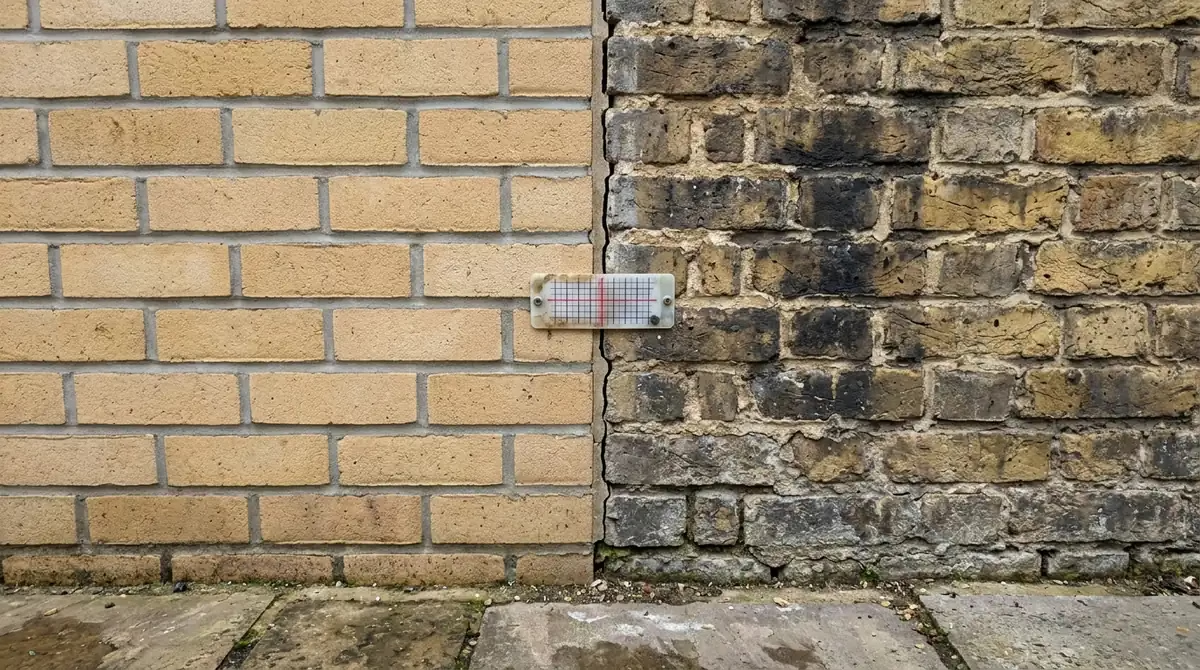
A vertical crack where a rear or side extension meets the original house is one of the most common things London homeowners notice a year or two after a build, or spot on a viewing. Sometimes it’s a fine line in the paint. Sometimes it’s a gap you can see daylight through. The question everyone asks is the same: is this just settling, or is the extension moving away from the house?
This guide explains why cracks form at that junction, how to judge how serious one is, what to record, and who to call. It’s general information, not a diagnosis. Anything beyond a hairline crack deserves a look from a qualified professional.
Why cracks appear where an extension meets the house
The junction is where two different structures meet. In a typical London terrace or semi:
- The foundations are different. A Victorian or Edwardian house may sit on shallow brick footings. A modern extension sits on deeper concrete foundations designed to current standards. The two parts can respond differently to the ground.
- The materials are different ages and types. New brick, block and mortar shrink slightly as they dry out, while older lime-mortared brickwork has long since settled. Plaster and paint across the joint will often crack as the new work dries, especially in the first year or two.
- The ground moves seasonally. Much of London is built on clay. The British Geological Survey explains that clay soils shrink when they dry and swell when they get wet, which can move shallow foundations, particularly in hot, dry summers and where trees draw moisture from the soil (BGS: swelling and shrinking soils).
- How the two were joined. Extensions are usually connected to the house with wall-starter ties or by toothing new brickwork into the old. A rigid connection, render or plaster carried straight across the joint, or no allowance for movement can all concentrate cracking at that line.
So a crack at the junction is common and doesn’t automatically mean something is wrong. The point is to work out whether the movement is small and finished, or continuing.
How serious is it? Using the BRE crack categories
Surveyors, engineers and insurers commonly use BRE Digest 251, Assessment of damage in low-rise buildings, to describe crack damage. BRE summarises it like this: categories 0, 1 and 2, with crack widths up to 5mm, can generally be regarded as aesthetic issues needing only redecoration. Categories 3 and 4 are generally serviceability issues affecting weather-tightness and the operation of doors and windows. Category 5 presents stability issues likely to need structural intervention (BRE: assessing cracks in houses).
A council fact sheet based on the Digest gives the first bands as:
- Category 0: hairline cracks under 0.1mm.
- Category 1: fine cracks up to 1mm.
- Category 2: cracks up to 5mm.
- Category 3: cracks of 5–15mm, or several cracks of 3mm or more.
(Babergh District Council: cracks and structural issues fact sheet.) The same fact sheet notes that the edge of a one pound coin is about 3mm, a handy reference if you don’t have a crack gauge.
BRE stresses that width alone is a simplification. Whether a crack is getting wider over time can change the assessment, and so can its shape and what else is happening around it.
Signs that mean you should get it looked at
Book an inspection by a structural engineer or a chartered building surveyor if you notice any of these:
- The crack is wider than about 5mm, or wider at one end than the other (tapered).
- It’s getting wider, or keeps reopening after being filled.
- It shows both inside and outside at the same point.
- It’s diagonal or stepped through the brickwork rather than following the straight joint.
- Doors or windows in the extension have started to stick, or the floor has started to slope.
- The roof junction has opened up: split or lifted flashing, gaps where the extension roof meets the house wall, or damp appearing along the joint.
- You can see daylight or feel a draught through it.
- There are large trees nearby, or you’ve had a drain or water leak close to the extension.
Leaking drains and water pipes are worth a special mention. They can soften or wash out the ground under foundations, which is why an engineer may ask for a drain survey as part of the investigation.
What to do now
- Don’t fill it straight away. Filling hides the evidence. If you need to know whether it’s moving, you need to see it.
- Photograph and measure it. Put a ruler or tape next to it, photograph it square-on, and note the date. Mark the ends of the crack in pencil with the date so you can see if it lengthens.
- Repeat over time. Every few weeks, and across seasons if you can. Clay-related movement often shows a seasonal pattern.
- Check outside. From the ground, look at the external joint, the roof flashing, the gutters and downpipes at the junction, and any paving or drainage gullies near the extension.
- Find the paperwork. Building control completion certificate, structural calculations, drawings and any warranty for the extension. If the extension is recent, contact the builder and, if there’s a warranty, check what it covers and the notification deadlines.
- Get professional advice if any of the warning signs above apply. An engineer may recommend proper crack monitoring with gauges fixed across the crack over several months before deciding on a repair.
If you suspect subsidence, also speak to your buildings insurer early. Policies have their own claims processes and you don’t want to have started repairs before they’ve seen it.
How the repair usually depends on the cause
There’s no single fix, which is why the diagnosis matters:
- Cosmetic cracking in finishes at the joint can often be raked out and filled with a flexible filler when you next decorate, or covered with a neat cover strip internally.
- A movement joint that was never formed may be cut and sealed with a suitable flexible sealant outside, once the movement is confirmed as stable.
- Failed roof flashing at the junction needs repairing quickly, because water getting in there can cause damp and timber decay.
- Ongoing ground movement is an engineering problem. Depending on the cause, it may involve dealing with leaking drains, managing trees, or in more serious cases foundation work designed by an engineer.
Repointing or filling a joint without understanding why it opened usually just means the crack comes back.
If you’re planning an extension: designing the junction properly
A lot of junction cracking can be anticipated at design stage. With a new extension it’s worth asking your designer and builder:
- What foundation depth and type the engineer has specified, especially near trees on clay (see our guide to extending near trees).
- How the new walls will be tied to the existing house, and whether a movement joint is needed at the junction.
- How the roof will be flashed into the existing wall.
- Where existing drains run, and whether any will be built over or need protecting.
- Whether the work affects a party wall or a neighbour’s foundations (see our Party Wall Act guide for extensions).
It’s also normal for new plaster to show fine shrinkage cracks as an extension dries out. Those are usually dealt with at the first redecoration, not with structural work.
Frequently asked questions
Is a crack between an extension and the house normal?
Fine cracking at the junction is common, because the two structures were built at different times on different foundations and with different materials. It’s the width, the shape and whether it’s still moving that tell you if it matters.
How wide a crack should I worry about?
Under BRE Digest 251, cracks up to 5mm are generally aesthetic. Get professional advice for anything wider, anything tapered or growing, or any crack with sticking doors, distortion or damp.
Does a crack mean my extension has subsidence?
Not necessarily. Drying shrinkage, thermal movement and minor settlement are more common causes. Subsidence is one possibility, especially on clay near trees or leaking drains, and needs investigating by a professional.
Should I fill the crack?
Not until you know whether it’s still moving. Measure and photograph it over time first, then repair according to the cause.
Planning a house extension in London?
When we scope an extension, the junction with the existing house, the foundations and the roof flashing are part of the conversation from the start, alongside your designer and structural engineer. See our house extension service in London, request a project review, or call 020 7971 1318.
General information only. If you’re worried about structural movement, get advice from a structural engineer or chartered building surveyor. Sources checked on 9 November 2026.