
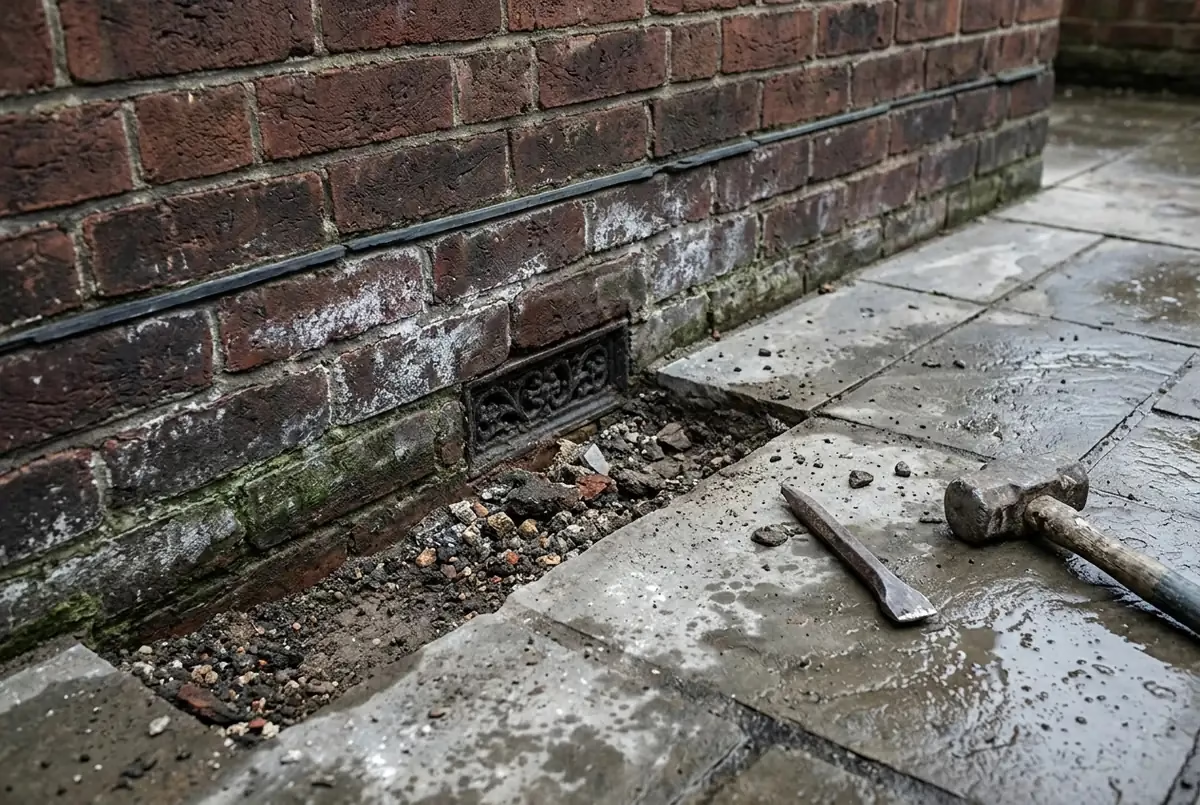
A new patio can transform a London garden. But if it’s been laid right up to the back wall, at or above the line of the damp-proof course, you may start to notice damp along the bottom of the inside wall, tide marks on the plaster, swollen skirting or a musty smell under the floor. And it’s often the first thing a surveyor points out when they walk around the outside of a house.
Here’s why ground or paving height matters, how to check your own wall, and the realistic ways to fix it, usually without injecting a new damp-proof course.
Why the patio height matters
A damp-proof course (DPC) is a barrier built into the wall near ground level to stop moisture from the ground rising into the brickwork. In many older London houses it’s a course of slate or bitumen felt, visible as a thin line in the mortar a couple of bricks above the ground. Some very old houses don’t have one at all.
A DPC only works if the ground outside is below it. For new walls, Approved Document C (paragraph 5.5) says an external wall’s DPC should be at least 150mm above the level of the adjoining ground, unless another part of the building protects the wall. That’s roughly two brick courses. The RICS consumer guide on bridged DPCs and raised ground uses the same two-brick rule of thumb for paths.
When a patio is laid higher than that, two things happen:
- The DPC is “bridged”. Moisture in the paving, bedding and soil can move into the bricks above the DPC, bypassing it altogether.
- Rain splashes back. Water bouncing off a hard surface wets the wall above the DPC. RICS notes this splashing as a source of moisture in its example.
The important point from the RICS guide is that in this situation the DPC has not failed and does not need replacing. The problem is the ground level around it.
How to check your own wall
- Find the DPC line outside. Look for a thin dark line, a slate edge or a different mortar joint near the bottom of the wall. Inside, it should line up roughly with or below your floor level.
- Measure from the DPC down to the patio surface. If it’s less than about 150mm, or the patio is at or above the line, the DPC may be bridged.
- Look for buried air bricks. Many Victorian and Edwardian houses in London have suspended timber ground floors ventilated by air bricks. If the patio has covered or half-buried them, the void under the floor can’t ventilate properly. If you have a musty smell under the floorboards, see musty smell under floorboards.
- Check the falls. Does rain run towards the house and pool against the wall? Is there a downpipe emptying onto the slabs?
- Compare with the inside. Damp that lines up with the stretch of wall behind the raised patio, and is worse after rain, points towards bridging rather than a whole-house problem.
A raised patio isn’t the only thing that can bridge a DPC. Render taken down over it, soil in a flower bed piled against the wall, or a new internal floor laid higher than the DPC can do the same. That’s why the diagnosis matters: our guide to rising vs penetrating damp explains how the different causes look.
The realistic fixes
1. Lower the paving next to the wall
The most direct fix is to bring the finished surface back down to at least 150mm below the DPC, at least along the strip next to the house. Sometimes the whole patio has to be relaid. More often a band along the wall can be lowered and the rest left in place.
2. Form a drained margin or channel along the wall
Where the patio can’t come down far enough, for example because it has to meet a door threshold, a common approach is to cut a narrow strip away from the wall and form a gravel margin or a channel drain that takes water away. The detail must actually drain somewhere suitable, and the paving should stop short of the wall rather than pressing against it.
3. Free up air bricks and sort out rainwater
Re-expose any buried air bricks, or extend them properly, so the floor void can ventilate. Make sure downpipes discharge into a gully or drain rather than onto the slabs, and set falls so water runs away from the house.
4. Let the wall dry before redecorating
Once the source is removed, a solid brick wall can take a long time to dry. Salt-contaminated plaster may need replacing rather than repainting. Our guide to plastering after damp work covers what to use.
What usually isn’t the answer
A chemical injection DPC doesn’t solve a bridging problem, because the moisture route goes around the existing barrier, not through it. Sealing the face of the wall or tanking the inside can simply move the moisture somewhere else. Before you pay for treatment, read is a chemical DPC injection worth it? and damp survey vs damp-proofing quote.
Planning a new patio or extension?
If you’re about to lay a new patio, or the patio is being rebuilt as part of an extension, design the levels before the slabs arrive. Set the finished surface below the DPC and the air bricks, with falls away from the house, and decide how a level threshold will be drained. It is far cheaper to get right first time.
Frequently asked questions
How far below the damp-proof course should a patio be?
Approved Document C guidance for new walls is that the DPC should be at least 150mm above the adjoining ground, roughly two brick courses. That’s the usual benchmark for paving next to a house.
Can a patio cause rising damp?
It can cause damp at the base of the wall that looks like rising damp. The DPC hasn’t failed; the patio has bridged it and rain splashes onto the wall above it.
Do I have to lift the whole patio?
Not always. Lowering or cutting back a strip along the wall and forming a drained margin or channel often deals with the problem.
Will injecting a new DPC fix it?
Not if the existing DPC is simply being bridged. The ground level needs correcting first.
Damp at the bottom of your walls in London?
We start with the outside of the house: levels, paving, air bricks and rainwater, before recommending anything inside. See our damp survey service and damp proofing in London, request a project review, or call 020 7971 1318.
General information only. Every wall is different; get the cause confirmed before paying for treatment. Sources checked on 10 November 2026.