
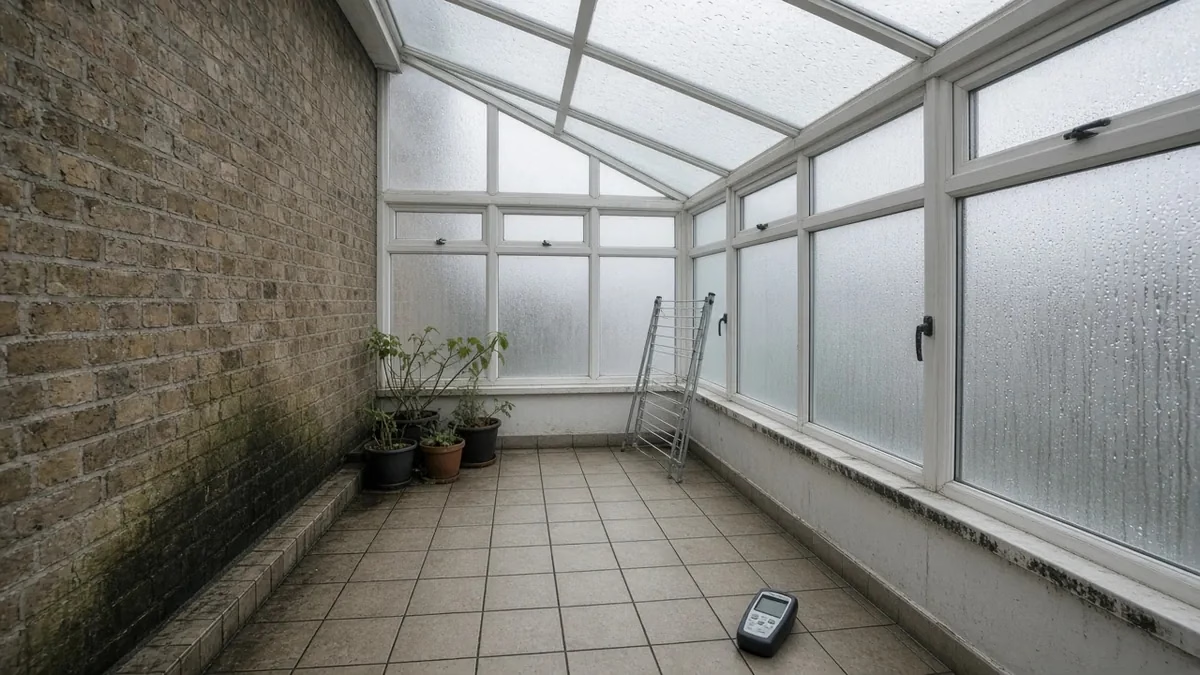
Water running down the glass on a winter morning, a musty smell, black spots on the frames, a tiled floor that’s wet for no obvious reason, or a damp tide mark on the old house wall inside: damp in a conservatory is common, and it’s one of the reasons people stop using the room for half the year. The good news is that the cause is usually one of a small number of things, and the pattern of the damp tells you which.
This guide explains how to tell condensation from leaks and ground moisture in a conservatory, what to check yourself, and what changes the building regulations position if you try to fix it by heating or opening up the room.
Where and when: the quickest way to narrow it down
- Water on the inside of the glass and frames, worst on cold mornings, spread over large areas: almost always condensation.
- Drips or wet patches after rain, in one place: a leak in the roof, a roof-to-wall junction, a gutter or a frame seal.
- Damp at the base of the dwarf walls or the old house wall, present in dry weather, sometimes with salts or a tide mark: ground moisture getting past a damp-proof course or membrane, or the damp-proof course being bridged.
- A wet patch that doesn’t follow the weather at all: think plumbing, such as a radiator pipe in the floor, an outside tap pipe through the wall or a washing machine connection.
Keep a note for two or three weeks of the weather, the time of day and where the water is. It’s the most useful thing you can give anyone you ask to look at it.
Condensation: the most common cause
Glass and frames are the coldest surfaces in most homes, and a conservatory has a lot of them. When warm, moist air reaches them it cools and the moisture turns to water. RICS’s consumer guide describes condensation forming on the coldest surfaces in a room when temperatures drop or humidity is high, and lists drying clothes indoors, poor ventilation and not heating enough among the things that make it worse. Conservatories often get all three: washing dried in them, vents shut in winter and the heating off.
The moisture usually comes from the house, not from the conservatory itself. If the doors between the house and the conservatory are left open, warm air from the kitchen or living room flows in and condenses on the glass.
What helps
- Open roof vents and trickle vents and keep them clear; if there aren’t any, ask about adding some.
- Don’t dry washing in the conservatory, and keep the doors to the house closed when it’s cold.
- Keep a steady, moderate temperature rather than letting it go very cold and then heating it hard.
- Wipe frames and sills down on cold mornings so water doesn’t sit in the corners.
- Check the glazing: steamed-up double glazing (moisture between the panes) means the sealed unit has failed, and a cold, failed unit or an old single-glazed or polycarbonate roof will always attract more condensation.
Our guide to mould after new windows covers the same mechanism in the main house.
Leaks: roof, junction, gutters and frames
If the water follows the rain, look at:
- The roof: slipped or cracked panels, perished seals and gaskets, and failed glazing bars, especially on older polycarbonate roofs.
- The junction with the house wall: where the conservatory roof meets the brickwork it should be protected by a flashing, and in a cavity wall often a cavity tray. A flashing that has pulled away, or a junction that relies on sealant alone, lets water run down inside the wall and appear lower down.
- Gutters and box gutters: conservatory gutters fill with leaves, and a blocked box gutter overflows into the room. Check the downpipe discharges somewhere sensible rather than onto the base of the wall.
- Frames and doors: blocked drainage slots and failed seals let water track into the frame and out onto the floor.
Look from the ground or through the glass with binoculars rather than climbing onto a conservatory roof; most roof panels aren’t designed to take a person’s weight.
Ground moisture: base, dwarf walls and the old house wall
Many conservatories are built on a concrete base with low brick or block dwarf walls. Approved Document C (paragraph 4.2) says floors next to the ground should resist the passage of ground moisture to the upper surface, which in a solid floor normally means a damp-proof membrane. A conservatory base laid without one, or with a membrane that doesn’t link to the damp-proof course in the walls, can let moisture up into the floor finish.
Things to check:
- Ground levels outside the dwarf walls: paving, soil or gravel at or above the damp-proof course bridges it. Our article on a patio higher than the damp-proof course explains why and how to fix it.
- The old external wall of the house, now inside the conservatory: its damp-proof course and the conservatory’s may be at different levels, there may be old air bricks or redundant openings, and anything leaning against it outside before the conservatory was built (soil, a raised bed) may still be there under the base.
- Tile floors: water under or between tiles, or tiles lifting, can be ground moisture, condensation on a cold floor, or a leak tracking across from the walls.
Low-level damp is often labelled rising damp. Check the simpler causes, such as bridging, leaks and condensation, before paying for a chemical damp-proof course. Our guide to rising damp vs penetrating damp explains how to tell them apart.
Heating it or opening it up? Check the rules first
A common reaction to a cold, damp conservatory is to extend the house heating into it or take out the doors between the conservatory and the house. Both can change its status under the building regulations. The Planning Portal says conservatories are normally exempt when they’re at ground level and under 30 square metres, separated from the house by external quality walls, doors or windows, have an independent heating system with separate temperature and on/off controls, and have glazing and fixed electrics that comply. It also says any new structural opening between the conservatory and the house needs building regulations approval, even if the conservatory itself is exempt.
So removing the separating doors, or connecting the conservatory to the main central heating, can mean it’s treated as an extension that has to meet the regulations, including energy efficiency. If you’re at that point, it may be time to think about replacing it; see our guide to replacing a conservatory with an extension.
What a damp inspection should cover
A proper inspection of a damp conservatory looks at the whole room and the house wall behind it, not just a meter reading on one wall. It should cover the glazing and seals, the roof and junction flashings, gutters and downpipes, ground levels and the damp-proof course outside, the floor and any services in it, how the room is heated and ventilated, and how it’s used. You should get a written explanation of the cause, not just a treatment.
Frequently asked questions
Why is my conservatory so damp in winter?
Usually condensation: warm, moist air reaching very cold glass and frames. Ventilation, keeping the doors to the house shut, not drying washing there and keeping a steady temperature all help.
Why is my conservatory floor wet?
Condensation on a cold tiled floor is common, but water can also come from a roof or gutter leak, failed door seals, a pipe in the floor, or ground moisture through a base without an effective damp-proof membrane.
Can a conservatory have rising damp?
Ground moisture can affect a conservatory base and dwarf walls, especially if the damp-proof course is bridged or the membrane is missing. Rule out bridging, leaks and condensation first.
Can I connect my conservatory to the central heating?
The Planning Portal says exempt conservatories should have an independent heating system with separate controls. Extending the main heating into it can mean it needs to meet the building regulations as an extension, so check first.
Damp conservatory you can’t get on top of?
We trace the cause from the roof and junctions down to the base before recommending anything. See our damp survey service and damp proofing guide for London homes, request a quote and project review, call 020 7971 1318 or message us on WhatsApp.
General information only. Sources checked on 20 November 2026.