
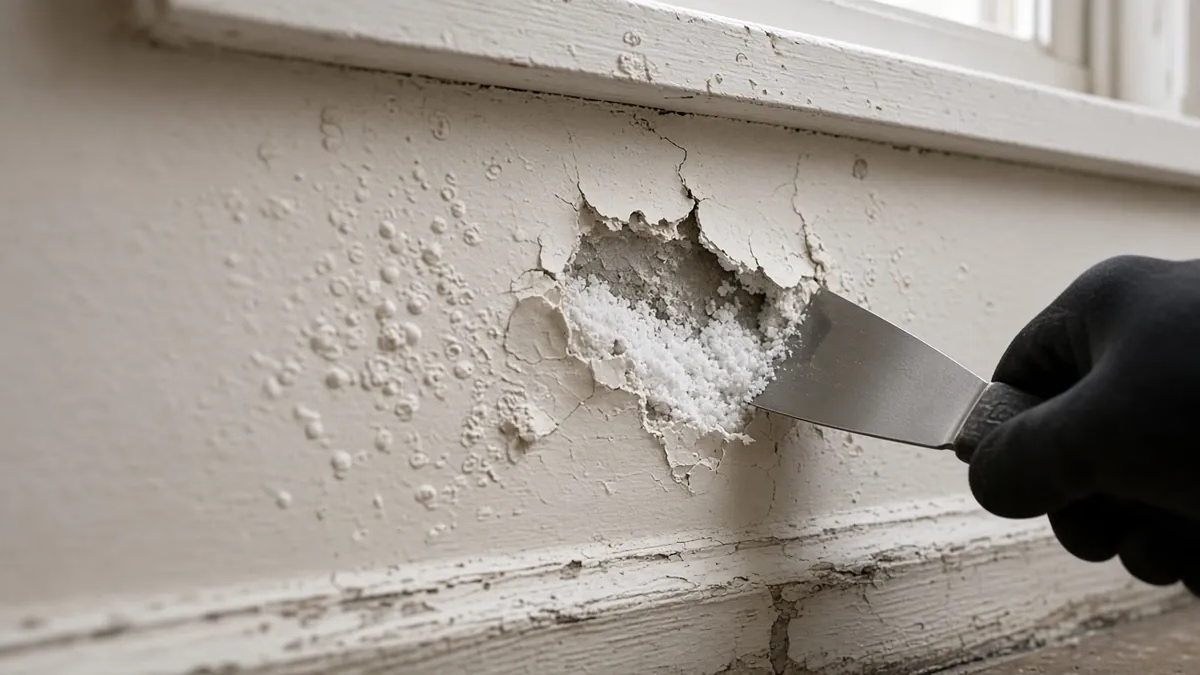
Paint that bubbles, blisters or lifts off a wall in a London house is one of the first things people notice when something is wrong, and one of the easiest to misread. Sometimes it’s damp coming through the wall. Sometimes it’s salts left behind by old damp, condensation in a cold room, or simply paint put on new plaster too soon. Repainting over it without knowing which won’t last, and treating it as rising damp when it isn’t can cost far more.
This guide explains the common causes of paint bubbling on a wall, the simple checks you can do yourself, and the right order to fix it.
First, look at what’s inside the bubble
Gently open one blister with a scraper or your fingernail (wear gloves and don’t sand old paint, which in older houses may contain lead). What you find is a strong clue:
- Water or a wet, dark surface behind: moisture is coming through the wall or from a leak, now.
- White, fluffy or crystalline powder: salts. They’re carried to the surface by water and left behind when it evaporates; see our guide to efflorescence on walls.
- Crumbly, soft or powdery plaster: the plaster itself has been damaged, often by long-term damp or salts.
- Dry, sound plaster with the paint simply lifting off: more likely a decoration problem, such as poor adhesion, dust or an incompatible old finish underneath.
Where it is tells you a lot
- A band along the bottom of a ground-floor wall: could be ground moisture, but also bridging from high ground levels or render, a leaking pipe in the floor, or salts. Don’t assume rising damp.
- Below a window, under a gutter or downpipe, or high up near the ceiling on an outside wall, worse after rain: rain getting in from outside.
- On a chimney breast: often salts from old flue deposits, which can attract moisture even when the wall is otherwise dry.
- In a bathroom, kitchen or cold bedroom corner, worse in winter, often with black mould: condensation.
- Near pipes, a radiator, a bath or shower, and not linked to the weather: a plumbing leak. Bubbling paint behind a radiator is common and has its own causes; see damp behind a radiator.
- On a wall that was replastered recently: the plaster may not have dried before painting, or the wrong paint was used.
The main causes in more detail
Rain getting in (penetrating damp)
Water from outside soaks into the wall and pushes the paint off from behind. RICS’s consumer guide on damp and mould lists the usual external defects to check: leaking or blocked gutters and rainwater pipes, ill-fitting doors and windows, roofing defects, poor pointing, cracked render, and raised ground levels next to walls. In London’s solid-walled Victorian and Edwardian houses there’s no cavity to stop rain crossing the wall, so external defects show inside more readily. Hard cement render can also trap water in an old wall; see cement render and damp.
Salts from earlier damp
The Property Care Association’s code of practice on dampness explains that hygroscopic salts absorb water vapour from the air, so walls containing them can be intermittently damp even with no source of liquid water. It also notes that combustion gases in chimney flues can deposit salts in chimney breasts, which is frequently misdiagnosed as penetrating damp. Salts are why paint often bubbles again after a leak has been fixed: the plaster is still contaminated and keeps pulling in moisture on humid days.
Condensation
RICS describes condensation forming on the coldest surfaces in a room when temperatures drop or humidity is high, commonly around windows, on external walls and on ceilings close to external walls. In a bathroom without effective extraction, repeated condensation can soften the paint film and make it blister.
Ground moisture and bridging
Low-level bubbling can be caused by moisture from the ground, but the SPAB warns that rising damp is widely misdiagnosed on the basis of electrical moisture meter readings alone, because salts can give high readings on walls that are virtually dry. Check ground levels, render, leaks and condensation first.
New plaster painted too soon
Fresh plaster holds a lot of water. Plaster manufacturers, including British Gypsum, say finishing plaster should be thoroughly dry before it’s finally decorated, though a permeable mist coat can be applied while it’s still drying. A vinyl or other low-permeability paint applied too early can blister as the water tries to get out.
The wrong paint on an old wall
Many older London houses have lime plaster or old distemper finishes. Modern low-permeability paints and some coatings on solid walls can trap moisture that would otherwise evaporate from the surface. The SPAB, writing about brickwork, warns that paints and water-repellent solutions can cause additional deterioration by trapping moisture. On old walls, the paint system needs to suit the wall.
Fix it in the right order
- Find the source. Leak, rain, condensation, ground moisture or salts. A meter reading alone isn’t a diagnosis.
- Stop the moisture. Repair the gutter, pointing, flashing, render or pipe, or improve ventilation and heating for condensation.
- Let the wall dry. Solid walls can take a long time to dry out after a leak, and rushing to redecorate is the most common reason the bubbles come back.
- Remove damaged or salt-contaminated plaster rather than painting over it.
- Replaster with a suitable system. Our guide to plastering after damp proofing covers the choices, including breathable materials.
- Redecorate with a paint that suits the wall, following the plaster and paint manufacturers’ guidance on drying and preparation.
Frequently asked questions
Does bubbling paint always mean damp?
No. It often does, but paint also lifts because of poor preparation, painting over dust or an incompatible old finish, or painting new plaster before it’s dry. Open a blister and look at where it is before deciding.
Can I just scrape it off and repaint?
Only if the cause is a decoration problem and the plaster is sound and dry. If moisture or salts are behind it, the bubbles will come back.
Why does the paint keep bubbling after the leak was fixed?
Usually because the wall hasn’t fully dried, or salts left in the plaster keep drawing in moisture from the air. Contaminated plaster often has to be replaced.
Is bubbling paint near the floor rising damp?
Not necessarily. High ground levels, bridged damp-proof courses, leaking pipes, condensation and salts can all cause low-level bubbling. Get it diagnosed before paying for a chemical damp-proof course.
Paint bubbling and not sure why?
We look at the wall, the outside and the room together and tell you what’s causing it before suggesting any work. See our damp survey service and damp proofing guide for London homes, request a quote and project review, call 020 7971 1318 or message us on WhatsApp.
General information only. Sources checked on 20 November 2026.