Physical address:
128 City Road, EC1V 2NX, London,UK

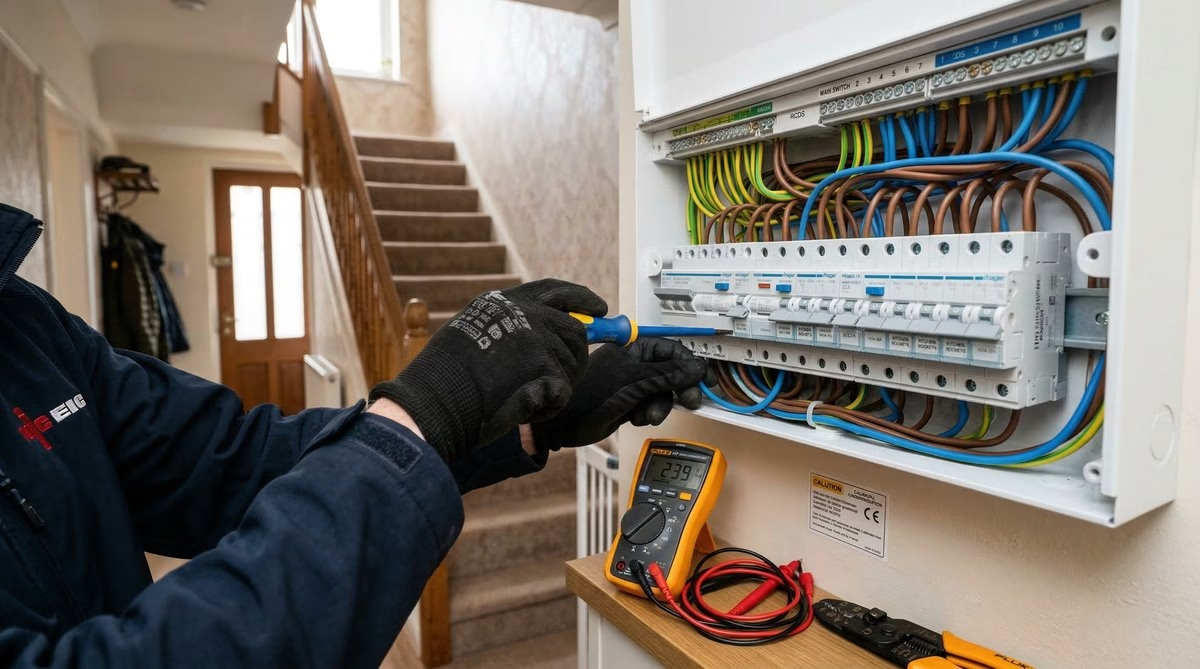
If you have been collecting quotes for a consumer unit upgrade hidden extras remedial faults testing UK homeowners regularly overlook, you have probably noticed a wide spread of prices with very little explanation. What most quotes fail to tell you is that the consumer unit itself is often the least complicated part of the job. The real unknowns live in your cables and in the earthing arrangement your current board has been silently masking for decades. This article is about what testing reveals — and how to approach a quote so those discoveries do not blindside you.
Why a consumer unit swap is never “just a board change” — what testing reveals
There is a phrase we hear from homeowners almost every week: “The last electrician said it was just a straightforward board change.” We understand why electricians say it — until the old board is off the wall and the installation is live in front of an insulation resistance meter, many faults are genuinely invisible. But a properly conducted consumer unit upgrade is not complete until every circuit has been tested to the requirements of BS 7671 — the IET Wiring Regulations — and every finding has been documented on an Electrical Installation Certificate.
Testing is not a tick-box exercise. When we apply an insulation resistance test to an older ring final circuit, we are putting a 500-volt DC signal across the insulation of every metre of cable on that ring. Ageing rubber insulation, cables running through damp cavities, conductors nicked by screws over the years — all of these show up as a low or zero megaohm reading. A circuit that appeared functional under normal 230-volt AC can fail under test, because the test is deliberately harsher than operating conditions. The purpose is to find weakness before it finds you.
On a board change in a 1930s semi in Croydon last autumn, we found four circuits with insulation resistance readings well below the 1 MΩ minimum required. The homeowner had no symptoms: lights worked, sockets worked, nothing had tripped. But the cables were original vulcanised rubber and two were running through a section of wall that had suffered historic damp — none of it visible without a meter. Identifying and explaining that to the homeowner before we proceeded, rather than simply reconnecting the circuits to the new board, is the difference between compliant electrical work and dangerous work dressed up as a board change.
Beyond insulation resistance, a full upgrade involves continuity testing of every protective conductor, polarity checks on every socket and light fitting, earth fault loop impedance verification on every circuit, and a functional test of every RCD and RCBO on the new board. On a typical three-bedroom house with eight to twelve circuits, that testing regime alone takes two to three hours. Any quote suggesting a board change can be completed, tested, and certified in under half a day on a pre-1990s property should prompt questions, not celebration.
The most common remedial faults — old tails, missing bonding, dodgy ring finals, and TT earthing
Understanding the categories of fault we most commonly encounter helps you budget realistically and evaluate quotes intelligently. These are not exotic problems — they are the standard inventory of an ageing UK housing stock that has been incrementally modified and bodged over generations.
Old service tails and meter tails. The cables running from your electricity meter to the consumer unit are called tails. In properties built before the 1970s, these are frequently still original lead-sheathed or rubber-insulated cables — often undersized, with degraded insulation, and too short to reach a modern consumer unit. Replacing tails requires coordination with your distribution network operator because the incoming supply side must be isolated before work can begin. DNO call-out costs typically add £150 to £350 to a job. Some electricians include a provisional allowance in their quotes; many do not.
Missing or inadequate main protective bonding. Every metal service entering your property — gas pipework, water pipework, oil supply — must be bonded to earth with a conductor of the correct cross-sectional area, connected as close as possible to the point of entry. We see missing bonding on the majority of properties built before 1980. Fitting it is a relatively quick task — an hour or two of work plus materials — but it is a non-negotiable requirement and will be flagged as a C2 observation on your Electrical Installation Certificate if absent.
Ring final circuit faults. A ring final is the wiring configuration used for most UK socket circuits — a loop of cable that starts and ends at the consumer unit, with sockets connected along the way. It is uniquely vulnerable to DIY intervention. We tested a flat in Greenwich last spring and found a ring final that measured correctly at the board but had a hidden open circuit mid-ring — someone had extended it years earlier using an unfused junction box that had since corroded. The circuit was technically live but without ring integrity, half the sockets were running on a radial with undersized cable. That is exactly the kind of fault a board change uncovers and that a responsible electrician cannot simply reconnect.
TT earthing and electrode condition. Properties not connected to the network’s earth — typically older homes on overhead supplies — rely on a metal rod driven into the ground. The resistance of that electrode changes over time, and a value above 200Ω will prevent your RCDs from operating fast enough to protect against electric shock. Electrode replacement or supplementation typically costs £150 to £400 — not enormous, but it is something many electricians only discover when they measure earth fault loop impedance at the end of a job rather than the beginning.
How to tell if your quote accounts for extras — or if you’ll get a nasty phone call mid-job
Most electricians quote a fixed price for the board, its installation, and the certification paperwork. That price is competitive because they are quoting what they know. What they do not know is the condition of your existing installation. The question to ask is not “what does the quote include?” but “what happens when testing finds a fault?”
A well-structured quote should contain: the new consumer unit and all protective devices (confirm MCBs or RCBOs — a full RCBO board costs more but offers better protection); full testing labour; an Electrical Installation Certificate from a Part P-registered competent person; and any known additional materials. It should also contain a clearly stated policy on remedial works — either a contingency allowance for likely faults, or agreed fixed prices for common remedial tasks. What you should not accept is “additional works charged as required” with no indication of what those works might cost.
Ask these questions before accepting any quote: Is the price based on MCBs or RCBOs? Does it include new meter tails if required? What is your process when testing reveals a C1 or C2 fault — will you notify me in writing before proceeding? Are you registered with a competent person scheme such as NICEIC, NAPIT, or ELECSA?
We worked on a property in Lewisham where a previous electrician had fitted a new consumer unit, issued a certificate, and left — having noted three C2 faults on the certificate but never discussed them with the homeowner and never carried out any remedial work. The homeowner had a piece of paper that looked like compliance but an installation that was still potentially dangerous. This is not an isolated example. Understanding what the certificate should say, and what the quote should commit to, is the most effective protection you have against that outcome.
What a responsible electrician does when they find a fault — C1, C2, C3 codes explained
When a UK electrician issues an Electrical Installation Certificate following a consumer unit upgrade, they classify observations using a coding system defined in BS 7671. Understanding these codes helps you interpret the paperwork and understand what action — and what cost — a finding requires.
C1 — Danger present, risk of injury. A C1 code means the fault poses an immediate risk of electric shock or fire. A responsible electrician will not leave a C1 fault in place. They will either rectify it before completing the job and charge accordingly, or isolate the affected circuit, clearly label it as not in service, and provide a written explanation of what is required to bring it back into use. A consumer unit upgrade that concludes with a C1 on the certificate and no action taken is not a completed job — it is a liability.
C2 — Potentially dangerous, urgent remedial action required. C2 faults represent a significant risk that requires attention. Missing main protective bonding is a typical C2. A ring final with an open circuit is a C2. An EICR with C2 observations will not be issued as satisfactory, and a mortgage lender or building insurer who sees a C2 on a report may require evidence of remediation. When we find a C2 during a consumer unit upgrade, our standard practice is to pause, photograph the finding, and speak to the homeowner on the day — not in a report they receive by email three days later. We explain what we have found, what it will cost to fix, and what the consequence of not fixing it is. We do not proceed without agreement, and we do not conceal findings.
C3 — Improvement recommended. A C3 observation indicates something that does not meet current best practice but is not inherently dangerous. C3 observations do not prevent the issuing of a satisfactory certificate, and remedial work is advisory rather than mandatory. We include them for completeness and transparency, but we are clear with homeowners about the distinction between advisory and essential.
How Fixiz handles consumer unit upgrades — pre-test, transparent pricing, no bill shock
We have carried out consumer unit upgrades across London — in Edwardian terraces in Hackney, 1960s council-built flats in Southwark, Victorian conversions in Brixton, and new-build apartments in Canary Wharf — and no two jobs are the same. What is consistent is our process, because process is what prevents surprises.
Before we quote for any consumer unit upgrade, we carry out a brief visual inspection of the existing installation — the current board, visible wiring, the earthing arrangement, and the meter tails. This takes twenty minutes and costs nothing. It allows us to identify obvious risk factors before we price the job: are the tails original? Is the earthing arrangement TT or TN-S? Is there evidence of DIY additions to the ring finals? Based on that inspection, we provide a quote that distinguishes between the fixed-price elements and the contingency items — specifically, what we will charge if testing reveals the most common categories of fault.
We fitted a replacement board in a mid-terrace in Tooting two months ago. The pre-quote inspection flagged that the property was on a TT earthing system and that the existing electrode had not been tested in over a decade. We included a line in the quote for electrode replacement if the measured resistance exceeded 200Ω. On the day of the upgrade, the electrode measured 280Ω — above the limit. We replaced it within the day’s work, at the price already agreed, with no surprise call to the homeowner and no delay to certification.
Our consumer unit upgrades use full RCBO boards as standard. Each circuit has its own residual current device, which means a fault on one circuit does not trip the protection for the rest of the house. We issue every upgrade with a full Electrical Installation Certificate, signed by the installing electrician, and we notify every job to Building Control under Part P of the Building Regulations. You receive the certificate, the notification reference, and a clear record of every test result — documentation that has tangible value for insurance, for property sale, and for your own peace of mind.
Frequently asked questions
How much extra should I budget for remedial works during a consumer unit upgrade?
Properties built before 1970 should carry a contingency of £300 to £600 — covering missing bonding, meter tail replacement, and basic ring final rectification. Properties built between 1970 and 1990 should allow £150 to £300. Properties built after 1990 are less likely to produce surprises, though not immune. Choose an electrician who carries out a pre-quote inspection and provides a written breakdown of likely contingencies.
Can an electrician legally refuse to reconnect a circuit if testing finds a fault?
Yes — and a responsible one will. An electrician who connects a known C1 fault to a new board and certifies the installation is issuing a false certificate and potentially breaching their duty of care. The options when a circuit fails testing are: rectify the fault within the current job, isolate the circuit with a written explanation, or decline to certify. If an electrician says “I’ll reconnect it for now and sort the fault later,” treat that as a warning sign.
What is the difference between an MCB board and a full RCBO consumer unit?
An MCB board uses a single or dual RCD protecting groups of circuits. A full RCBO board gives every circuit its own combined overcurrent and residual current protection. On an MCB board, a leakage fault on one circuit trips the RCD and cuts power to everything it protects — including the fridge and alarm system. A full RCBO board isolates the fault to the individual circuit, which is the specification we fit as standard.
Do I need a new consumer unit if my EICR came back with C2 observations?
Not necessarily. C2 observations mean faults requiring remediation — but those faults may be unrelated to the consumer unit itself. If your current board is relatively modern and correctly specified, the C2 items may be addressable without a board change: missing bonding conductors, a ring final fault, a damaged socket. If your consumer unit is an old rewireable fuse board or a plastic-cased board without RCD protection, upgrading it alongside the remediation is strongly advisable. We are happy to discuss the most cost-effective approach.
How long does a consumer unit upgrade take when remedial faults are found?
A straightforward upgrade with a clean test result takes four to six hours on a typical three-bedroom property. When testing reveals remedial faults, the additional time depends on their nature: missing bonding adds one to two hours; a ring final fault adds one to four hours depending on access; meter tail replacement adds one to two hours including DNO coordination. It is not unusual for a job quoted as a day’s work to extend to a day and a half, which is why we build realistic timeframes into our quotes rather than promising a completion time that testing results may make impossible to honour.
Ready to move from confusion to construction? Get in touch with Fixiz today for a no-pressure chat about your project and the fastest route to full compliance.