Physical address:
128 City Road, EC1V 2NX, London,UK

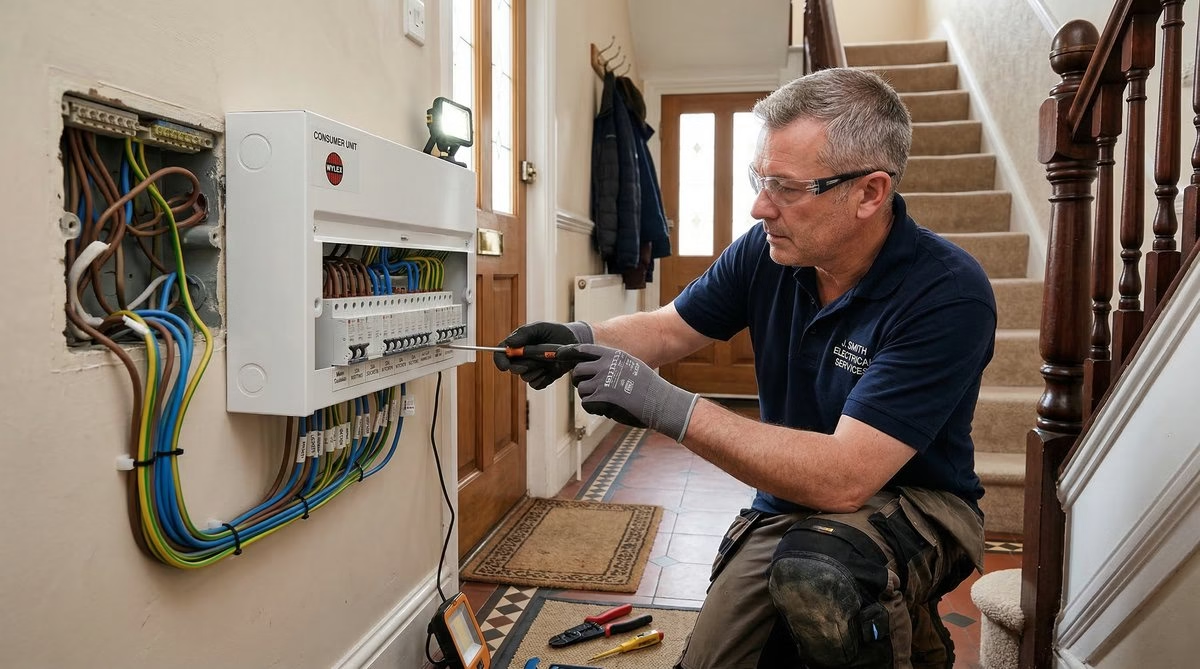
If you have ever received two quotes for a consumer unit replacement and found them hundreds of pounds apart, you are not alone. Consumer unit replacement cost what included testing certification UK is one of the most searched electrical questions on the internet right now — and for good reason. Homeowners across London are handed vague one-line quotes that say little more than “replace fuse board, £X” with no breakdown of what the labour covers, whether the certification fee is included, or what happens if something unexpected surfaces once the old board comes off the wall. At Fixiz Ltd, we believe a confused customer cannot make a good decision — so this article lays out everything you need to know before accepting any quote.
What a consumer unit replacement actually involves — components, tails, earthing, and bonding
A consumer unit replacement is not simply a case of unscrewing an old plastic box and screwing on a new one. The work touches almost every aspect of your home’s electrical installation, and understanding the physical steps helps you hold any contractor to account.
The consumer unit itself is the enclosure housing your circuit breakers. Current UK regulations — specifically Amendment 3 of BS 7671:2018 — require new consumer units in domestic premises to have a metal enclosure, which significantly reduces fire risk compared to the old white plastic boards many homes still carry. Inside that metal enclosure sit the protective devices: traditionally a mix of MCBs and RCDs, but increasingly RCBOs — residual current breakers with overcurrent protection — which give each circuit its own independent protection. RCBOs are the gold standard because a fault on your washing machine circuit will not take down your lighting at the same time. We fit full RCBO consumer units as standard on all our London projects because the marginal cost is small compared to the protection gained.
The meter tails are the large cables running from your electricity meter to the consumer unit. These are often overlooked in cheap quotes. If your existing tails are undersized, damaged, or too short to reach the new unit’s position, they must be replaced or extended — work that requires Part P notification. Any quote that does not address the tails has not properly assessed the job.
Earthing and main protective bonding are equally critical. The earthing conductor connects your consumer unit to the earth electrode or the DNO’s earth terminal depending on whether you are on a TN-S, TN-C-S, or TT earthing system. Main protective bonding conductors must then run from the earth bar to all extraneous conductive parts entering the building — the gas pipework, the water service, and in some cases structural steelwork. We have replaced consumer units in Croydon where the previous installer had left bonding cables from the 1970s — far too small for the current installation — a genuine safety hazard that a thorough pre-installation survey would have flagged and priced in advance.
Finally, all circuits must be labelled clearly so that any person — including an emergency responder — can identify which breaker controls which circuit without ambiguity. These finishing details are part of the job, not optional extras.
What should be included in every quote — testing, certification, and Building Regs notification
The price you pay for a consumer unit replacement is not just for the physical installation. A compliant, legally sound replacement in England and Wales must include a set of testing and administrative steps that confirm the installation is safe and notify the relevant authorities. If these are absent from a quote, either the contractor is planning to skip them — which is illegal — or they will add them as extras at the end.
Every circuit in the installation should be tested before and after the new unit is fitted. Pre-installation testing identifies existing faults, confirms earth loop impedance on each circuit is within acceptable limits, and checks insulation resistance. Post-installation testing verifies that all protective devices operate correctly, that RCD or RCBO trip times meet BS 7671 requirements, and that the installation is safe to energise. The results must be recorded on an Electrical Installation Certificate (EIC) — a three-part document covering design, construction, and inspection and test, each signed by a competent person.
Building Regulations notification is mandatory for consumer unit replacement in England. Under Part P, replacing a consumer unit is a notifiable work activity. A contractor registered with NICEIC, NAPIT, or Elecsa can self-certify, and that scheme notification fee must be included in the quote. The resulting completion certificate is your legal evidence of compliance — your solicitor will ask for it when you sell, and its absence can delay or derail a transaction. We have helped homeowners in Lewisham obtain retrospective certificates for work done by unregistered traders years earlier — a stressful and costly process that proper certification at the time of installation would have avoided.
A complete quote should therefore itemise: supply and fit of the new consumer unit with specified protective devices, replacement of tails if required, earthing and bonding work, full circuit testing, issue of the Electrical Installation Certificate, and Building Regulations notification. If any of those items is absent, ask about it explicitly before you sign anything.
What triggers extra work — old wiring, TT earthing, lack of main bonding, and asbestos boards
The most common reason a consumer unit replacement costs more than the initial estimate is the discovery of conditions not visible during the survey. A good electrician will flag the likely triggers in advance and explain how they would be priced if encountered. Understanding those triggers helps you ask the right questions upfront.
Old wiring is the most frequent culprit. Homes with rubber-insulated wiring — common in properties built before the 1960s — present a specific challenge. Rubber insulation becomes brittle with age and heat, and connecting modern protective devices to aging rubber cables can cause the insulation to crack and fail. In many cases a partial or full rewire is the appropriate solution, and that is a separate and larger job. We have surveyed properties in Bromley where the consumer unit was sitting on apparently modern cables right up to the board, but tracing those cables into the floor voids revealed the original rubber wiring still in place — a hazard masked by a superficial refresh.
TT earthing systems — found in some older urban installations where no DNO earth is available — require an earth electrode and typically an RCD at the origin. Replacing a consumer unit on a TT system often requires testing or replacing the earth electrode and verifying that electrode resistance is low enough to operate the protective devices. This affects scope and cost and should be identified at the survey stage.
Lack of main protective bonding is discovered surprisingly often, particularly in houses that have been extended, replumbed, or where plastic pipework has replaced metal supply pipes without anyone checking whether the bonding remained effective. Missing or undersized bonding conductors must be replaced — this is non-negotiable under BS 7671 and is not an optional upgrade.
Asbestos-containing materials around or behind the existing consumer unit are a less common but serious trigger. Some older distribution boards were mounted on asbestos-cement backing panels, and disturbing asbestos is a licensed activity requiring proper survey, removal, and disposal. We encountered exactly this situation in a Catford terrace: the board was fixed directly to asbestos cement. The right course was to pause, arrange a survey, and coordinate removal before returning to complete the electrical work — which is what we did, on behalf of the homeowner.
How to spot a dodgy quote — red flags that mean corners are being cut
Not every low quote is a bad quote, and not every high quote is a thorough one. The question is not just the number — it is what the number represents. There are specific red flags that indicate a contractor who is either unqualified, planning to skip required steps, or intending to add charges later.
The first red flag is a quote with no mention of certification. Every consumer unit replacement in England requires an Electrical Installation Certificate and Building Regulations notification. If a contractor says these are “not required” or “only needed for insurance purposes,” walk away — they are legally required.
The second red flag is a quote given over the phone without a site visit. Consumer unit replacements vary enormously depending on the earthing system, the age and condition of the wiring, the position of the board, and access constraints. An honest quote requires a physical inspection of the installation — opening the existing board, testing the circuits, checking the tails, and verifying the earthing arrangement.
The third red flag is the absence of any specification. A quote that says “fit new consumer unit” without specifying whether devices are MCBs, dual RCDs, or full RCBOs — and without naming a brand or confirming a metal enclosure — is a quote you cannot evaluate. Hager, Schneider, Legrand, and Wylex are all reputable manufacturers. Unbranded boards are not.
The fourth red flag is cash-only payment with no VAT receipt. Registered contractors provide a proper invoice. Cash-in-hand with no paperwork leaves you with no recourse if the work is faulty, no documentation for your property sale, and no comeback if the certification never materialises. We have seen homeowners in Greenwich discover — only at the point of sale — that their “certified” replacement was never notified to Building Control because the trader was unregistered.
How Fixiz prices consumer unit upgrades — transparent, itemised, and fully certified
At Fixiz Ltd, we price consumer unit replacements based on a structured assessment that begins with a proper site visit. We do not give binding prices over the phone, and we explain exactly why: a figure given without seeing the installation is either a guess or a trap. Our survey covers the earthing system, the condition and sizing of the tails, the age of the wiring, the bonding arrangement, and the physical position of the existing board. Only once we have that picture do we provide a written, itemised quote.
Our quotes break down the supply of the consumer unit and its protective devices — specifying brand, type, and the number of ways — separately from installation labour, testing, certification, and Building Regulations notification. If we identify likely triggers for additional work — old wiring, marginal tails, missing bonding — we include conditional line items with a clear explanation. There are no day-of surprises.
We are registered with NICEIC, which means our installations are self-certified under Part P of the Building Regulations. The completion certificate is issued directly to you on completion, along with your Electrical Installation Certificate. We have completed consumer unit upgrades across Croydon, Lewisham, Bromley, and throughout South London, and our approach is consistent regardless of property type or budget.
We also offer a combined package for homeowners who need a consumer unit replacement and an Electrical Installation Condition Report — the periodic inspection report that assesses the whole installation. Commissioning both together saves time, avoids the cost of a second mobilisation, and provides independent evidence of installation condition before and after the upgrade. Many landlords and homeowners preparing properties for lettings or sale opt for this combination, particularly when the property has not had a formal electrical inspection in over a decade. We are happy to walk you through both scopes on the same survey visit at no extra charge.
Frequently asked questions
How long does a consumer unit replacement take?
A straightforward consumer unit replacement on a property with a modern earthing system, accessible tails, and circuits in reasonable condition typically takes a full working day — between five and eight hours for an experienced electrician. This allows time for pre-installation testing, physical removal and installation, post-installation testing, labelling, and issue of the Electrical Installation Certificate. Properties with older wiring, TT earthing, or any of the trigger conditions described above will take longer. We always give a realistic time estimate at the survey stage so that you can plan accordingly.
Will replacing my consumer unit affect my home insurance?
Replacing an outdated unit with a modern, certified metal-enclosure board typically has a positive effect on home insurance. Some insurers specifically ask about the age and type of consumer unit on the proposal form, and an old plastic board with rewireable fuses may attract a loading or policy exclusion. If your existing unit is the subject of an outstanding remedial recommendation on an EICR, some insurers may limit a claim in the event of an electrical fire. Replacing the unit and obtaining the Electrical Installation Certificate gives you clean documentation demonstrating the installation meets current standards. Always inform your insurer once the work is complete.
What is the difference between a dual RCD board and a full RCBO board?
A dual RCD board divides circuits into two groups, each protected by a single RCD alongside individual MCBs. This is an improvement on an MCB-only board, but a fault on one circuit can trip the whole RCD and cut power to multiple circuits simultaneously. A full RCBO board fits a combined RCBO on every circuit, giving each its own independent overcurrent and residual current protection — so a fault on the dishwasher circuit trips only that circuit, and everything else stays live. Full RCBO boards cost more in materials but provide significantly better protection and far less disruption in day-to-day use. At Fixiz, we recommend full RCBO boards on all new installations and replacements and explain the cost difference clearly at the quote stage.
How long is an Electrical Installation Certificate valid for?
An Electrical Installation Certificate does not expire like a driving licence — it is a record of the condition of the installation at the time of the work. However, BS 7671 and best practice guidance recommend that domestic installations are periodically inspected: every ten years for an owner-occupied property and every five years (or at every change of tenancy) for a rented property. The EICR produced by that periodic inspection will assess whether the installation still meets current standards and identify any items requiring attention. If significant time has passed since your last EIC or EICR, commissioning a new inspection is the responsible step — and it resets your documentation timeline, which matters if you are planning to sell or let the property.
Ready to move from confusion to construction? Get in touch with Fixiz today for a no-pressure chat about your project and the fastest route to full compliance.