Physical address:
128 City Road, EC1V 2NX, London,UK

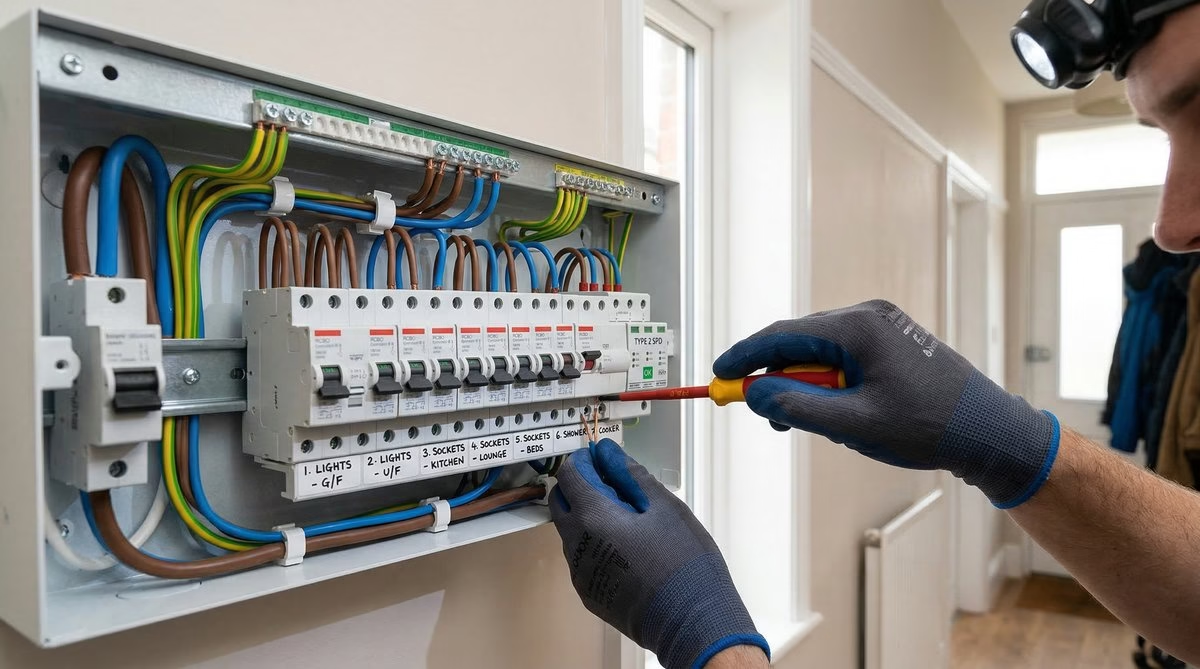
If you have asked two electricians to quote for a consumer unit quote RCBO vs split load SPD compare UK job, you may have two very different figures in front of you — and no reliable way to work out whether the cheaper one is cutting corners or the pricier one is padding the bill. A £600 quote and an £850 quote can represent wildly different scopes of work, or they can be almost identical jobs priced with different levels of transparency. At Fixiz Ltd, we carry out consumer unit replacements across London — from Victorian terraces in Hackney to purpose-built flats in Canary Wharf — and the question we hear most often before work starts is not “how long will it take?” but “why are these quotes so far apart?” This article is our direct answer. We will explain the difference between RCBO and split-load boards in plain terms, cover what surge protection devices actually do, break down every cost driver behind that price gap, and give you an eight-point checklist you can apply to any quote before you sign anything.
RCBO boards vs split-load boards — what the difference actually means for your home
The consumer unit — what most homeowners still call the fuse box — has one primary job: to protect the circuits in your home and to cut power quickly when something goes wrong. Whether that protection is delivered by a split-load board or a full RCBO board is the single biggest variable in both the cost and the quality of a consumer unit replacement.
A split-load consumer unit — also called a dual-RCD board — divides your circuits into two groups, each sitting behind a shared RCD (Residual Current Device). The MCB (Miniature Circuit Breaker) on each individual circuit handles overcurrent protection, but the RCD covering shock and earth-fault protection is shared across an entire bank. This means that if a single earth fault develops anywhere in that bank, everything in that group goes down together — lights, sockets, the fridge — until the fault is found and the RCD is reset.
A full RCBO consumer unit takes a completely different approach. Every single circuit has its own RCBO — a Residual Current Breaker with Overcurrent protection — combining MCB and RCD functions in one device. If a fault develops on your bathroom circuit, only the bathroom circuit trips. Everything else stays on. This is called fault discrimination, and it matters enormously in practice. We fitted a full RCBO board for a homeowner in Islington whose previous split-load installation had caused months of frustration — a refrigerator with a developing insulation fault periodically took out half the kitchen, the dining room, and the hallway with no way to identify the culprit quickly. One RCBO board resolved that immediately.
Individual circuit protection means faults are identified instantly — the tripped RCBO is labelled and obvious. There is no nuisance tripping caused by accumulated earth leakage from multiple circuits sharing one RCD. The board also aligns closely with the best-practice direction of BS 7671 (the 18th Edition Wiring Regulations), which pushes strongly towards improved circuit discrimination. Split-load boards remain compliant and are still regularly installed where cost is the overriding consideration — but for most London properties with twelve or more circuits, the RCBO board is the better long-term investment. Supply-only, an MCB-populated 10-way board costs around £60–£100 compared to roughly £200–£250 for a fully RCBO-populated equivalent — that materials gap, multiplied by labour, is one of the main reasons two quotes for “a new consumer unit” can differ by £150 or more before anything else is considered.
Surge protection devices (SPDs) — what they do, whether you need one, and the 18th Edition requirement
Surge protection devices sit at the origin of your electrical installation — at or adjacent to the consumer unit — and absorb or divert transient overvoltages before they can reach your equipment and wiring. A transient overvoltage is a very brief but very large spike in voltage: caused by a lightning strike nearby, by switching operations on the electricity network, or increasingly by EVs, heat pumps, and solar inverters operating on the same grid. Modern homes are full of equipment — smart TVs, computers, heat pump controllers — that is acutely vulnerable to these spikes. An SPD does not protect against sustained overvoltages; it clamps and redirects those fast, damaging transients to earth before they can burn out sensitive electronics or, in more serious cases, cause wiring insulation to fail.
The regulatory position under BS 7671:2018 (including Amendment 2:2022) is clear: SPDs are mandatory in most new electrical installations unless a documented risk assessment justifies omission. The blanket underground-cable exemption that once excluded many dwellings has been removed, and the exemption is now narrow. Any property with an EV charger, a heat pump, a PV inverter, or significant smart home equipment should have an SPD as standard. A property assessed under an EICR that lacks an SPD where one is required will receive a C2 notation — causing real complications for landlords and sellers.
A Type 2 SPD (or combined Type 1+2) is the standard choice at the consumer unit, installed as close to the origin of the installation as possible. Supply-only cost for a domestic combined SPD is typically £40–£80; installation, including correctly sizing the disconnection fuse and confirming earth conductor adequacy, adds to overall labour time. When an electrician includes an SPD in their quote, they are doing the job properly. When a quote omits one without explanation, that is a question worth asking directly.
We routinely include SPDs in our London consumer unit installations — including older Victorian-era properties in Stoke Newington and Peckham, where overhead supply routes and aging network infrastructure make transient overvoltage risk genuinely elevated. The cost of an SPD is modest; the cost of replacing a heat pump control board or EV charger management unit after a transient event is not.
What explains the price gap between quotes — board choice, number of ways, bonding, and extras
When two quotes for what appears to be the same job are £250 apart, there is nearly always a structural reason — and it is almost never simply that one electrician charges less per hour. The variables that drive the gap between a £600 and an £850 consumer unit replacement quote fall into four categories: board specification, circuit count, bonding and earthing work, and certification.
Board specification is the most obvious driver. A split-load board on a 10-way installation will cost measurably less in materials than a full RCBO board on the same circuit count. When a quote does not specify board type, the cheaper option is very likely a split-load installation — which may be entirely appropriate, or may represent a compromise you are not aware you are making.
Circuit count — the number of ways — is the second major variable. A 10-way consumer unit suits most 3-bedroom homes; a 12- or 14-way unit is needed for larger properties with dedicated circuits for a cooker, shower, EV charger, or outbuildings. Each additional way adds material cost and labour time. If the first electrician quoted for 10 ways without a thorough survey while the second correctly identified you need 14, those quotes are not comparable on price at all.
Main bonding and earthing is the item most homeowners do not expect. When a consumer unit is replaced, BS 7671 requires the installer to verify that main protective bonding is adequate — that the gas service pipe, water service pipe, and other extraneous-conductive-parts are bonded to the main earthing terminal with correctly sized conductors. In London, where many properties pre-date modern bonding requirements, bonding conductors are frequently undersized (6mm² where 10mm² is required) or missing from gas pipes entirely. Remedial bonding — running new 10mm² conductors to the gas meter and water stopcock — adds time and materials. A quote that includes bonding upgrades is completing the legal scope of work. A quote that makes no mention of bonding is a question worth asking.
Certification and notification is the fourth factor. Consumer unit replacement is notifiable work under Part P of the Building Regulations. A registered electrician on a scheme such as NICEIC or NAPIT self-certifies and notifies Building Control on your behalf at no extra charge. An unregistered installer must notify Building Control separately — typically £150–£400. A quote that omits certification is not a quote for a complete, legally compliant installation.
A like-for-like comparison checklist — the eight things every quote should itemise
The only way to compare two consumer unit replacement quotes properly is to confirm they both describe the same scope of work. Ask every electrician to confirm the following eight items in writing before you decide.
- Board type and manufacturer: Full RCBO or split-load? Which manufacturer and model? Boards from Hager, Schneider, Wylex, and Eaton carry long warranties. Unbranded boards do not.
- Number of ways: How many circuits will the board accommodate, and how many are currently in use? Is there spare capacity for an EV charger or future circuits?
- SPD inclusion: Is a surge protection device included? If not, is a written risk assessment available to justify its omission?
- Main bonding check and upgrade: Will the electrician verify bonding to gas and water services? Is any remedial bonding work included in the price or quoted separately?
- Meter tails: Are new meter tails included, or will existing tails be reused? Older tails may be undersized or in poor condition.
- Testing and inspection: Does the price include a full Schedule of Test Results and inspection schedule as required by BS 7671 Section 6?
- Electrical Installation Certificate (EIC): Is the EIC included and issued on the day of completion? Will Part P notification to Building Control be handled by the installer?
- Disposal of the old unit: Is removal and disposal of the existing consumer unit included, or charged separately?
Any quote that cannot answer all eight of these questions clearly, in writing, is not a quote you can compare on price alone. The risk of additional charges — or a substandard installation — sits entirely with you.
The checklist also protects you from the opposite scenario: an unnecessarily expensive quote. If a quote includes a 14-way RCBO board when your property has eight circuits and no future expansion planned, that is a cost worth questioning too. Like-for-like comparison works in both directions — it protects you from underspecification and from overspecification equally.
How Fixiz quotes consumer unit replacements — transparent, itemised, no ambiguity
When Fixiz carries out a consumer unit replacement in London, our process starts with a survey rather than a phone estimate. Every installation is different — circuit counts vary, existing bonding varies, access conditions vary. We have replaced consumer units in basement flats in Brixton where the incoming meter was in a ground-floor communal cupboard and new tails required routing through fire-rated enclosures, and in maisonettes in Hammersmith where bonding to a plastic water meter required a documented assessment rather than a straight upgrade.
Our written quotes itemise every element: board type and manufacturer, circuit count, SPD inclusion rationale, bonding scope, certification route, and any advisory items identified in the existing installation. We do not present a headline figure and expect you to trust it — we explain every line, because an informed customer makes better decisions and encounters fewer surprises on installation day.
We are NICEIC registered. Every consumer unit installation we complete is self-certified and fully notified to Building Control as part of the standard service. The EIC is issued on the day of completion. We use boards from established manufacturers — predominantly Hager and Schneider — and do not substitute materials without discussion. Our London-based team covers all boroughs, with same-week survey availability across the capital.
We flag advisory items separately from required work — so you can see clearly what is legally necessary now versus an optional upgrade for future-proofing. If your existing bonding is adequate, we will say so. If your meter tails are compliant, they will not appear on your invoice. That transparency is not a sales strategy — it is simply how a professional installation should be quoted. It builds the kind of trust that generates referrals across London boroughs, and it is the standard we hold ourselves to on every job.
Frequently asked questions
Is a full RCBO board always worth the extra cost over a split-load board?
For most London properties with ten or more circuits — yes. The additional material cost of individual RCBOs over shared RCDs is typically £80–£150 in a completed installation, and the benefit — fault isolation to a single circuit, no nuisance tripping, and alignment with BS 7671 best practice — is tangible from day one. Where cost is the overriding constraint and the circuit count is modest, a well-specified split-load board from a quality manufacturer remains fully compliant. The key is that the decision is made consciously.
Do I legally need an SPD, and what happens if a quote does not include one?
Under BS 7671:2018 including Amendment 2:2022, SPDs are required unless a documented risk assessment justifies omission. For most domestic properties with EV chargers, heat pumps, or significant electronic equipment, the exemption does not apply. If you receive a quote omitting an SPD with no explanation, ask the electrician to confirm in writing what risk assessment applies and whether the omission will be noted on the EIC. A missing SPD will be flagged as a defect on any future EICR — which matters significantly for landlords and sellers.
What is the difference between an EIC and an EICR, and which should I receive after a consumer unit replacement?
An Electrical Installation Certificate (EIC) is issued for new work — consumer unit replacements, new circuits, major alterations. It confirms the installation meets BS 7671 and must include a Schedule of Test Results. An Electrical Installation Condition Report (EICR) assesses the condition of an existing installation and does not certify new work. After a consumer unit replacement, you must receive an EIC. An electrician who offers only an EICR for a replacement job is issuing the wrong document.
What is main protective bonding, and why might it add to my quote?
Main protective bonding connects metallic services entering your property — gas pipes, water pipes — to the main earthing terminal of your electrical installation. Its purpose is to equalise potential across those conductive parts so that a fault does not create a dangerous voltage difference between them. In many older London properties, bonding conductors are undersized or missing. When a surveying electrician identifies deficient bonding, they must inform you and include remedial work in the scope before proceeding. This is one of the most common reasons a survey-based quote is higher than a phone estimate — the survey found work that the phone estimate simply ignored.
Ready to move from confusion to construction? Get in touch with Fixiz today for a no-pressure chat about your project and the fastest route to full compliance.