Physical address:
128 City Road, EC1V 2NX, London,UK

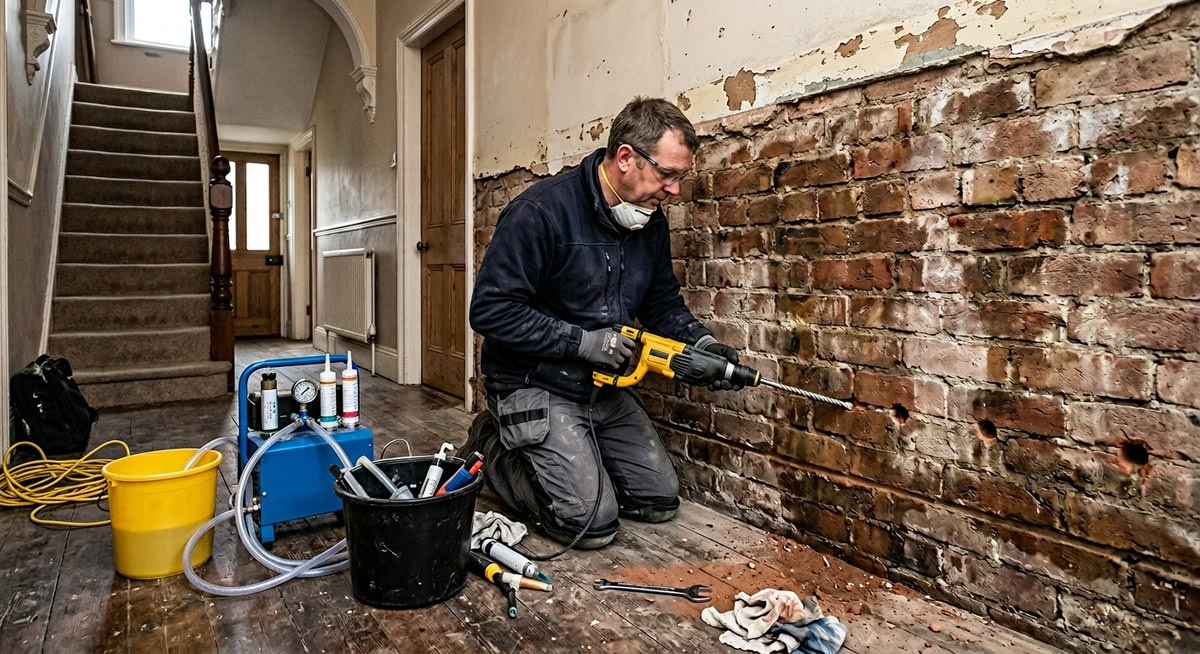
You’ve had your Level 2 or Level 3 survey, the word “damp” appeared in the report, and now a specialist firm has handed you a chemical DPC injection quote running into thousands of pounds — possibly before you’ve even exchanged contracts. It’s a scenario we see regularly at Fixiz, and it raises a question that deserves a careful, honest answer: is the injection actually needed, or are you about to pay handsomely for a treatment that won’t fix the real problem? This guide walks you through exactly how to find out.
What a “damp” flag on your survey actually means — and what it doesn’t
A Level 2 (HomeBuyer) or Level 3 (Building) survey is a general health check, not a specialist damp investigation. When a surveyor flags “rising damp” or “evidence of dampness at low level,” they are typically reporting elevated readings on a handheld electronic moisture meter — a useful screening tool, but one with well-documented limitations. Electronic meters respond to moisture, yes, but they also respond to hygroscopic salts, metallic wall ties, foil-backed plasterboard, and even dense plaster. A high reading does not, on its own, prove that groundwater is travelling upwards through your masonry by capillary action.
The surveyor’s job at this stage is to flag potential issues and recommend further investigation. The problem starts when the “further investigation” is carried out by a company whose business model revolves around selling chemical damp-proof courses. As one buyer on a popular UK housing forum put it bluntly: “DPC injections are a con… it’s wise to obtain an independent damp survey before spending £10,000 on a ‘fix’ that won’t address the root cause.” At Fixiz, we’ve helped buyers unpick exactly this kind of situation — a general survey flags damp, a “specialist” firm swoops in, and within days the buyer has a four-figure quote without anyone having actually proved what’s causing the moisture.
Genuine rising damp — groundwater travelling upwards via capillary action against a failed or absent damp-proof course — is far rarer than the damp-proofing industry suggests. Stephen Boniface, former chairman of the construction arm of RICS, stated in The Architects’ Journal that “true rising damp is a myth” and chemically injected DPCs are a “complete waste of money.” The underlying point is supported by building scientists across the UK: most low-level dampness has other explanations.
Common causes that mimic rising damp — and why they matter
Before accepting any chemical DPC injection quote UK buyers receive, it pays to understand the conditions that produce identical symptoms without any capillary rise involved. The damp-proofing industry is worth over £200 million a year in the UK, and much of that revenue depends on diagnosing rising damp — even when the real culprit is far more straightforward.
- Bridged DPC: Your property may already have a perfectly functional damp-proof course — slate, bitumen felt, or engineering brick — but external ground levels, paving, or render have been built up above it, allowing moisture to bypass the barrier entirely. No amount of injection will help if the bridge remains.
- High external ground levels: Garden soil or driveways sitting above your DPC line push moisture directly into the masonry. The fix is lowering the ground or installing drainage — not injecting chemicals.
- Leaking gutters and downpipes: A cracked hopper or blocked downpipe can saturate the base of a wall over months, producing staining and salt deposits that look exactly like textbook rising damp.
- Condensation on cold walls: Lower wall sections are cooler — they sit close to the ground, receive less radiant heat, and suffer from thermal bridging at floor level. Warm indoor air condenses on these cold surfaces, creating damp patches routinely misdiagnosed as rising damp.
- Penetrating damp concentrating low down: Defective render or cracked pointing lets rainwater into the wall. Gravity pulls it downward, where it accumulates at the base — creating the illusion of moisture “rising” when it is actually falling.
We recently worked on a 1930s semi in south London where the buyer had been quoted over £4,000 for a full perimeter injection. The original slate DPC was intact — but a previous owner had raised a patio 150 mm above it. Lowering the patio and re-pointing the brickwork solved the problem at a fraction of the cost.
How to commission a genuinely independent damp survey
An independent damp surveyor earns their fee from the investigation itself and has no commercial interest in selling remedial work. They diagnose; they do not drill, inject, or plaster. That separation matters enormously, because a surveyor who also offers treatment has a financial incentive to find a problem requiring their product.
Here’s what a thorough investigation should include:
- Building history and context: Age, construction type, previous alterations, heating and ventilation patterns, and any earlier damp treatment.
- Full external inspection: Ground levels relative to any existing DPC, condition of render, pointing, gutters, downpipes, gullies, and any evidence of bridging.
- Electronic moisture profiling: Systematic readings at multiple heights and locations — not a single reading used as a binary verdict.
- Calcium carbide (speedy) testing: Drilling small samples and measuring total moisture content. More quantitative than a surface meter, but as BRE Digest 245 makes clear, it cannot distinguish between free moisture and hygroscopic moisture.
- Gravimetric and salts analysis: The gold standard. Drilled samples are sent to a laboratory to separately measure free moisture and hygroscopic moisture content. If the hygroscopic fraction dominates, you are looking at salt contamination — not active rising damp — and chemical injection is pointless.
- Thermal imaging (where appropriate): Infrared cameras can pinpoint condensation zones, thermal bridges, and hidden moisture pathways invisible to the naked eye.
Tip: Ask any prospective surveyor two questions before booking: “Do you also carry out damp-proofing work?” and “Will your report include laboratory salts analysis if rising damp is suspected?” If the answer to the first is yes, or the second is no, keep looking.
At Fixiz, we’ve seen reports from firms that diagnosed “severe rising damp” on the strength of a single electronic meter reading — no drilling, no lab work, no mention of external ground levels. A proper investigation typically costs £300–£600 and can save you thousands by identifying what actually needs fixing.
Decision framework — when chemical DPC injection is and isn’t appropriate
We are not saying chemical DPC injection is never appropriate. There are circumstances where it is a legitimate treatment — but those circumstances are narrower than many firms suggest, and the diagnosis must be backed by laboratory evidence rather than a meter reading alone. Here’s a practical framework to help you decide.
Chemical DPC injection may be appropriate when:
- True rising damp is confirmed: Gravimetric analysis shows free moisture in a pattern consistent with capillary rise — highest at the base, diminishing with height.
- No existing physical DPC is present or functional: The property predates mandatory DPCs, or the original barrier has genuinely failed.
- Bridging cannot be rectified: If ground levels or floor construction bridging the DPC cannot practically be lowered, injection above the bridge may be considered as part of a broader strategy.
- The mortar bed is continuous and drillable: Chemical creams rely on spreading through porous mortar joints. Rubble-filled or stone walls may not allow a continuous barrier to form.
Chemical DPC injection is almost certainly NOT appropriate when:
- The existing DPC is being bridged: Fix the bridge first — lower the ground, cut back render — then reassess.
- Moisture is caused by condensation: Improve ventilation, insulation, and heating instead.
- Only hygroscopic salts are detected: Old salt contamination needs replastering with lime-based plaster, not injection.
- The property is a pre-1919 solid-wall building: Older buildings manage moisture through breathability. Injecting a chemical barrier and replastering with gypsum can trap moisture and accelerate decay.
Tip: If no one has proved the moisture route with laboratory testing, no one should be injecting anything. Fix root causes first; consider chemical DPC only if dampness persists after external defects, bridging, and ventilation have been addressed. We’ve seen Fixiz clients save thousands simply by following this sequence — addressing the easy wins before committing to invasive treatment.
Budgeting, negotiating, and knowing when to walk away
If you’re buying a property and a chemical DPC injection quote lands on your desk, understanding the numbers puts you in control. Typical UK costs for injection alone run £70–£100 per linear metre — roughly £800–£1,200 for a terraced house, £1,500–£2,500 for a semi, and £2,000–£5,000 for a detached property. Replastering with salt-retardant plaster adds £80–£150 per square metre on top. When firms quote £7,000–£10,000 for a “rising damp package,” much of that cost is replastering — understanding that breakdown gives you leverage.
Here’s what to do before exchange to protect your position:
- Commission your own independent survey: Budget £300–£600 for a proper investigation with lab analysis.
- Share findings with your solicitor: If the independent survey identifies a different root cause, your negotiating position changes entirely.
- Request a price reduction rather than pre-completion works: A reduction gives you control over the specification and contractor.
- Get multiple quotes if injection IS justified: Obtain at least two further quotes from firms that did not carry out the survey.
- Know your walk-away point: If the seller refuses to negotiate and your independent survey confirms a genuine, costly problem — it may be better to walk away than to inherit a poorly diagnosed repair that could unravel after completion.
Remember that your lender may place a retention on the mortgage until damp works are completed to their satisfaction. Factor this into your cash-flow planning — a retention means funds are withheld from the mortgage advance until evidence of satisfactory remediation is provided.
We’ve helped Fixiz clients negotiate five-figure price reductions on the strength of a £400 independent survey that disproved a rising damp diagnosis. The return on that investment is hard to beat — and it gives you the evidence to negotiate from a position of confidence rather than anxiety.
Why PCA membership alone doesn’t guarantee independence
Mortgage lenders frequently require damp reports from firms holding Property Care Association (PCA) membership, and buyers understandably treat that accreditation as a mark of quality. It can be — but it is not a guarantee of independence. The PCA has several membership categories: a PCA-accredited contractor is qualified to diagnose and carry out remedial work, while a PCA-accredited surveyor is expected to diagnose only with no commercial interest in selling treatment. Both carry the PCA badge, but their business models are fundamentally different.
The conflict of interest arises when the same firm surveys your property and then quotes to fix the problem it just diagnosed. Even with the best intentions, there is an inherent tension between impartial diagnosis and commercial revenue. What to look for instead:
- Separation of survey and works: The firm producing your report should not be the firm quoting to fix the problem. Full stop.
- RICS-regulated surveyors: Chartered surveyors regulated by RICS are bound by professional standards on conflicts of interest and are more likely to provide genuinely impartial assessments.
- “No commercial interest” declaration: Some lenders explicitly require this. Ask whether the surveyor’s report includes a declaration that they have no financial interest in any remedial works recommended.
- Evidence-based methodology: An independent surveyor should explain their diagnostic process — moisture profiling, lab analysis, external inspection — not just hand you a meter reading and a quote.
Tip: If your lender insists on a PCA member, look specifically for a PCA-registered surveyor (not contractor) who does not carry out remedial work. That distinction alone can save you from a diagnosis shaped by commercial incentive rather than building science. If in doubt, ask the firm directly whether they earn revenue from remedial works — a genuinely independent surveyor will answer without hesitation.
How Fixiz keeps your damp project on track
At Fixiz, we sit between you and the noise. We don’t sell damp-proofing products and we don’t earn commission on chemical DPC installations. We help you cut through conflicting advice, connect you with genuinely independent surveyors, and ensure that any remedial work — if it’s actually needed — is specified correctly and priced fairly. In most cases the answer isn’t a £5,000 injection — it’s a gutter repair, a lowered flower bed, or a ventilation improvement that costs a fraction of the quoted work. When chemical DPC is genuinely needed, we make sure the specification follows BS 6576 guidance from start to finish.
Frequently asked questions
Is rising damp actually real?
Rising damp is a real physical phenomenon, but confirmed cases in occupied UK buildings are far less common than the industry suggests. Most low-level dampness is caused by bridged DPCs, high ground levels, condensation, or penetrating damp. Laboratory analysis can distinguish between them.
How much should a chemical DPC injection cost in the UK?
Injection alone typically costs £70–£100 per linear metre — roughly £1,500–£2,500 for a semi-detached house, plus £80–£150 per square metre for associated replastering. Quotes above £5,000 for a standard semi should prompt a second opinion.
Should I pay for damp treatment on a house I haven’t bought yet?
Generally, no. The damp survey cost falls to you as the buyer, but remedial works should be funded by the seller, reflected in the purchase price, or held as a mortgage retention.
What is the difference between a calcium carbide test and gravimetric analysis?
A calcium carbide test measures total moisture in a drilled sample but cannot separate free water from moisture held by hygroscopic salts. Gravimetric analysis, recommended by BRE Digest 245, sends samples to a laboratory to measure both separately — essential for proving whether active rising damp or residual salt contamination is responsible.
Can a chemical DPC make things worse?
Yes. In older solid-wall buildings, injecting a chemical barrier and replastering with non-breathable gypsum can trap moisture, redirecting it to untreated areas. If the real problem was condensation or a bridged DPC, the injection treats a non-existent symptom while the real cause continues unchecked.
My lender requires a PCA survey — does that mean I must use a PCA contractor?
Not necessarily. Seek a PCA-registered surveyor rather than a contractor. A surveyor diagnoses without carrying out works, reducing the risk of a commercially motivated recommendation. Confirm with your lender they will accept a surveyor-only report.
Ready to move from confusion to construction? Get in touch with Fixiz today for a no-pressure chat about your project and the fastest route to full compliance.