Physical address:
128 City Road, EC1V 2NX, London,UK

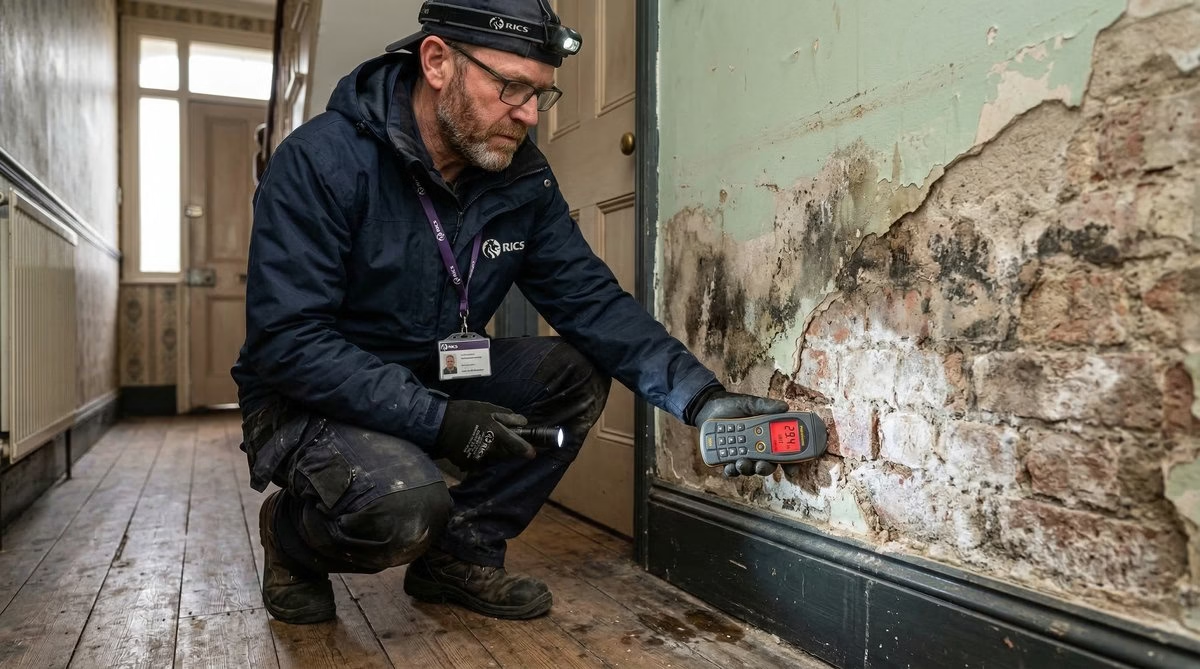
You have just received a damp specialist’s report recommending chemical DPC injection worth it rising damp myth UK homeowners should scrutinise — and you are not alone if something about that advice feels off. A damp company visits, points a moisture meter at the base of your walls, and hands you a quote running into the thousands. The problem, they say, is a failed slate DPC. Before you sign anything, read this. At Fixiz, we carry out independent damp assessments across London — from Victorian terraces in Hackney to Edwardian semis in Ealing — and we have seen this scenario more times than we care to count. This article explains what chemical DPC injection is, why the science behind it is heavily disputed, what the real culprits almost always turn out to be, and how to protect yourself from a costly misdiagnosis.
What chemical DPC injection actually does — and the science behind the sales pitch
Chemical DPC injection involves drilling a series of holes at low level along a wall — typically around 150 mm above floor level — and pumping a silicone-based fluid into the masonry. The theory is that the fluid permeates the brickwork and creates a hydrophobic barrier that stops moisture from rising. Sounds logical. The problem is that the underlying science has been contested by some of the most credible voices in British surveying for decades.
Stephen Boniface, former chairman of the construction arm of the Royal Institution of Chartered Surveyors, stated publicly that true rising damp is a myth and that chemically injected damp-proof courses are a complete waste of money. That is not a fringe view — that is the former head of the RICS construction faculty telling forty thousand members that a standard treatment being sold to homeowners across the UK does not address a problem that, in most cases, does not exist in the form being described.
The capillary action argument — that ground moisture wicks upward through brick and mortar like water through a paper towel — sounds convincing in a sales brochure. But building scientist Jeff Howell, author of The Rising Damp Myth, demonstrated through lab trials that in real-world masonry the water does not reliably rise by capillary action under normal conditions. Brick in contact with damp ground will absorb water at the base. That water does not necessarily travel a metre up the wall by capillary pull alone. Modern cement-based and lime mortars are substantially less porous than the theory requires.
None of this means your walls are dry. It means the mechanism being used to justify the recommended treatment is, at best, unproven — and if the mechanism is wrong, the treatment that targets it is also wrong. The real question is always: where is the moisture actually coming from? That is a diagnostic question, not a sales question. It requires an honest, independent assessment — not a company that profits from selling you the solution before it has properly investigated the problem.
It is also worth noting that most chemical injection guarantees contain a carve-out for condensation damage. If the damp in your property turns out to be condensation — as it frequently is — the guarantee is entirely worthless. That clause is not in small print by accident.
The “rising damp” debate — why many experts say the real culprit is almost always something else
The consensus among independent surveyors and heritage building specialists is clear: true rising damp is rare — far rarer than the volume of chemical DPC injection work being sold would suggest. The real causes of low-level wall damp are condensation, penetrating damp, bridged DPCs, and high external ground levels. Understanding each of these matters before any money changes hands.
Condensation is responsible for a striking proportion of damp problems that get misdiagnosed as rising damp. A moisture meter reading taken at the base of a cold external wall in a poorly ventilated room will show elevated moisture content. That is not rising damp — that is condensation, where warm humid air meets a cold surface and releases its water. In a Victorian terraced house in Islington or a purpose-built flat in Bermondsey, poor ventilation, inadequate heating, and cold bridging at junctions are endemic. The conditions for chronic condensation are baked into the building’s construction. Chemical injection does nothing whatsoever for condensation. It is a completely irrelevant intervention.
Penetrating damp is another major culprit. Defective pointing, cracked render, failed window seals, and leaking gutters all allow rainwater to enter a wall at varying heights. When that water manifests at low level, a moisture meter survey will flag it as suspicious. A specialist who sells injections has every incentive to describe it as a DPC failure. An independent surveyor has the incentive to find the actual source and fix it — typically for a fraction of the cost.
The slate DPC argument deserves particular attention, because it is the version of this story we hear most often. The damp company tells homeowners that slate degrades and fails over time. But in the vast majority of cases, an original slate DPC in a well-built Victorian or Edwardian property is perfectly functional. Slate is one of the most impermeable natural materials available. If you are being told your slate DPC has failed, ask for specific physical or structural evidence — not a meter reading. According to independent damp survey specialists, one in three rising damp callouts in heritage homes turns out to be basic condensation. Our own experience across London is entirely consistent with that figure.
Bridged cavities, high ground levels, and cement render — the common causes that get missed
Even when there genuinely is a moisture pathway from ground level into the wall, it usually has nothing to do with the DPC failing. It has to do with the DPC being bypassed — what surveyors call bridging. Bridging is a physical problem with a physical solution. No amount of chemical injection addresses a bridge. You remove the bridge. That is the entire fix.
A bridged DPC occurs when something provides a continuous moisture path that goes around the DPC rather than through it. The most common culprits are: raised external ground levels, where soil or paving has been built up over decades until it sits above the DPC line; cement render that extends from above the DPC down to or below ground level, carrying moisture down and around the barrier; debris in the cavity wall, particularly where cavity insulation has been retrofitted carelessly; and concrete or mortar at the base of the cavity, common in older houses where builders discarded waste into the void during construction.
We assessed a property in Crouch End last year where the owners had already spent money on a chemical injection treatment two years prior. The damp had returned. When we carried out a proper external walkround, we found that a new patio — installed shortly before the damp appeared — had been laid hard against the wall at a level five centimetres above the DPC. Rainwater was puddling against the wall and wicking straight around the barrier. The fix was to cut back the patio and install a drainage channel. Total cost: a few hundred pounds. The chemical injection had achieved nothing.
Cement render is another persistent offender that rarely gets mentioned in damp company reports — possibly because identifying it as the problem does not lead to a product sale. Cement render is not breathable. It traps moisture behind it and can carry water from above the DPC to below it in the same continuous film. The correct response is to remove the cement render, allow the wall to dry, and replace it with a breathable lime render.
High external ground levels are remarkably common in London’s older housing stock. In many Victorian terraces in Peckham, Stoke Newington, or Shepherds Bush, the original DPC now sits at or below paving level after two centuries of street resurfacing. Wherever ground sits above the DPC, moisture has a clear path into the masonry — and the fix is to excavate and ensure drainage exists, not to inject the wall. Cavity debris is also worth checking wherever insulation has been retrofitted; a borescope check takes fifteen minutes and can fundamentally change the diagnosis.
How to tell if you actually need a DPC — and when to walk away from a damp company’s report
The starting question is always: has the surveyor who recommended chemical injection actually tried to rule out every other cause first? If the answer is no — or if you are simply not sure — you are looking at a sales process dressed as a diagnosis. There are four indicators that should make you pause before accepting any report’s conclusions.
First: was the survey purely based on a moisture meter? A protimeter is a useful screening tool, not a diagnostic instrument. A credible survey includes an external walkround recording DPC height versus ground levels, a cavity check, assessment of ventilation, examination of render and gutters, and temperature and humidity readings to assess condensation risk. If none of these steps were taken, the report is incomplete.
Second: does the report mention condensation? If the surveyor has not taken humidity readings and has not addressed condensation as a possible cause, the diagnosis is incomplete by definition. Third: ask whether the quote includes investigation of external ground levels, bridged cavities, or render condition. Fourth: read the guarantee terms — most injection guarantees explicitly exclude condensation damage, which means they provide no protection whatsoever in many of the cases where damp has been misdiagnosed.
When might you genuinely need chemical injection? In our view, it applies in a very narrow set of circumstances: where a thorough independent survey has ruled out every other cause, where the DPC can be confirmed as absent or structurally failed, and where moisture profiling confirms a rising pattern consistent with capillary action. That combination is unusual. When it does occur, injection may be appropriate as part of a broader remediation strategy. It is the last resort of an honest diagnosis — not the first recommendation of a product vendor.
How Fixiz diagnoses damp properly — independent assessment, no products to sell
At Fixiz, we are not a damp proofing company. We are a property works contractor. We do not sell chemical injection kits, we do not stock damp treatment products, and we have no financial incentive to recommend one course of treatment over another. Any organisation that profits from selling a specific solution faces structural pressure when arriving at a diagnosis. We do not face that pressure — our job is to find the actual cause and specify the correct repair.
Our assessments begin by gathering background information: the age and construction type of the property, any alterations that may have changed ground levels or cavity conditions, records of previous treatments, and the history of the problem. A homeowner who tells us the damp appeared after new paving was laid has already given us a significant diagnostic clue.
We then carry out a full external inspection — recording DPC height on every elevation, comparing it to ground and paving levels, examining render condition, checking cavity trays, and inspecting gutters. In a property in Walthamstow last spring, this walkround took under thirty minutes and revealed a blocked cavity weep hole that was pooling water directly above the DPC line on the north-facing elevation. That was the entire diagnosis. The fix took one afternoon.
Internally, we map moisture distribution at multiple heights and assess whether the pattern is consistent with bridging, penetrating damp, capillary rise, or condensation. We take temperature and humidity readings wherever condensation risk exists. In a flat in Lewisham earlier this year, our internal assessment revealed a consistent pattern of elevated relative humidity — well above the condensation threshold — alongside cold external walls with no insulation. The walls were wet from the inside, not the outside. No injection would have made any difference. The report we produce separates observed facts from professional interpretation, gives you options in plain language, and explains the reasoning behind every recommendation.
Frequently asked questions
Is rising damp actually real, or is it always a misdiagnosis?
True rising damp exists, but it is significantly rarer than the volume of chemical injection work being sold would suggest. The overwhelming majority of cases turn out to be condensation, penetrating damp, a bridged DPC, or high external ground levels. Each has its own correct solution — and none of them is chemical injection. Before accepting a rising damp diagnosis, insist on a survey that has genuinely ruled out the more common alternatives.
My property has an original slate DPC. Can it really fail?
Slate is one of the most durable and impermeable natural materials used in building. An original Victorian or Edwardian slate DPC that has not been subjected to significant structural movement is almost certainly still functional — the claim that they routinely fail with age is not supported by the evidence. If a damp company says your slate DPC has failed, demand specific physical evidence, not a moisture meter reading. In most cases we have investigated, the slate DPC was perfectly intact.
How can I tell if my damp is condensation rather than rising damp?
Key indicators of condensation: damp or mould appearing on cold surfaces — external corners, north-facing walls, window reveals — rather than uniformly across a low wall band; damp that is worse in winter; elevated relative humidity above 70%; and an absence of white salt deposits associated with ground-sourced moisture. A humidity logger left in the room for a week gives far more reliable data than a moisture meter. If you have poor ventilation, inadequate heating, or laundry drying indoors, condensation must be addressed regardless of what else may be happening in the wall.
What should an independent damp survey actually include?
A credible survey includes: an external walkround recording DPC height versus ground levels; inspection of render, pointing, gutters, and window seals; a cavity check for debris; internal moisture profiling at multiple heights; temperature and humidity measurements; and a written report that distinguishes observations from interpretation and explains the reasoning behind recommendations. It must not be based solely on a moisture meter reading, and must explicitly address condensation before drawing any conclusions about the DPC.
If I have already had chemical injection done and the damp has come back, what should I do?
If damp has returned after injection, that is strong evidence the underlying cause was not a failed DPC. Investigate external wall condition — ground levels, render, gutters, cavity — and internal humidity and ventilation. In some cases, a bridge was never identified. In others, the original problem was condensation and remains unaddressed. Either way, more injection is not the answer. An independent surveyor with no product to sell is the right first step.
Ready to move from confusion to construction? Get in touch with Fixiz today for a no-pressure chat about your project and the fastest route to full compliance.