Physical address:
128 City Road, EC1V 2NX, London,UK

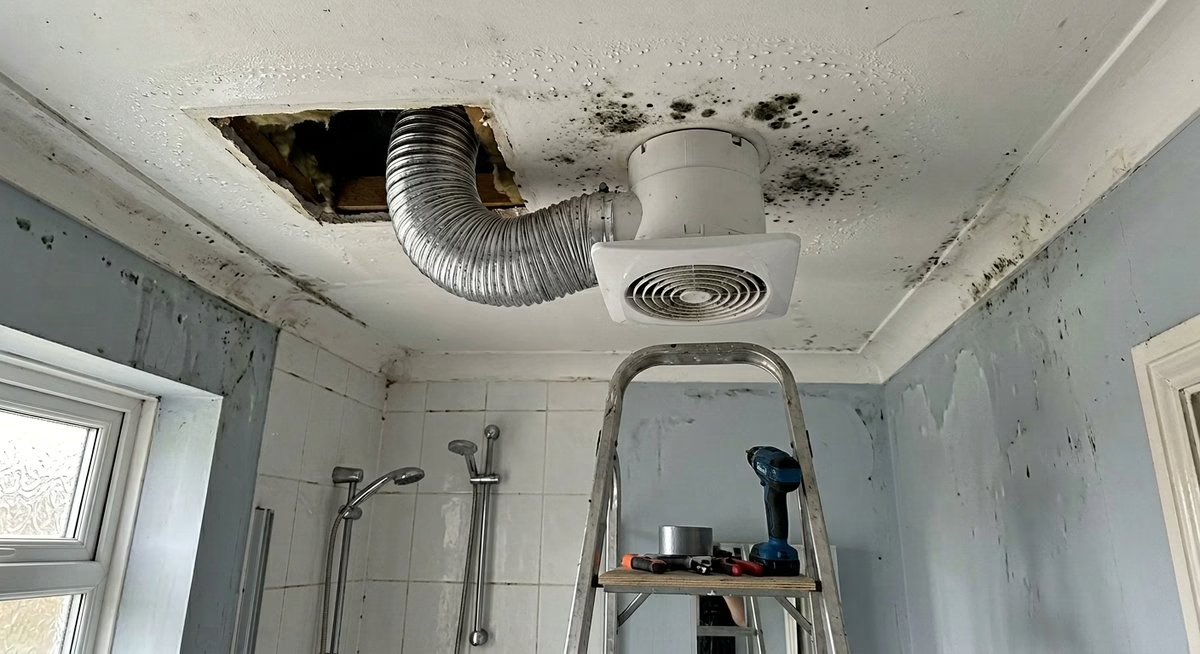
If your bathroom extractor fan runs every time you shower but the room still drips with condensation, fogged mirrors take ages to clear, and you have noticed dark patches creeping across the ceiling — there is a good chance the fan is not actually ducted to outside. It is a problem we see regularly at Fixiz, and it is more common than most homeowners realise. A bathroom extractor fan not vented outside UK homes is one of the leading causes of hidden damp, loft mould, and long-term structural damage — yet it often goes undetected for years because the fan appears to be working perfectly from inside the room.
Why a Fan That Blows Into a Void Is Not Really Ventilating
An extractor fan has one job — remove warm, moisture-laden air from the bathroom and discharge it to the outside. When a fan terminates inside a ceiling void, loft space, or boxed-off cupboard instead of reaching the exterior, every shower you take pumps humid air into a space that was never designed to handle it. The moisture condenses on cold surfaces — roof timbers, insulation, plasterboard — and creates the perfect breeding ground for mould and rot. Over time, the damage spreads silently through the building fabric while everything looks fine from the bathroom below.
We once inspected a property in south London where the homeowner had noticed a musty smell in the bedroom below the loft. When we opened the loft hatch, the roof felt was dripping wet and the rafters were coated in black mould. The cause was a bathroom fan whose flexible ducting hung loose in the loft, pumping steam into the roof space for years.
Warning signs that your fan may not be ducted to outside include:
- Persistent condensation on bathroom walls and windows: despite the fan running during and after every shower.
- Damp or discoloured patches on ceilings below the loft: moisture soaking through from the void above.
- Wet or compressed loft insulation: insulation near the bathroom feeling damp to the touch.
- Mould on loft timbers or roof felt: black or green growth on rafters above the bathroom.
- A musty smell you cannot trace: often strongest in rooms beneath the loft space.
Tip: The simplest first check is to go outside and look for the vent terminal — a grille on the wall, a tile vent on the roof, or a soffit vent under the eaves. If you cannot find one, the fan almost certainly terminates inside the building.
Part F Building Regulations — What the Law Actually Requires
Under Approved Document F of the Building Regulations, bathrooms in England require adequate mechanical ventilation to control moisture and maintain indoor air quality. Similar requirements apply in Wales and Scotland. The key requirements homeowners need to know are:
- Minimum extraction rate: an intermittent bathroom extractor fan must achieve at least 15 litres per second (l/s), or 8 l/s for continuous systems such as dMEV units that run constantly.
- Windowless bathrooms must have mechanical ventilation: if your bathroom has no openable window, an extractor fan ducted to outside is a legal requirement.
- Fans must discharge to outside: venting into a loft, ceiling void, or internal space does not satisfy the regulations.
- Fan position: mounted as high as practical, no more than 400 mm below the ceiling.
- Electrical compliance: installing a new fan circuit falls under Part P — the work must be carried out or certified by an electrician registered with NICEIC or NAPIT.
Part F applies fully to new builds and extensions, but also when you carry out building work in an existing bathroom. If your refurbishment makes the property less compliant than before, you may need to bring ventilation up to current standards. Landlords have additional obligations under the Homes (Fitness for Human Habitation) Act 2018 to ensure adequate ventilation — a fan that vents into a void rather than outside would not satisfy these requirements. On our projects, we always confirm the duct termination point before signing off any bathroom ventilation work, because we know this is one of the most commonly overlooked details in the trade.
Tip: If you are buying a property, ask specifically whether the extractor ducting runs to the outside. A fan that vents into a void is worse than no fan at all — it gives a false sense of security while pumping moisture into the building fabric.
Choosing the Right Fan — Axial vs Inline and Centrifugal
Not all extractor fans are created equal, and the right choice depends almost entirely on how far the air needs to travel through ducting to reach the outside. This is where many installations go wrong — a cheap axial fan gets fitted because it is the simplest and cheapest option, but the duct run is too long for it to push air through effectively.
- Axial fans: the most common type — flat, round units mounted on walls or ceilings. They work well when the duct run is short and straight, typically under 1.5 metres with minimal bends. Beyond about 3 metres of ducting, an axial fan struggles because it generates very little static pressure.
- Inline fans: mounted within the ductwork itself, usually in the loft. Mixed-flow inline models deliver higher pressure while staying compact and quiet — the go-to choice for runs through a loft to a tile vent or soffit vent.
- Centrifugal fans: these generate significantly higher static pressure by turning air through a 90-degree bend internally. Popular for bathrooms without an external wall, where duct runs involve distance and turns. They are noisier than inline alternatives but handle resistance far more effectively.
On a recent project in a terraced house, we replaced a wall-mounted axial fan connected to a four-metre run with two 90-degree bends. The homeowner said it “barely did anything.” We fitted a mixed-flow inline fan in the loft with rigid ducting to a tile vent — the bathroom mirror was clearing within minutes.
Tip: When comparing fans, look at the extraction rate at expected system resistance (measured in Pascals), not just the “free air” rate on the box. A fan rated at 25 l/s in free air might deliver only 10 l/s against 30 Pa of duct resistance.
Ducting Best Practice — Routing, Materials, and Common Mistakes
Even the best fan will underperform if the ducting is poorly routed. Good duct design follows straightforward principles:
- Keep it short: every metre adds resistance. The shorter the run from fan to outside, the better the airflow.
- Keep it straight: each bend significantly reduces airflow. Use sweeping 45-degree bends or long-radius fittings rather than sharp elbows.
- Insulate in cold spaces: when ducting passes through an unheated loft, warm air inside condenses on cold duct walls. Use factory-insulated ducting or rigid duct with insulation giving a thermal resistance of at least 0.6 m²K/W. Insulation should ideally be factory-applied rather than wrapped on site.
- Slope towards the outside: a gentle fall ensures condensation drains outward rather than back into the fan or ceiling.
- Fit a condensation trap on vertical runs: where the duct rises vertically to a tile vent, fit a trap near the base with a drain pipe discharging at eaves level.
- Terminate correctly: the duct must end at a proper external grille, tile vent, or soffit vent with a backdraught shutter. Position at least 300 mm from windows, doors, and boiler flues.
We always emphasise to our clients that ducting is not an afterthought — it is half the installation. A powerful fan with poorly routed ducting will be outperformed by a modest fan with a clean, short duct run.
One of the most common shortcuts we encounter is an entire duct run done in cheap flexible ducting. Rigid ducting — round PVC or flat channel — has smooth internal walls that create minimal resistance, making it the right choice for any run over 1.5 metres. Flexible ducting has a corrugated surface that creates turbulence and higher resistance. It sags, kinks, and compresses over time. Industry guidance limits flex duct to a maximum of 1,500 mm, used only as a final connection between rigid ductwork and the fan or vent.
When flex duct is used, it must be pulled taut to at least 90 per cent of its maximum length, supported at no more than 600 mm intervals, and secured with jubilee clips rather than tape.
On one job in a 1930s semi, we found three metres of unsupported flex duct draped across loft joists — sagging, kinked, and partly crushed under stored items. We replaced it with rigid 100 mm round duct, clipped and insulated. Measured airflow at the grille more than doubled.
Tip: If a fitter plans to run the entire duct in flexible tubing, ask why. Rigid ducting is usually achievable and delivers far better long-term performance.
Retrofit Options for Houses and Flats — And Who Does the Work
Retrofitting proper ducting to an existing bathroom varies in complexity depending on the type of property:
Houses with loft access
The most straightforward scenario. A ceiling grille connects via ducting through the loft to a tile vent or soffit vent. An inline fan mounted in the loft on a plywood base handles the extraction. The electrician runs wiring, and a roofer may be needed for the tile vent. The job can often be completed in a day.
Houses without loft access above the bathroom
If the bathroom is on the ground floor with rooms above, ducting may need to run horizontally through a ceiling void to an external wall. Flat-channel ducting works well here — it can be concealed above a ceiling or within a bulkhead. A wall-mounted grille with a backdraught shutter completes the run.
Flats
Flats can be trickier — you may not have a loft, an external bathroom wall, or easy access to a discharge point. Options include running duct through a ceiling void to an external wall in an adjacent room, or through a cupboard to reach an exterior surface. In some flats, communal risers may be available — check with the freeholder first. Centrifugal or high-pressure inline fans are typically needed because duct runs tend to be longer.
In terms of who does the work, installation typically involves two or three trades:
- Electrician (Part P registered): wiring, isolator switch, circuit connection, and certification.
- Roofer: needed if the duct terminates through the roof via a tile vent — ensuring a watertight seal is skilled work.
- General builder or bathroom fitter: ducting route, core drilling, boxing-in, and making good.
At Fixiz, we coordinate these trades so you are not juggling three separate contractors. We find this is where homeowners get most frustrated — the electrician says ducting is not his job, the builder says wiring is not his problem, and nobody takes ownership of the complete installation.
The Condensation Cascade — What Happens If You Leave It Unfixed
Ignoring a fan that vents into a void rather than to outside sets off a predictable chain of damage that gets progressively worse and more expensive to put right:
- Surface condensation and mould: bathroom walls and grout develop persistent mould that returns no matter how often you clean it. Paint peels, sealant blackens, and the room never feels properly dry despite the fan running.
- Moisture migrates into the building fabric: warm, damp air pushed into a ceiling void or loft condenses on cold surfaces — the underside of roof felt, timber rafters, metal fixings, and insulation. Over weeks and months, these surfaces stay permanently damp.
- Insulation loses effectiveness: wet insulation conducts heat far more readily than dry material. Heating bills rise because the thermal barrier above the bathroom — and potentially adjacent rooms — is compromised.
- Timber decay and structural risk: sustained moisture causes rafters and joists to soften. Wet rot sets in first; if dampness persists, dry rot can follow — a far more destructive and costly problem to remediate.
- Mould becomes a health hazard: prolonged exposure to mould spores — particularly in lofts and voids where growth can be extensive before anyone notices — is associated with respiratory problems, allergic reactions, and worsened asthma.
- Costly remediation: a straightforward ducting job can escalate into replacing roof timber, re-insulating the loft, treating mould, and redecorating multiple rooms. We have seen remediation costs reach ten times the original ducting installation.
The fix — properly ducting the fan to an external vent — is usually a one-day job costing a few hundred pounds. The remediation after years of hidden moisture damage can run into thousands.
Tip: If you suspect your fan is venting into a void, pop your head into the loft with a torch and follow the ducting. If it ends in thin air rather than connecting to a tile vent or soffit grille, you have found the problem.
Frequently Asked Questions
Is it legal to have a bathroom extractor fan that vents into the loft?
No. Under Part F, extracted air must be discharged to outside the building. Venting into a loft or ceiling void does not satisfy the regulations. If your fan vents into the loft, it needs extending to a tile vent, soffit vent, or wall grille.
Can I install bathroom extractor fan ducting myself?
You can physically run the duct yourself if you are comfortable working in a loft, but the electrical connection must be carried out or certified by a Part P registered electrician. If you are cutting into a roof for a tile vent, that is best left to a roofer to ensure a watertight finish.
How much does it cost to duct a bathroom extractor fan to outside in the UK?
A straightforward loft-to-tile-vent installation with an inline fan typically costs £250–£500 including materials and labour. More complex routes in flats or properties without easy access can run to £600–£900, particularly if core drilling through masonry is required.
What size ducting should I use for a bathroom extractor fan?
The standard is 100 mm (4 inch) round duct or the equivalent flat-channel profile. A smaller diameter restricts airflow and can prevent the fan achieving 15 l/s. Match the duct diameter to the fan outlet — never reduce it.
Do I need a backdraught shutter on my bathroom extractor fan duct?
Yes — a backdraught shutter at the external termination prevents cold air blowing back in when the fan is off. Without one, you get draughts, heat loss, and potentially insects entering the ductwork. Most external grilles and tile vents include an integrated shutter.
How do I know if my extractor fan is powerful enough?
Check the fan’s rated extraction at expected system resistance — not the free-air figure on the packaging. You need at least 15 l/s at the actual operating resistance of your duct run. If the rated flow drops below 15 l/s at 20–40 Pa, you need a more powerful fan or a shorter duct route.
Ready to move from confusion to construction? Get in touch with Fixiz today for a no-pressure chat about your project and the fastest route to full compliance.