
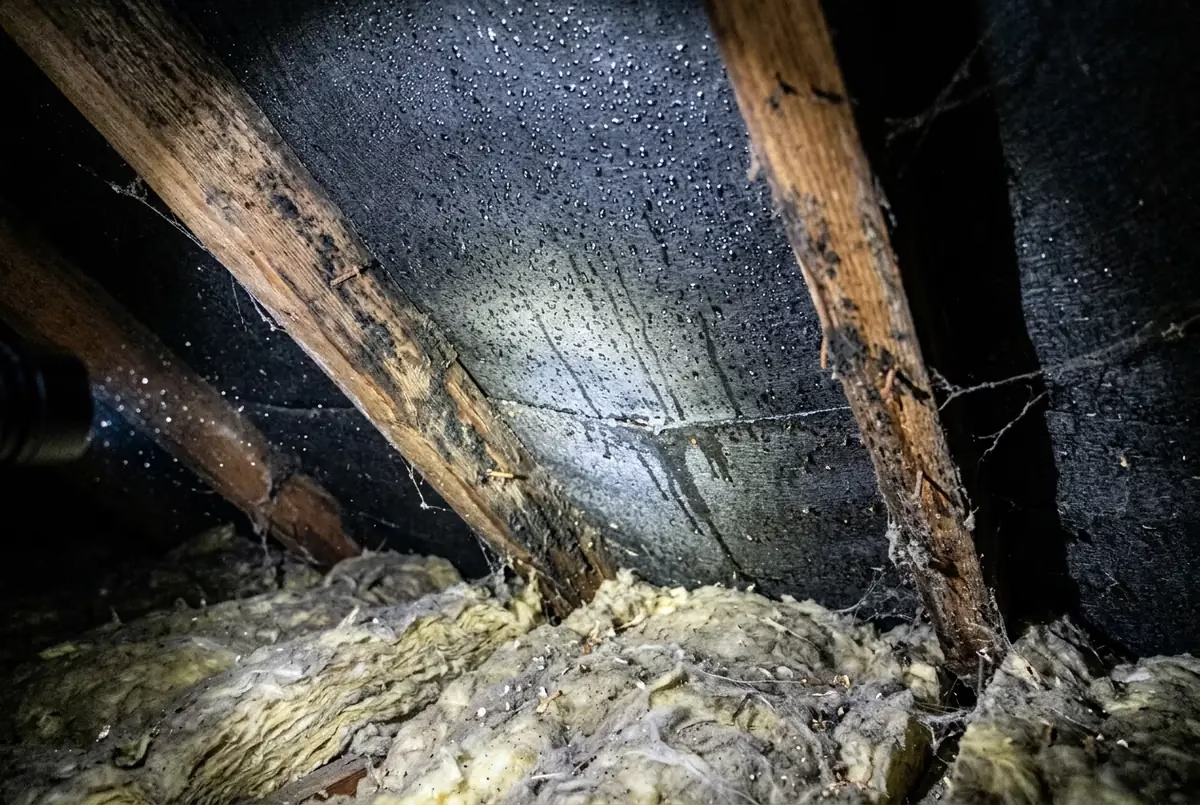
You go into the loft on a cold morning and the underside of the roof is wet. Droplets hang off the felt, the timbers look dark, there might be drips on the insulation or a musty smell, and some people find a stain appearing on the bedroom ceiling below. The first fear is usually a roof leak. Very often, though, the water hasn’t come in from outside at all. It’s condensation, made from moisture that has travelled up from the house.
Condensation in the loft is common, and much of it is fixable without a new roof. But it needs the right diagnosis, because the fixes for a leak and for condensation are very different.
Leak or condensation? How to tell
A few quick checks help separate the two:
- Pattern. Condensation tends to appear as droplets or a damp sheen spread across large areas of the felt, nails and the cold side of the roof. A leak usually shows as a localised wet patch or a drip line below a specific point, such as a slipped tile, a chimney or a valley.
- Timing. Condensation is typically worst on cold, clear nights and early mornings, even when it hasn’t rained. A leak follows rain, especially wind-driven rain. If damp appears in the house when it rains, our guide on why your house smells damp when it rains covers entry points.
- Frost. In very cold weather you may see frost or ice on the underside of the felt or on nail tips, which is a classic sign of condensation.
The NHBC’s guide to condensation in your roof space notes that most cases are temporary and happen when outside temperatures are cold, change from warm to cold, or drop sharply between day and night. Occasional light condensation can be normal; persistent dripping, mould on timbers or wet insulation isn’t.
Why condensation forms in a loft
Everyday life produces a lot of water vapour: showers, cooking, drying washing indoors, boiling kettles and simply breathing. Warm, moist air rises, and if it can get into the loft it meets the cold underside of the roof and condenses. Three things usually combine:
- Moisture getting into the loft. Gaps around the loft hatch, pipes, cables, downlights and the tops of internal walls let warm air through. A very common culprit is a bathroom or kitchen extractor fan ducted into the loft instead of to the outside, or a duct that has come loose. Approved Document F defines extract ventilation as air discharged to the outside, not into the roof space. See bathroom extractor fan not vented outside.
- A colder roof space. Thicker loft insulation keeps the rooms below warm, but it also means less heat reaches the loft, so the roof is colder. The NHBC and the Energy Saving Trust both point out that this can make condensation more likely. That’s not a reason to avoid insulation (the Energy Saving Trust gives 270 mm as the minimum recommendation for new builds), but it does mean ventilation has to keep up.
- Blocked or missing ventilation. Many pitched roofs rely on ventilation at the eaves, so air can flow across the roof space. When insulation is pushed right into the eaves, or the eaves are boarded or sealed, that airflow stops.
Roofs that have been re-covered at some point often have traditional bitumen felt under the slates or tiles, which doesn’t let vapour pass through, so they depend on ventilation. More recent roofs may have a “breathable” membrane, but roof tile manufacturer Marley stresses that this doesn’t remove the need for ventilation as set out in BS 5250, the British Standard code of practice for controlling condensation.
What the rules and guidance say
Approved Document C (paragraph 6.11) says the requirement to resist interstitial condensation in roofs is met by ventilating cold deck roofs, and paragraph 6.12 says gaps and penetrations for pipes and wiring should be filled and sealed, particularly over bathrooms and kitchens, and that loft hatches should have an effective draught seal. Building control guidance such as Bath & North East Somerset Council’s gives typical figures for ventilated roofs: a continuous 25 mm opening (or equivalent) along the eaves, a clear 50 mm air space between insulation and roofing felt where the insulation follows the slope, and 5 mm at the ridge where needed.
The SPAB’s advice on loft insulation sums up the approach well: keep a ventilation path at the eaves, restrict moist air getting into the roof space by sealing ceiling gaps and fitting tight hatches and tank lids, and avoid cold spots by insulating consistently, including the edges.
How to fix condensation in the loft
Start with the cheapest, most effective steps, in this order:
- Stop the moisture at source. Check every extractor duct in the loft ends at an outside vent and is properly connected. Use extractor fans when showering and cooking, and avoid drying washing indoors without ventilation.
- Seal the ceiling. Fit a draught-sealed loft hatch and seal around pipes, cables and light fittings. If there’s a cold water tank, make sure it has a fitted lid. See loft water tanks.
- Clear the eaves. Pull insulation back so it doesn’t block the eaves vents, and fit rafter trays or eaves ventilators to hold an air path open over the insulation.
- Add ventilation if there isn’t enough. Eaves vents, tile or slate vents, or a vented ridge can be added. This should be designed for your roof covering and underlay, ideally by a roofer or surveyor familiar with BS 5250.
- Dry and check the timbers. Once the cause is fixed, the roof should dry out. Have any persistently wet or mouldy timbers checked for decay; our guide to wet rot vs dry rot explains what to look for.
If the house generally suffers from condensation, whole-house measures such as better extract or positive input ventilation may help; see does PIV stop condensation? Be aware that PIV units installed in the loft draw air from the roof space, so get advice on how they interact with your loft.
Thinking of converting the loft?
A loft conversion changes how the roof is ventilated, because the insulation moves from the ceiling to the roof slope. Deciding between a warm roof and a cold roof is a key part of avoiding condensation in the finished rooms. See warm roof vs cold roof loft insulation.
Frequently asked questions
Is some condensation in the loft normal?
Light, occasional condensation during cold snaps can happen, and the NHBC notes most cases are temporary. Persistent dripping, wet insulation or mould on timbers means the cause needs fixing.
Can new loft insulation cause condensation?
It can make it more likely, because the roof space becomes colder, especially if the insulation blocks the eaves vents. Keep ventilation paths clear and seal gaps in the ceiling.
Will a dehumidifier in the loft fix it?
It may reduce the symptoms, but it doesn’t deal with the cause. Stopping moist air getting into the loft and making sure it’s ventilated are the lasting fixes.
Can condensation in the loft damage the roof?
Persistent condensation can wet insulation, encourage mould and, over time, contribute to timber decay. That’s why it’s worth fixing rather than ignoring.
Damp or condensation in your loft?
We trace where the moisture is coming from before recommending anything, so you don’t pay for a roof repair you don’t need. See our damp survey service, request a project review, or call 020 7971 1318.
General information only. Take care in lofts: walk only on joists or boards, and get professional advice before altering roof ventilation. Sources checked on 11 November 2026.