
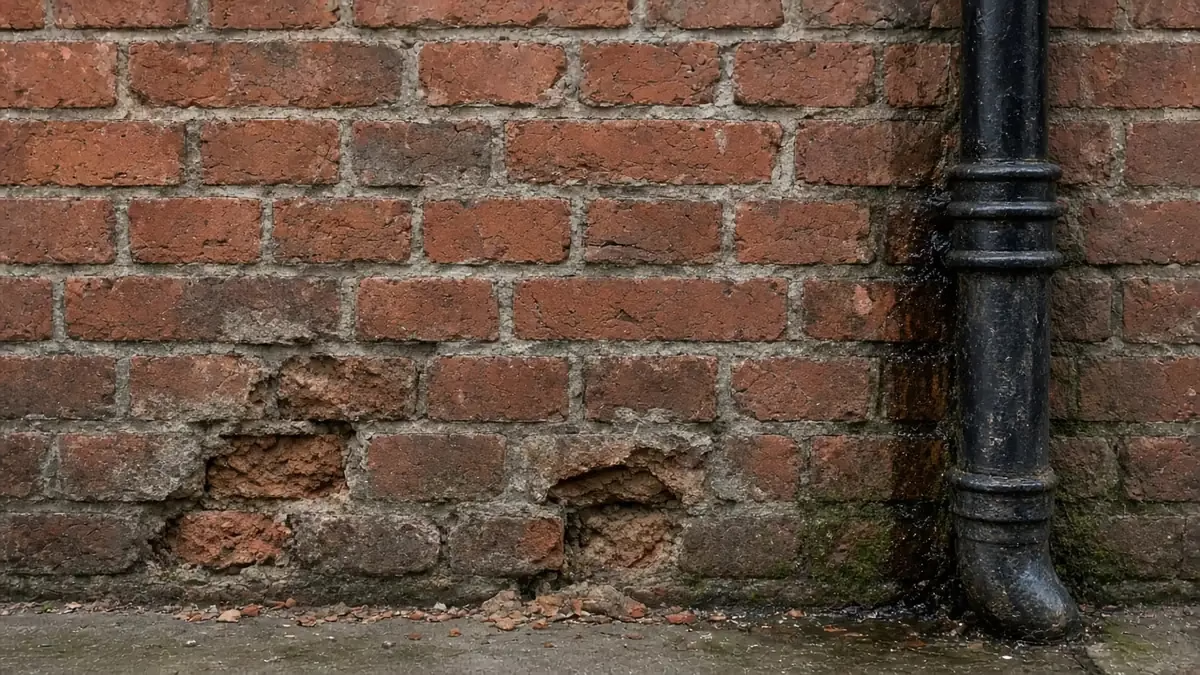
After a cold, wet winter, a lot of London homeowners find small curved flakes of brick on the path, or notice that a few bricks on the chimney stack, the garden wall or the low part of the front elevation have lost their faces and gone soft and crumbly. That’s spalling. It looks cosmetic at first, but it’s usually a sign that part of the wall is staying too wet, and the wrong repair can make it spread.
Here’s what causes spalling bricks, how to find the source of the water, and how to repair the wall so it doesn’t keep happening.
What spalling is
Spalling is the flaking, crumbling or breaking away of the face of a brick or stone. Historic Environment Scotland’s guidance on brick describes how it causes the loss of the brick’s hard outer surface, known as the “fire skin”, and ultimately the complete deterioration of the brick. Once that skin has gone, the softer body of the brick behind absorbs water more easily, so a spalled brick tends to keep getting worse.
Typical signs:
- flakes or thin layers of brick face on the ground below the wall;
- bricks with a hollow, eroded face while the mortar joints around them stand proud;
- a powdery, white or crumbly surface on some bricks;
- damage concentrated in particular places: chimney stacks, parapets, garden walls, the bottom few courses, or under a gutter or downpipe.
What causes bricks to spall
Water, then frost
The most common mechanism is simple. Bricks that are kept saturated by a defect get frozen, the water expands, and the face breaks off. The same Historic Environment Scotland guidance makes the key point: dry masonry isn’t damaged by frost, so keeping brickwork free from saturation is what matters. It also notes that bricks vary a lot in their frost resistance, with more porous bricks more vulnerable.
Salts
Water carries soluble salts into the brick. As it evaporates, the salts crystallise, and if they build up just under the surface rather than on it, the crystal pressure pushes the face off. White powder on the surface (efflorescence) is a related sign that the wall has been wet and salts are moving.
Hard cement pointing
In older solid brick walls, the mortar joints were designed to be the softer, more porous part of the wall, so moisture evaporated through the joints. When the joints are repointed with hard cement mortar, the water has to come out through the bricks instead, and the brick faces decay. The SPAB’s guide to repairing old brick walls lists crumbling (spalling) of brick faces due to frost action, particularly on parapets and chimney stacks, or the use of a cement mortar rather than a lime-based one, among the common causes of decay. You’ll often see it as a wall where the cement joints are intact and standing out while the bricks between them have eroded back.
Coatings that trap moisture
Masonry paints and water-repellent sealants applied to old, solid brickwork can trap moisture and salts behind the surface. Heritage House, a building conservation specialist, warns that these coatings can make spalling worse, and that salts can crystallise behind surface treatments and force them off.
Where the water usually comes from
Spalling is a symptom. Before anyone replaces a brick, the source of the water needs to be found. The usual suspects, drawing on the conservation guidance above:
- Leaking gutters, joints and downpipes soaking the same patch of wall every time it rains.
- Failed copings and parapets, so water runs down the face of the wall instead of being thrown clear.
- Chimney stacks, exposed on all sides, with worn flaunching, failed flashings or no cap.
- High ground or paving keeping the bottom of the wall wet, and splash-back from hard surfaces. See patio higher than the damp proof course.
- Cement pointing or render trapping moisture, as above. See cement render and damp.
- Exposed elevations that take the worst of the wind-driven rain, such as gable ends. See damp on a gable end wall.
Is spalling a damp problem inside the house too?
It can be. In a solid brick wall, the same saturation that causes spalling outside can show up as damp patches, stained plaster or a musty smell inside, particularly after rain. Spalled bricks also absorb more water than sound ones, so the problem feeds itself. If you’re seeing both, the outside defect is usually the place to start, not the inside wall. Our guides on why a house smells damp when it rains and rising vs penetrating damp explain how to tell where internal damp is coming from.
How spalled brickwork is repaired
The conservation bodies agree on one principle: do the minimum needed, with materials that suit the wall. Replacing more than you need can introduce denser bricks that shed water onto the old ones around them.
1. Fix the water source
Repair the gutter, coping, flashing or ground level first. Without this, new bricks and new pointing will start to fail the same way.
2. Decide which bricks actually need attention
Not every damaged brick has to come out. Historic Environment Scotland’s guidance suggests bricks can probably be left in place if they have only minor cracks that aren’t getting worse, or spalling that affects less than 20% of the brick’s surface. It’s guidance written for traditional buildings in Scotland, but the principle of keeping sound original bricks applies just as well to a London terrace.
3. Reverse, replace or repair the bad ones
- Reversing: the SPAB notes that bricks can often be carefully removed and turned round to hide the decayed face.
- Replacing: badly spalled bricks are cut out and replaced with bricks that match in size, colour, texture and, importantly, how they handle water. Reclaimed bricks are often the best match for older London houses.
- Mortar repairs: a coloured lime-based mortar can build up a decayed face, but the SPAB says it takes skill to get a good long-term colour match.
Bricks should be cut out carefully by hand or with suitable tools. Heritage House warns against angle grinders, which damage the edges of the surrounding bricks.
4. Repoint only where it’s needed, with the right mortar
For buildings pre-dating around 1919, the SPAB advises using lime mortar rather than cement, so that moisture can evaporate through the joints instead of the bricks. Not every joint needs work either: Historic Environment Scotland’s rough guide is that a joint doesn’t need repointing until it has eroded deeper than its width, unless water is coming through it or cement pointing is damaging the bricks. Our guide to breathable materials after damp works covers the inside face of the same walls.
What to avoid
- Patching with cement or filling holes with cement mortar.
- Painting or “sealing” the wall to stop the flaking.
- Repointing a whole elevation in cement because a few bricks have failed.
- Replacing sound bricks just to make the wall look uniform.
When it’s more than a surface problem
Get a structural engineer’s view if you see cracks running through both bricks and mortar that are widening, bulging, or damaged brickwork over windows and doors. The SPAB lists causes such as tree roots, rotten timber lintels over openings and the removal of internal load-bearing walls. Badly spalled chimney stacks and parapets also deserve prompt attention, because loose material at height can fall. If your house is listed, speak to the council’s conservation officer before changing materials or replacing brickwork.
Frequently asked questions
Can spalled bricks be repaired without replacing them?
Sometimes. Minor spalling can often be left once the water source is fixed. Bricks can sometimes be reversed, and lime-based mortar repairs can rebuild a decayed face, though they take skill to match.
Should I paint or seal spalling bricks?
Generally not on old solid brick walls. Paints and sealants can trap moisture and salts behind the surface and make spalling worse.
Does the whole wall need repointing?
Rarely. Repoint the joints that have failed or are causing damage, using a mortar suited to the wall, typically lime for older houses.
Is spalling caused by rising damp?
Spalling at the bottom of a wall can be linked to ground moisture, high paving or splash-back, but most spalling comes from rain, leaks, frost and hard pointing. Find the actual source before paying for any damp treatment.
Worried about spalling brickwork?
We inspect the outside of the wall first, find where the water is coming from, and repair the brickwork with materials that suit the house. See our damp survey service and damp proofing guide for London homes, request a quote and project review, call 020 7971 1318 or message us on WhatsApp.
General information only. Structural cracking should be assessed by a structural engineer, and listed buildings may need consent for repairs. Sources checked on 18 November 2026.