
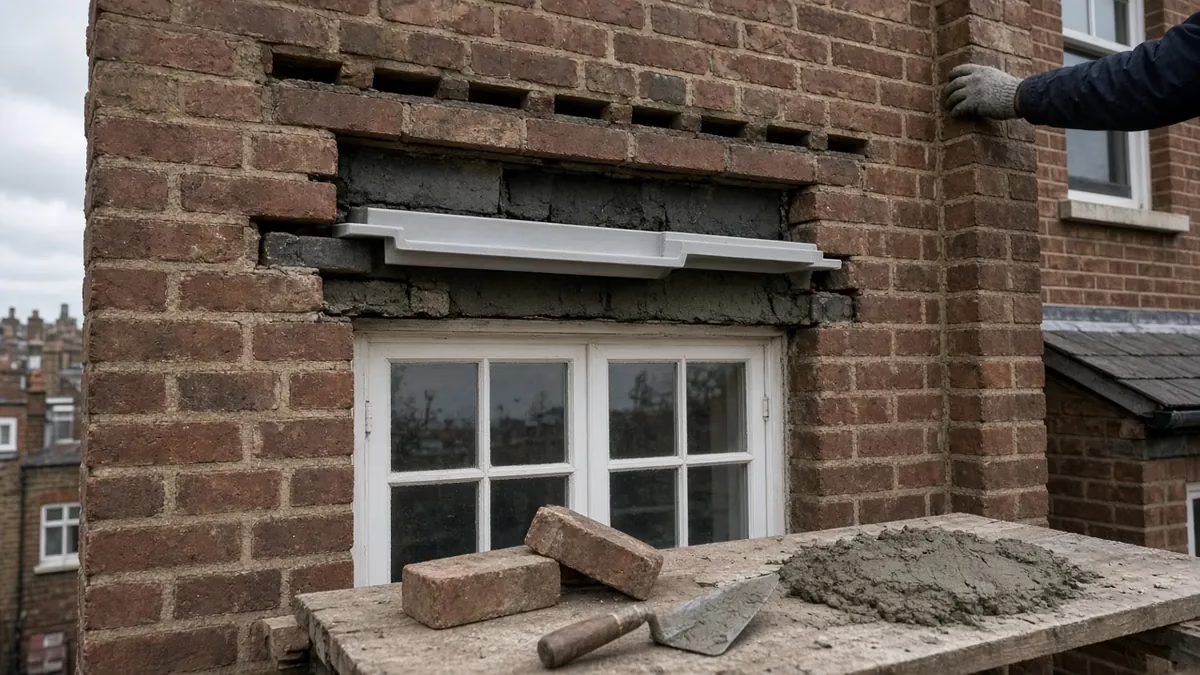
A damp patch or a band of mould just above a window is a common worry for London homeowners. It tends to come back after you repaint, and it’s easy to blame the window. In reality, the area above a window is where several different problems meet: rain getting past the lintel, water trapped in a cavity, a leak from higher up, or condensation on a cold patch of wall.
Each has a different fix, so the first job is working out which one you have.
Start with what the damp looks like
The pattern and timing tell you a lot before anyone gets a ladder out:
- A brownish patch, often with a tide mark, that grows or darkens after rain points to water getting in from outside (penetrating damp).
- Black speckled mould along the top of the window reveal or the wall just above, worse in winter, usually points to condensation. The RICS consumer guide to damp and mould lists areas around windows and ceilings close to external walls among the places where condensation typically shows.
- Damp that appeared after new windows were fitted is often about ventilation or the seal round the new frame. See mould after new windows.
- Damp around a bay window has its own set of causes, covered in damp around a bay window.
Keep a note for a few weeks: does it get worse the day after heavy, wind-driven rain, or on cold mornings when the windows are running with condensation? That one observation narrows things down a lot.
Is your wall solid or cavity?
The likely causes depend on how the wall is built. Most Victorian and Edwardian London houses have solid brick walls, while houses from roughly the inter-war period onwards are more likely to have cavity walls: two leaves of masonry with a gap between them. If you can see bricks laid with their short ends facing out (headers) in a regular pattern, the wall is probably solid; if every brick shows its long side, it’s often the outer leaf of a cavity wall. A surveyor or builder can confirm it.
Cavity walls: cavity trays, stop ends and weep holes
In a cavity wall, some rain always gets through the outer leaf and runs down the inside face of it. Above a window, that water meets the lintel. To stop it crossing to the inner leaf, a cavity tray (a damp-proof course shaped to fall outwards) is built in above the lintel, with stop ends to stop water running off the ends of the tray and weep holes in the outer leaf to let it drain out.
Approved Document C (paragraph 5.30) says damp-proof courses should be provided to direct moisture towards the outside where the downward flow of moisture would be interrupted at an obstruction, giving a lintel as the example. In its guidance on damp-proof trays, paragraph 5.5 adds that where a tray doesn’t extend the full length of the wall, for example above an opening, stop ends and at least two weep holes should be provided. LABC Warranty’s technical guidance adds that the tray should sit directly over the window head, extend beyond the lintel ends, and that weep holes should be provided at each end and at no more than 900mm centres.
Things that go wrong:
- Blocked weep holes, filled with mortar, render, paint or debris, so water sits on the tray.
- Missing stop ends, so water runs off the ends of the tray into the cavity, often showing as damp at the top corners of the window.
- No tray at all, or one that’s damaged, too short or falling the wrong way.
- Mortar droppings or debris on the tray bridging the cavity.
- Cavity insulation that lets water track across. See damp after cavity wall insulation.
From outside, look at the first course of bricks just above the window. You should normally see weep vents or open joints. If there are none, or they’re blocked, that’s a strong clue.
Solid walls: lintels, arches and pointing
A solid wall doesn’t have a cavity tray. Above the window there’s usually a brick arch or a flat brick head on the outside, often with a timber lintel behind on the inside. Damp above the window in these houses usually comes from:
- Eroded or cracked pointing in the brickwork over the window, letting rain soak straight in.
- Cracked or dropped arches, which can also be a structural sign.
- Timber lintels that have been wet for years. The SPAB lists rotten timber lintels over windows and doors among the causes of cracking and bulging in brickwork, so damp here deserves a proper look rather than another coat of stain block.
- Spalled bricks, whose damaged faces soak up more water than sound bricks.
- Cement render or a missing drip over the window, so water runs back onto the wall. See cement render and damp.
Water coming from higher up
The damp may show above the window but start somewhere else. Water runs down inside a wall before it appears, so check above and to the sides as well:
- an overflowing or leaking gutter, especially at a joint or outlet directly above;
- a downpipe leaking at a joint into the wall;
- a balcony, bay roof or flat roof above with failed flashings;
- the seal between the window frame and the wall. The RICS guide mentions broken sealant around a window letting rainwater in.
Our guide to why a house smells damp when it rains covers these entry points in more detail.
Condensation on a cold lintel
If the mould is black and spotty, appears mostly in winter, and the wall outside looks sound, condensation is the likely cause. Lintels, especially concrete or steel ones, can be colder than the wall around them, so the warm moist air in the room condenses there first. The RICS guide explains that condensation forms on the coldest surfaces when indoor temperatures drop or humidity is high.
The fixes are about moisture and temperature, not damp-proofing:
- use extractor fans when cooking and showering and keep those doors closed;
- keep trickle vents open, or open windows for short periods;
- keep the room more evenly heated rather than letting it go cold;
- where the reveal is very cold, ask whether insulating the reveal and the area over the window is practical when you next redecorate or replace the window.
See mould on the ceiling and mould on external walls behind wardrobes for the same mechanism elsewhere in the room.
How a proper damp inspection approaches it
A good damp inspection for this problem starts outside, ideally after rain: the brickwork and pointing over the window, weep holes, the window head and sill, gutters and downpipes above, and any roof or balcony. Inside, it looks at the pattern of the damp, the timing, and whether there’s condensation elsewhere. A moisture meter reading on its own doesn’t tell you the cause; our article on getting an honest damp diagnosis explains why. Damp above a window is not a rising damp problem, so a quote for a chemical damp-proof course here should be questioned.
How it’s fixed
- Clearing or adding weep vents where they’re blocked or missing.
- Inserting a new cavity tray above the lintel. Refurbishment cavity trays are made to be built into existing walls, with bricks taken out and relaid a few at a time; IG Lintels’ refurbishment system is one example.
- Replacing a rotten or corroded lintel. This is structural work: it needs temporary support, the right lintel for the opening and, where required, building control involvement.
- Repointing or rebuilding the brickwork over the window with suitable mortar.
- Resealing the frame and fixing gutters, downpipes and flashings above.
Once the source is fixed, let the wall dry before replastering and decorating, and use materials that suit the wall. Our guide to plastering after damp works covers that step.
Frequently asked questions
Why is there damp above my window only when it rains?
That pattern usually means rain is getting in: through pointing or brickwork over the window, past a missing or blocked cavity tray, from a gutter or downpipe above, or through a failed seal round the frame.
Is mould above a window condensation?
Often, yes, if it’s black and spotty, worse in winter and the outside of the wall is in good condition. Lintels can be colder than the surrounding wall, so condensation forms there first.
What are the holes in the bricks above my window?
In a cavity wall they’re usually weep holes or weep vents, which let water caught on the cavity tray drain out. They should be kept clear.
Can a cavity tray be added to an existing wall?
Yes. Refurbishment cavity trays are designed to be inserted into existing walls by removing and relaying the bricks above the lintel in short sections.
Damp above a window that keeps coming back?
We find the cause from the outside in and fix that, rather than treating the plaster. See our damp survey service and damp proofing guide for London homes, request a quote and project review, call 020 7971 1318 or message us on WhatsApp.
General information only. Lintel replacement is structural work and may need building control approval. Sources checked on 18 November 2026.