
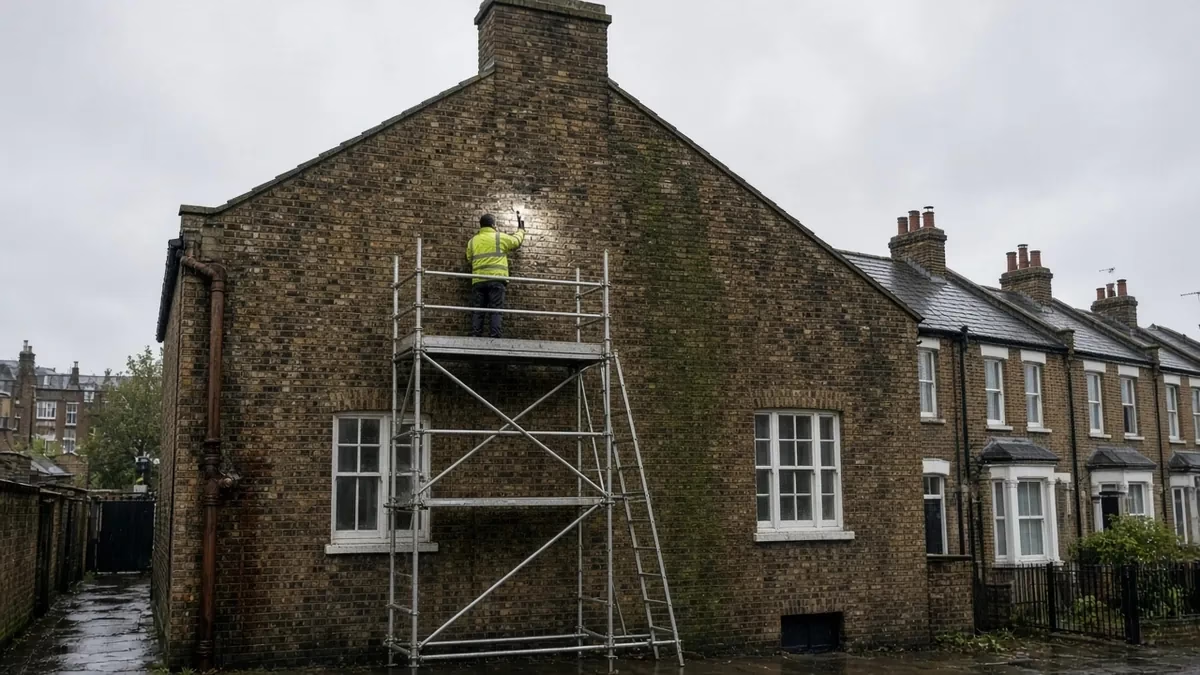
If you live in an end-of-terrace or a semi, the side wall of the house, the gable end, takes more weather than any other wall. It’s tall, often has little protection from eaves or neighbouring buildings, and it may carry a chimney stack. So it’s no surprise that damp on a gable end wall is a common complaint: a damp patch high up in a bedroom, peeling paint in the corner of the loft room, or a stain that spreads every time there’s wind and rain.
Here’s why gable walls get damp, how to trace the cause, and how to fix it without making the wall worse.
Why gable walls are prone to damp
A gable is the triangular top of the side wall under a pitched roof, but in practice the whole side wall of an end-of-terrace or semi behaves the same way: it’s exposed. Historic Environment Scotland’s guide to damp gables describes gable walls as often the most exposed part of a building and susceptible to driving rain, with defects typically appearing at the chimney and the roof edge first. The SPAB guide to rainwater penetration similarly lists roofs, chimneys, parapets and sometimes south-westerly facing walls as the parts of a building most susceptible to rain getting in.
In London, a gable wall facing south-west into the prevailing weather is often the one that suffers most, but any exposed side wall can be affected.
The usual causes
1. Worn or cracked pointing
On solid brick walls, common in Victorian and Edwardian houses, the mortar joints are where most rain gets in. Open, cracked or eroded joints let wind-driven rain soak deep into the wall. Repointing with a hard cement mortar on an old soft-brick wall can make things worse, as it can trap water and damage the bricks around it.
2. The roof edge (verge)
Where the roof meets the top of the gable, the verge needs to shed water off and away from the wall. Loose or missing verge mortar, slipped tiles, rotten bargeboards or a defective dry verge system can let water run down into the top of the wall. Clue: damp near the ceiling or in the top corners of the room, or in the loft along the wall head.
3. The chimney stack
Many gables carry a chimney. Failed flashings, a cracked chimney crown, open pots or porous brickwork on the stack can all send water down inside the wall. The HES guide notes that the poor condition of a chimney can cause problems to the gable below, and that wet masonry can bring salts from the chimney through to the inside surface as yellow or brown stains. See damp on an unused chimney breast.
4. Gutters and downpipes at the corners
A gable end usually has the ends of the gutters and a downpipe at one or both corners. A blocked outlet, a leaking joint or an overflowing gutter can soak the corner of the wall. The RICS consumer guide to damp and mould suggests going outside in the rain to see whether your gutters are overflowing.
5. Cracked or failed render
Many gable walls were rendered to keep the weather out. Once a hard render cracks, rain gets in behind it and can’t easily dry out, so the wall can end up wetter than if it were bare. Our guide to cement render and damp explains why.
6. Cavity wall problems
Houses from the 1920s and 1930s onwards often have cavity walls. Here, rain normally runs down the inside of the outer leaf and drains out. If the cavity is bridged, for example by mortar droppings on wall ties, rubble at the base, or insulation that isn’t suitable for an exposed wall, water can cross to the inner leaf. RICS lists bridged cavity walls among the things to check. See damp after cavity wall insulation.
7. Condensation on a cold wall
An exposed gable is also usually the coldest wall in the room. Mould in the corners and behind furniture, worst in winter and not linked to rain, points to condensation rather than rain getting in. It’s common for a wet wall to be cold and attract condensation as well, so the two can happen together. See mould on the ceiling and mould behind wardrobes on external walls.
How to trace the cause
- Map the damp inside. High up near the ceiling, in the top corners, around the chimney breast, in one corner, or spread across the wall? Mark the edges in pencil and photograph them.
- Match it to the weather. Does it get worse after wind and rain from a particular direction, and dry back in dry spells? That’s typical of penetrating damp. Worse in cold weather regardless of rain suggests condensation.
- Look at the outside from the ground. Use binoculars to check the verge, the chimney and its flashings, the pointing, any render cracks and the gutters at the corners. Look for dark wet patches, green algae, moss or plants growing from joints, which HES notes are signs of high moisture in the masonry.
- Check in the loft. Look at the inside face of the gable and the chimney in the roof space after rain, with a torch, for damp, staining or daylight.
- Watch it in the rain. As RICS says, if something doesn’t look right, it usually isn’t.
How to fix damp on a gable end
- Repair the roof edge and chimney first. Bed or refix verge tiles, replace rotten bargeboards, redress or renew flashings and repair the chimney crown. High-level defects often account for most of the water.
- Repoint failed joints with a mortar that suits the wall. On older solid brick walls, a lime mortar is generally the right choice; the HES and SPAB guidance both favour breathable lime-based mortars for traditional masonry.
- Repair or remove failed render. Patching a cracked cement render often just moves the problem. Sometimes the right answer is to remove it and repoint or re-render in a more suitable material; that may need checking with the council in a conservation area.
- Clear and repair the gutters and downpipes, and make sure water is carried away from the base of the wall.
- Deal with cavity bridging if investigation finds it, which can mean removing bricks to clear debris or, in some cases, extracting unsuitable insulation.
- Don’t seal the wall. HES advises that an impermeable sealant layer inside won’t solve the problem and that water-repellent treatments on masonry are ineffective in the longer term on traditional buildings. SPAB describes attempts to seal old buildings as “normally disastrous”.
- Let the wall dry, then repair inside. Once the source is fixed, give the wall time to dry before replastering and redecorating, using materials that let it breathe.
Much of this work is at height, and scaffolding or access equipment is usually needed for a gable. Don’t attempt roof or chimney repairs from a ladder without the right equipment.
A note on gables built during a loft conversion
If your gable wall was built as part of a hip-to-gable loft conversion, it’s usually a newer section of wall sitting on the old one. Damp in that area can come from the junction between the new and old masonry, the new verge, or the render on the new section, so those are the first places to check.
Frequently asked questions
Why is my gable end wall damp?
Usually because it’s exposed to driving rain, and water is getting in through worn pointing, the roof verge, the chimney, cracked render or overflowing gutters. Condensation on a cold gable wall is another common cause.
Is damp on a gable wall rising damp?
Rarely, if the damp is high up. Rising damp affects the base of walls. Damp high on a gable is almost always rain getting in, a roof or chimney defect, or condensation.
Should I put a waterproof coating on my gable wall?
Generally not, especially on older solid walls. Water-repellent coatings and impermeable sealants can trap moisture. Fix the defects letting water in instead.
Can cavity wall insulation cause damp on a gable end?
It can, if the insulation is unsuitable for an exposed wall or wasn’t installed properly, because it can carry water across the cavity. A specialist investigation can confirm whether it’s the cause.
Damp on your gable wall?
We look at the roof edge, chimney, pointing, render, gutters and the inside of the wall before recommending repairs, so you fix where the water is getting in. See our damp survey service and damp proofing in London, request a quote and project review, call 020 7971 1318 or message us on WhatsApp.
General information only. Work at height should be carried out by competent people with suitable access equipment. Sources checked on 17 November 2026.