
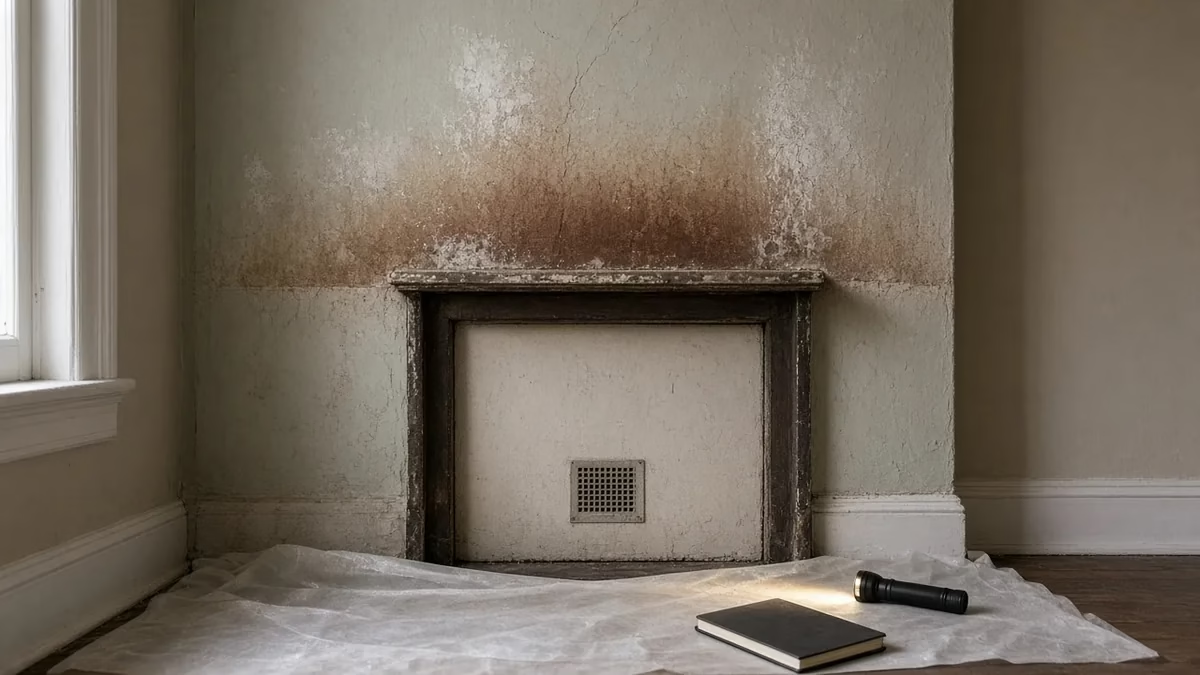
You stopped using the fireplace years ago. Maybe it was boarded up, maybe the chimney was capped. Yet there’s a brown stain or a damp patch on the chimney breast that keeps coming back, often in an upstairs bedroom, and repainting only hides it for a while.
Damp on an unused chimney breast is common in London’s Victorian and Edwardian houses, and it usually has a findable cause. This guide explains the usual culprits, what a proper damp inspection of a chimney should check, and why the fix is rarely just “damp proofing”.
Why disused chimneys get damp
When a fire was lit regularly, warm air rising up the flue helped keep the chimney dry. Once a fireplace stops being used, that drying effect stops. Historic England notes that chimneys are prone to water penetration, being very exposed to the weather and often having thin brick skins, and that a disused flue still needs some ventilation to stay dry (Historic England: open fires, chimneys and flues).
The main causes usually fall into four groups.
1. Rain getting into the stack
Weathered pointing, cracked flaunching around the pots, failed flashings where the stack meets the roof, or an uncapped pot can all let water in. The Society for the Protection of Ancient Buildings (SPAB) points out that chimney stacks are thin-walled structures vulnerable to wind-driven rain, and that many older stacks were built without a damp-proof course, so water can track down below the roofline (SPAB technical advice note). That’s one reason damp often shows on the top-floor chimney breast first.
2. Condensation inside a sealed flue
Capping the chimney and blocking the fireplace completely can trap moisture inside the flue. SPAB states that disused flues must be ventilated top and bottom, and that brown staining on the inside face of an old chimney is generally caused by condensation inside a disused or rarely used flue, carrying sooty tar deposits through to the plaster. Historic England’s guidance also says that, ideally, a sealed chimney should be hard-capped and vented externally at both its lowest and highest points.
3. Salts left behind by years of fires
This is the cause people least expect. Burning coal and wood leaves deposits in the flue and masonry that contain soluble salts. Historic England explains that certain salts are highly hygroscopic, meaning they draw moisture from the air, and that damp patches can appear even after the original source of water has been dealt with (Historic England: Assessing Damp in Historic Buildings). A typical sign is a patch that gets worse in humid weather and better in dry spells, sometimes with a white or crystalline bloom on the surface.
4. Debris blocking the flue
Historic England flags bird nests, debris from above, and fallen parging or broken brickwork from inside the flue as common problems. They can block a flue in unexpected places, leading to damp, smells and staining. Its simplest recommended check is to have the disused flue swept.
What a proper chimney damp inspection should check
A chimney breast is one location with several possible causes, so a good inspection looks at all of them before recommending anything. Expect it to cover:
- The pattern of the damp. Where exactly is it: top floor or all floors, high or low on the breast? Does it get worse after rain, or in cold, humid weather? A few weeks of your own notes or photos help a lot.
- The stack from outside. Pointing, flaunching, pots, caps or cowls, and the flashings at roof level, from the ground with binoculars, from a window, or with safe access if needed.
- Ventilation, top and bottom. Is the flue capped with a vented cap or sealed solid? Is there a vent at the bottom, at the fireplace or in the boarding?
- Loft and roof space. Where the chimney passes through the loft, is the brickwork wet, stained or showing salts?
- Whether the flue is blocked. Sweeping, or at least checking, for debris.
- Salt contamination. Where salts are suspected, testing plaster samples, because a meter reading on salty plaster can be misleading on its own (see our guide to rising vs penetrating damp).
- Neighbouring flues. In terraces, stacks are often shared, so a problem in the stack can relate to your neighbour’s side too.
The professional framework for this kind of investigation is set out in the joint position statement from RICS, Historic England and the Property Care Association (RICS, Historic England and PCA: Investigation of moisture and its effects on traditional buildings, 2022). The common thread is diagnosis first, treatment second.
Why a chemical damp-proof course is rarely the answer here
Damp on an upper-floor chimney breast is almost never rising damp from the ground, so treatments aimed at rising damp, such as injected damp-proof courses, don’t address the cause. The usual repairs are more targeted:
- Stop the water getting in. Repair the pointing, flaunching or flashings, and cap the pots with a vented cap.
- Restore ventilation. A vent at the top and a vent at the bottom of a disused flue, as Historic England and SPAB both recommend.
- Clear the flue if it’s blocked.
- Deal with salt-contaminated plaster. Once the moisture source is fixed, plaster heavily loaded with salts may keep showing damp in humid weather. In that case it’s usually removed and replaced with a suitable plaster, chosen after the cause has been fixed.
- Then redecorate. Paint goes last, not first.
Each step depends on what the inspection finds. If your chimney breast looks fine after a stack repair and ventilation, there may be no need to touch the plaster at all.
What about removing the chimney breast?
Some homeowners consider taking the breast out altogether. That’s a structural decision, not a damp repair. It involves supporting the chimney above and often the Party Wall Act, and it doesn’t fix water coming in through the stack. Our guide to removing a chimney breast covers the regulations and structural support.
Quick things you can do now
- Photograph the patch every week or two and note the weather.
- Check from outside, safely from the ground, whether the pots are capped and whether the stack’s pointing or flashings look damaged.
- Look for a vent in the boarded-up fireplace. If there isn’t one, that’s worth raising with whoever inspects it.
- Don’t seal the stain with waterproof paint as a fix. It hides the evidence and can push moisture elsewhere.
If you’re also noticing smells or damp elsewhere, these may help: why your house smells damp when it rains and damp smell in a bedroom corner that keeps coming back.
Frequently asked questions
Why is my chimney breast damp if I never use the fireplace?
Without regular fires the flue no longer dries out. Rain entering the stack, condensation in a sealed or unvented flue, salts from past fires that draw moisture from the air, and debris blocking the flue are the usual causes.
Should a capped chimney be ventilated?
Yes. Historic England and SPAB both advise that disused flues need ventilation, ideally at both the top and the bottom.
What are the brown stains on my chimney breast?
SPAB explains that brown staining on an old chimney breast is generally caused by condensation inside a disused flue, carrying tar deposits through to the plaster.
Will damp proofing fix a damp chimney breast?
Treatments for rising damp don’t address water coming in through the stack, condensation in the flue or salts. The repair should target whichever cause the inspection finds.
Damp chimney breast in North London?
We’ll look at the chimney as a whole, inside and out, and explain what’s causing the damp before recommending any work. Book a damp survey in North London, read more about our approach to damp in London homes, request a project review, or call 020 7971 1318.
General information only. Sources checked on 7 November 2026.