
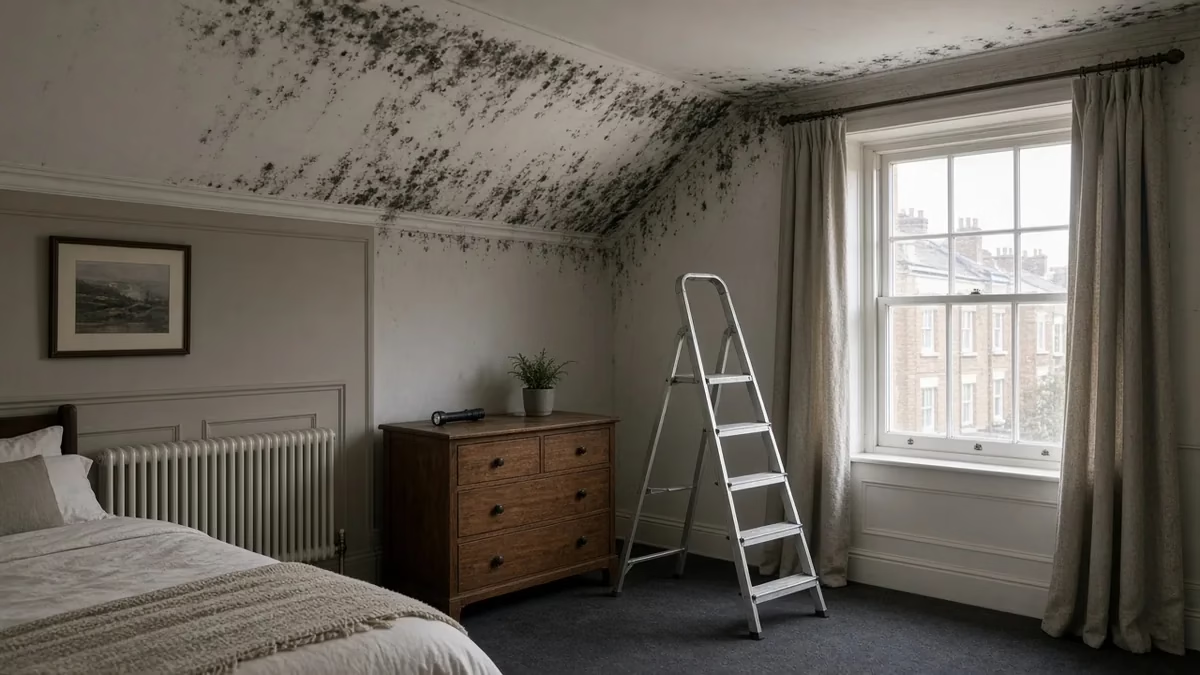
Black spots on the ceiling tend to appear in autumn and winter, often in a bedroom corner, along the edge where the ceiling meets an outside wall, or above the bath. Wipe them off and they’re back within weeks. Paint over them and the paint starts to speckle grey again.
Mould on the ceiling is a sign that the surface is staying damp for long enough for mould to grow. The question is where the moisture is coming from. Most of the time it’s condensation on a cold patch of ceiling, but it can also be a leak from the roof, a bathroom above or a flat roof. Treating the wrong cause is how people end up repainting the same ceiling every year. This guide explains how to tell the difference and what actually fixes it.
Condensation or a leak? Read the pattern
The shape and timing of the mould tell you a lot before anyone gets a ladder out.
- Speckled black spots spread over an area, especially in corners, along the edge next to an external wall, or above a window, usually point to condensation. The RICS consumer guide to damp and mould lists “ceilings close to external walls” among the typical places condensation mould forms.
- A brown or yellow ring-shaped stain, sometimes with mould inside it, more often points to water coming through from above: a roof defect, a leaking pipe, a shower tray or a blocked gutter.
- Worse in cold weather, and worse in rooms where people sleep, shower or dry washing: condensation is more likely.
- Worse after heavy rain, or after someone uses the bathroom above: a leak is more likely.
Some ceilings have both. A small roof leak can wet the insulation above, making that patch of ceiling colder, which then attracts condensation too.
Why condensation targets ceilings
Warm air holds moisture from breathing, cooking, showers and drying clothes. When that air meets a surface cold enough, the moisture condenses on it. Ceilings get cold in a few common situations in London homes:
- Top-floor rooms with gaps in the loft insulation. Insulation that’s been pushed aside for a cable, a downlight or storage boards, or that stops short at the eaves, leaves a cold strip on the ceiling below. Mould along one edge of a top-floor bedroom ceiling is a classic sign.
- The junction with an external wall. In older solid-brick houses, the corner where the ceiling meets the outside wall is often the coldest point of the room.
- Bathrooms without effective extraction. Steam rises, and the ceiling is the first place it hits. For new homes, Approved Document F (the ventilation guidance) sets a minimum intermittent extract rate of 15 litres per second for a bathroom. A fan that’s undersized, not vented outside or switched off too soon won’t clear the moisture. See our guide to a bathroom extractor fan not vented outside.
- Flat-roofed extensions and dormers. If the roof above is poorly insulated or the insulation has got wet, the ceiling below can be cold enough for condensation and mould.
Mould in a corner that spreads from wall to ceiling is closely related; our guide to a damp smell in a bedroom corner covers that wall-side problem in more detail.
Check the loft above
If the mouldy ceiling is under a pitched roof with a loft, a careful look in the loft is often the quickest diagnosis. Walk only on joists or boards, and look directly above the mould:
- Is the insulation missing, thin, compressed or pushed back?
- Is it damp, or are the timbers stained, suggesting a leak?
- Is there daylight through the tiles or a wet patch on the felt?
- Is a bathroom fan or cooker hood duct dumping moist air into the loft instead of outside?
If the loft itself is wet with condensation, that’s a related but different problem; see condensation in the loft.
How to clean ceiling mould safely
Government guidance on the health risks of damp and mould says mould can be removed from hard surfaces with an appropriate cleaning product, left to dry completely, and that mould and mildew products should be used in preference to bleach for health and safety reasons. It also says larger areas of mould should be dealt with by qualified professionals, and that simply removing surface mould will not prevent it from coming back.
The RICS guide adds practical precautions: wear gloves, a mask and goggles, keep the door shut so spores don’t spread and keep the window open. Working overhead means debris falls towards your face, so eye protection matters more than usual.
Mould-resistant paint can be useful once the cause has been fixed, but painting over active mould only hides it for a while.
Fixing the cause
What works depends on what you find.
- Insulation gaps: make the loft insulation continuous over the cold area, including the edges, while keeping the eaves ventilation clear.
- Too much moisture indoors: use extractor fans while cooking and showering and leave them running afterwards, keep trickle vents open, and avoid drying clothes in bedrooms. The RICS guide suggests opening windows for about five minutes for every hour you’re in a room, and keeping indoor temperatures ideally between 18°C and 21°C.
- Bathroom extraction: check that the fan actually vents outside and is the right size for the room, and consider a humidity-controlled fan.
- Leaks: trace and repair the roof defect, flashing, gutter or pipe first, then let the ceiling dry before redecorating. Our guide to a leak that keeps coming back explains how to find the real source.
- Whole-house condensation: where moisture is a problem in several rooms, a ventilation upgrade may be worth considering; see whether PIV stops condensation.
If you rent your home, report mould to your landlord. Our guide to Awaab’s Law explains landlords’ obligations.
When to get a professional damp inspection
Get the ceiling looked at properly if the mould keeps returning after you’ve improved ventilation, if there’s a ring stain or soft plaster, if the ceiling is sagging, or if you can’t get into the space above, such as under a flat roof. A good inspection should explain the cause with evidence, not jump straight to a product.
Frequently asked questions
Why is there black mould on my bedroom ceiling?
Usually because moist air is condensing on a cold part of the ceiling, often next to an external wall or under a gap in the loft insulation. A leak from above can cause similar marks, so check the pattern and the loft.
Is mould on the ceiling dangerous?
Government guidance says damp and mould mainly affect the airways and lungs, and that everyone is vulnerable, but people with certain health conditions, children and older adults are at greater risk of more severe effects. It should be dealt with promptly and the cause fixed.
Should I use bleach on ceiling mould?
Government guidance says mould and mildew cleaning products should be used in preference to bleach, for health and safety reasons. Larger areas should be dealt with by professionals.
Will a dehumidifier stop mould on the ceiling?
It can reduce moisture in the air and help, but it won’t fix a cold spot in the insulation or a leak. Find and deal with the cause as well.
Mould on your ceiling keeps coming back?
We find out whether it’s condensation, a cold spot or a leak before recommending any work, so you only pay for the fix you need. See our damp survey service and damp proofing in London, request a project review, or call 020 7971 1318.
General information only. Take care working at height and in lofts, and get professional help with large areas of mould. Sources checked on 12 November 2026.