
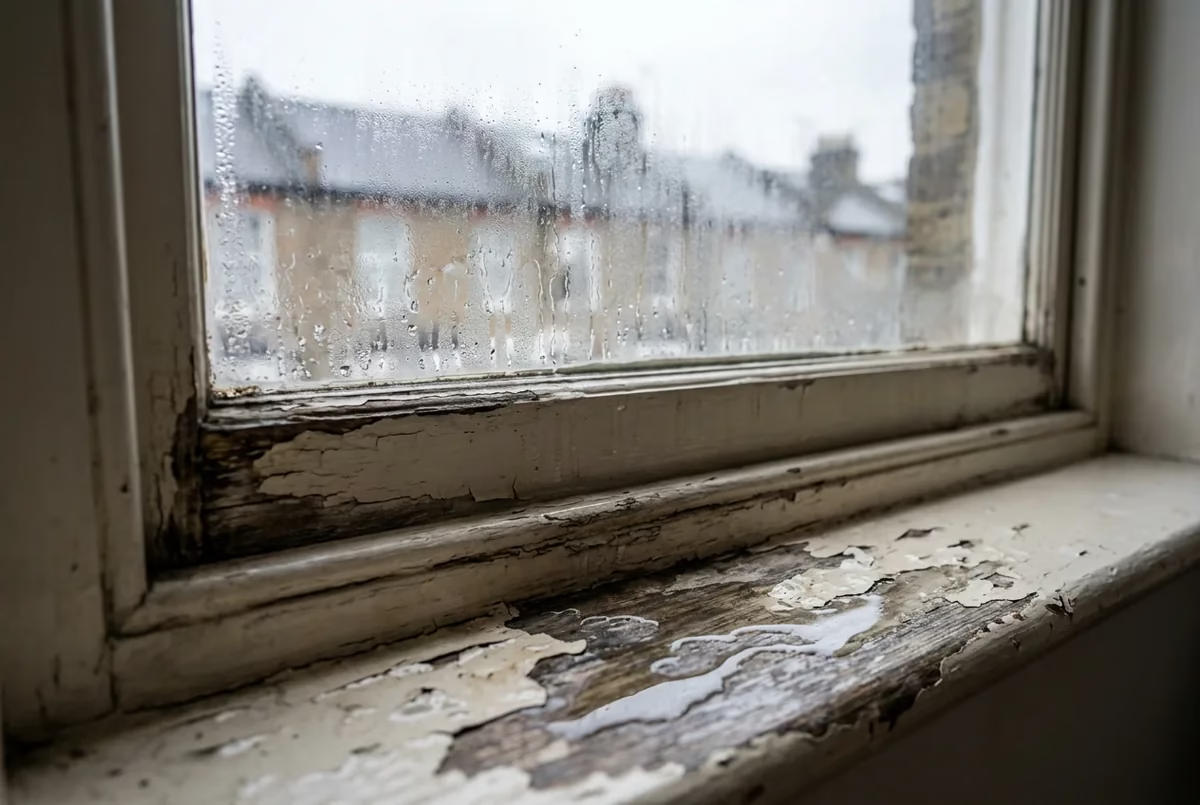
Original timber sash windows are one of the best things about a Victorian or Edwardian London house. They’re also, for many owners, the place where winter mornings start with a towel: the glass streaming with water, puddles on the sill, paint flaking and, eventually, soft timber at the bottom of the sash. It’s tempting to think the only answer is to rip them out and fit new double glazing.
Often it isn’t. Condensation on sash windows has clear causes, and there are practical ways to reduce it while keeping the originals, which matters even more if you live in a conservation area or a listed building.
Why sash windows run with condensation
All indoor air carries water vapour from cooking, washing, showers, drying clothes and breathing. Warm air can hold more vapour than cold air, so when warm, moist room air touches a cold surface and cools below its “dew point”, the water condenses out. Single glass is usually the coldest surface in a room in winter, so that’s where it shows first.
Condensation is worst when:
- there’s a lot of moisture in the air, for example in bedrooms overnight, kitchens and bathrooms;
- the room is poorly ventilated, so that moisture has nowhere to go;
- it’s very cold outside, making the glass colder;
- heating is intermittent, so surfaces cool down between heating periods.
Old sash windows are leaky, which in some ways helps: research published by Historic England on traditional timber sash windows found the original window was leaky enough that air infiltration would have met most winter ventilation needs even when closed. In the same research’s condensation tests, a single-glazed window at 60% indoor humidity had condensation covering the panes and running down them. So a leaky window still gets condensation if the indoor air is humid enough.
When condensation on sashes becomes a problem
A little misting in the corners on the coldest mornings is common in older homes. It becomes a problem when water runs down every morning and sits on the sill and the bottom rail. Repeated wetting can:
- break down paint and putty, letting water into the timber;
- lead to wet rot in sills and bottom rails (see wet rot vs dry rot vs damp);
- encourage mould on the reveals, shutters and nearby walls.
It’s also worth ruling out other causes. Water that appears after rain, rather than on cold mornings, may be getting in from outside through failed putty, a blocked sill drip or gaps around the frame. Bay windows bring their own issues; see damp around a bay window.
Step 1: reduce the moisture in the room
Because the glass is just where the problem shows, the most effective fixes start with the air in the room:
- Use extractor fans when cooking and showering, and make sure they vent outside. See extractor fans not vented outside.
- Avoid drying washing on radiators in rooms with no ventilation.
- Keep bedroom doors open or a little ventilation going overnight, when moisture builds up.
- Keep the heating at a steadier, moderate level rather than long cold periods.
- Wipe the glass and sills dry in the morning so water doesn’t soak into the timber.
If condensation and mould are widespread around the house, a whole-house approach such as positive input ventilation may be worth considering; see does PIV stop condensation?
Sash windows themselves can help ventilate: opening the top and bottom sashes slightly lets air circulate. It’s an old trick, but it works because the gap at the top lets warm, moist air out while the gap at the bottom brings drier air in.
Step 2: repair and maintain the windows
Well-maintained sashes cope with occasional condensation much better than neglected ones. Sound paint, intact putty and a sill that sheds water all protect the timber. Draught-proofing, with brush or wiper seals fitted to the sashes, is widely recommended for traditional windows. Islington Council’s 2025 guide to upgrading windows notes that planning permission isn’t needed for draught-proofing and that research published by Historic England suggests up to half of the heat loss through an undraught-proofed traditional window could be due to air leakage.
The catch: draught-proofing reduces the air flowing through the window, so the same guide says it’s important to make sure the room is still adequately ventilated. Draught-proofing without also dealing with moisture can make condensation worse.
Step 3: secondary glazing, done the right way
Secondary glazing is a second, slim pane fitted on the inside of the original window. Because the inner pane stays warmer, condensation on the room side is greatly reduced, and you keep the original sashes. But it has to be designed properly, or you simply move the condensation to the original glass.
Historic England’s research found that when the secondary glazing was closed and reasonably well sealed, it protected the original window from condensation. When the secondary glazing was left slightly open for ventilation, and especially when air flowed outwards from the room, condensation on the original window increased. Islington’s guide gives the practical rules:
- the secondary unit should be well sealed to stop moist room air getting into the gap;
- the original window should not be sealed or draught-proofed, so a little outside air can reach the gap and keep it dry;
- the room still needs adequate ventilation by other means.
On consents, Islington’s guide says planning permission is not needed for secondary glazing, while listed building consent is usually required in a listed building. The Planning Portal also notes that some councils have Article 4 Directions, and that leaseholders may need landlord consent. Check with your own borough before you order.
What about replacing the glass or the windows?
Islington’s guide says that where no historic glass survives, it’s often acceptable to replace the glass in existing frames with thermally efficient glass or slimline double-glazed units, if the frame can take them. For Islington, the guide says replacing windows in a conservation area will usually need planning permission, and in a listed building listed building consent as well. Rules vary between boroughs, so check yours.
New windows are not a guaranteed cure either. They make the room more airtight, and the moisture then condenses on the next coldest surface, often the reveals around the window. We explain that in mould around new windows.
Frequently asked questions
Is condensation on single-glazed sash windows normal?
Some condensation on cold mornings is common, because single glass is usually the coldest surface in the room. Water running onto the sills every day points to too much moisture or too little ventilation.
Does secondary glazing stop condensation on sash windows?
It can, if the secondary unit is well sealed and the original window isn’t draught-proofed. If the secondary glazing is left open, condensation can form on the original pane instead.
Should I draught-proof my sash windows?
Draught-proofing cuts heat loss, but it also cuts ventilation. Make sure the room is still ventilated, and don’t draught-proof the original window if you fit secondary glazing.
Do I need permission for secondary glazing in a conservation area?
Planning permission isn’t usually needed for internal secondary glazing, but listed buildings usually need listed building consent. Check with your borough.
Condensation or damp around your windows?
We look at moisture, ventilation and the condition of the windows together, so the fix suits a period home instead of fighting it. See our damp survey service, request a project review, or call 020 7971 1318.
General information only. If your home is listed or in a conservation area, check consent requirements with your council before altering windows. Sources checked on 11 November 2026.