
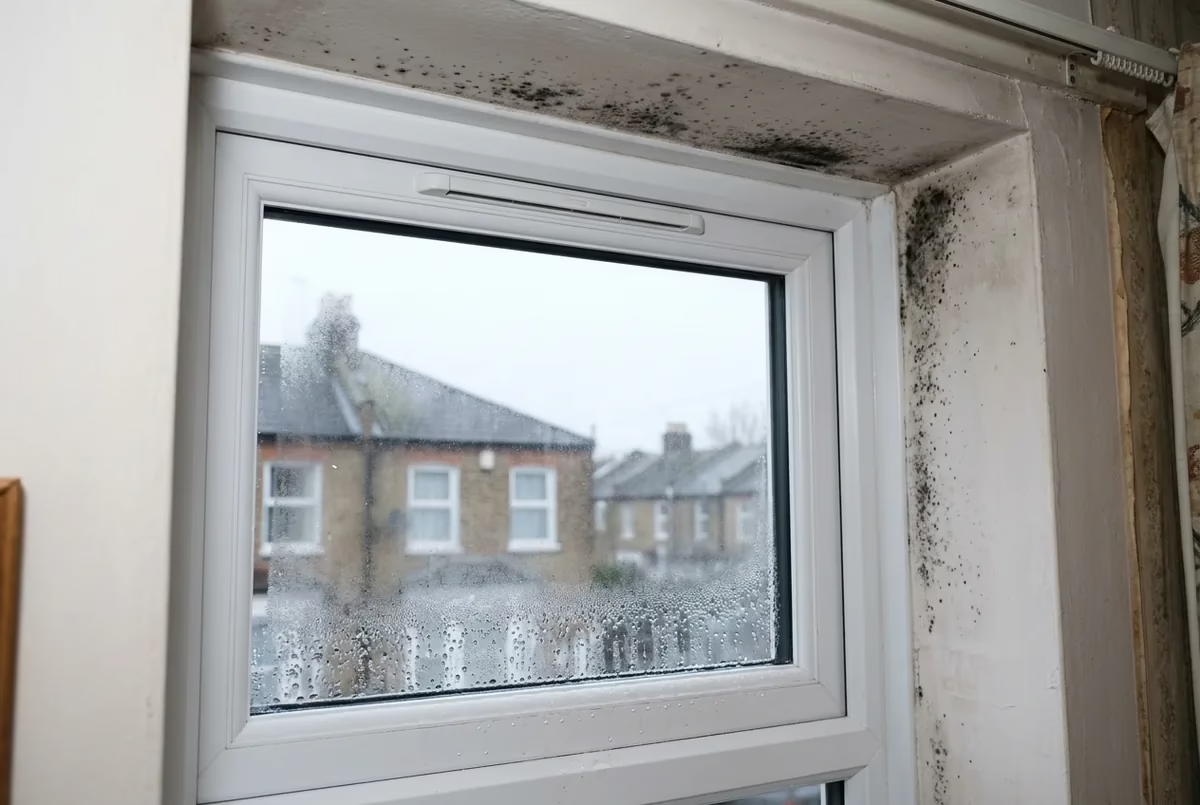
You’ve finally replaced the draughty old windows. The house feels warmer and quieter, and then, a few weeks into the first winter, black spots appear on the plaster around the new frames, in the top corners of the reveals or along the sill. It’s one of the most frustrating damp problems London homeowners run into, because it feels as if the new windows have caused it.
In most cases the windows haven’t created the moisture. They’ve changed how the house loses it. Understanding that helps you fix the problem without ripping anything out.
Why mould appears after new windows
1. The house is more airtight
Old sash and single-glazed windows leak air around the frames all the time. That’s wasteful for heating, but it also carries moist air out. Approved Document F, the building regulations guidance on ventilation, recognises this directly: paragraph 3.15 says replacing windows “is likely to increase the airtightness of the dwelling” and may reduce beneficial ventilation.
Cooking, showers, drying clothes and simply breathing all add moisture to the air. With less accidental ventilation, more of it stays inside and condenses on the coldest surfaces in the room. The RICS consumer guide on damp and mould lists “around windows” first among the places mould typically forms.
2. The cold spot has moved from the glass to the wall
With single glazing, condensation formed on the glass, where you could see it and wipe it off. New double glazing has a warmer inner pane, so the coldest surface in the room may now be the plaster reveal, the corner of the ceiling or the wall below the sill. Moisture that used to collect on the glass now condenses where you don’t notice it until mould grows.
3. Disturbed or cold reveals
Fitting new frames often disturbs the plaster around the opening. In solid-walled London houses the reveal can be a thin, cold strip of masonry right next to a warm frame, and if it’s been patched with a dense filler or left with gaps, it can stay colder than the rest of the wall. A neat line of mould tracing the edge of the frame often points to this.
4. Trickle vents that are closed, or missing
Many modern windows have small slot vents, called trickle vents or background ventilators, in the top of the frame. They’re designed to stay open. If they’re shut all winter, or were never fitted, the room loses a planned route for moist air to escape.
What the regulations say about replacement windows
Replacing windows is building work. Government guidance explains that an installer registered with a competent person scheme can self-certify that the work complies and will give you a certificate as evidence, so keep it with your house documents.
Approved Document F, Volume 1 (2021 edition) sets out two situations:
- If your old windows had background ventilators (paragraph 3.14), the replacements should include them too, no smaller than the originals and controllable automatically or by the occupant.
- If your old windows had none (paragraph 3.15), the ventilation in the home should be no worse than before the work. One way of showing this is fitting background ventilators of at least 8,000mm² equivalent area in habitable rooms and kitchens and 4,000mm² in bathrooms. The document also allows other approaches, such as continuous mechanical extract ventilation, and says that where the minimum sizes aren’t technically feasible the vents should be as close to them as possible.
If you’re unsure what was fitted, ask your installer what ventilation provision they designed for and check whether the certificate covers it.
Condensation or a leak? Check before you treat
Not every damp patch next to a new window is condensation. Rain can get in through a poorly sealed frame, a missing or damaged sill, or cracked render around the opening. A few clues help separate the two:
- Condensation mould tends to be spotty and spread along the coldest edges: top corners of the reveal, behind curtains, along the sill. It’s worse in cold weather and after cooking, showers or drying washing indoors.
- Water getting in tends to show as a stain or wet patch in one place, often below a corner of the frame, and gets worse during or after rain, especially wind-driven rain.
If your windows are in a bay, the junction details are different again; see damp around a bay window. If water appears inside soon after rain, contact your installer while the work is still under guarantee.
What to do now
- Open the trickle vents and leave them open, particularly in bedrooms. RICS also suggests airing rooms for about 5 minutes for every hour you’re in them, or using trickle vents or a secure window latch.
- Use extractor fans every time you cook or shower, and check that they actually vent outside. Our guide to a bathroom extractor fan not vented outside explains why this matters.
- Reduce moisture at source. Avoid drying clothes on radiators where you can, cover pans and keep kitchen and bathroom doors closed while in use, all things RICS lists as increasing condensation.
- Keep rooms consistently warm rather than letting them get very cold and then heating them quickly.
- Clean off small areas of mould, then watch whether it comes back. If it does, the cause is still there.
- If it keeps returning, have the reveals and the ventilation looked at. A cold reveal may need insulating and re-plastering, and some homes need a whole-house ventilation solution rather than room-by-room fixes. See does PIV stop condensation?
Mould behind furniture on the same external walls is often the same problem in a different spot; see mould behind fitted wardrobes.
Frequently asked questions
Why do I have mould since getting new windows?
Usually because the house is now more airtight, so moisture that used to escape through draughty frames stays inside and condenses on cold surfaces such as the reveals. Closed or missing trickle vents and cold, disturbed reveals make it worse.
Should trickle vents be left open in winter?
Yes. They’re designed to provide background ventilation all the time, and winter is when condensation is most likely.
Do replacement windows have to have trickle vents?
Under Approved Document F, if the old windows had background ventilators, the new ones should too. If they didn’t, the ventilation should be no worse than before, and fitting trickle vents of set sizes is one way of showing this.
Is mould around new windows the installer’s fault?
Not necessarily. It’s often a ventilation and moisture issue. But if water is getting in around the frame, or the reveals were left cold or badly made good, raise it with the installer.
Mould around windows in your London home?
We look at ventilation, moisture sources and the reveals together, so the fix matches the cause. See our damp survey service, request a project review, or call 020 7971 1318.
General information only. If mould is widespread or anyone in the home has health concerns, seek professional advice. Sources checked on 10 November 2026.