
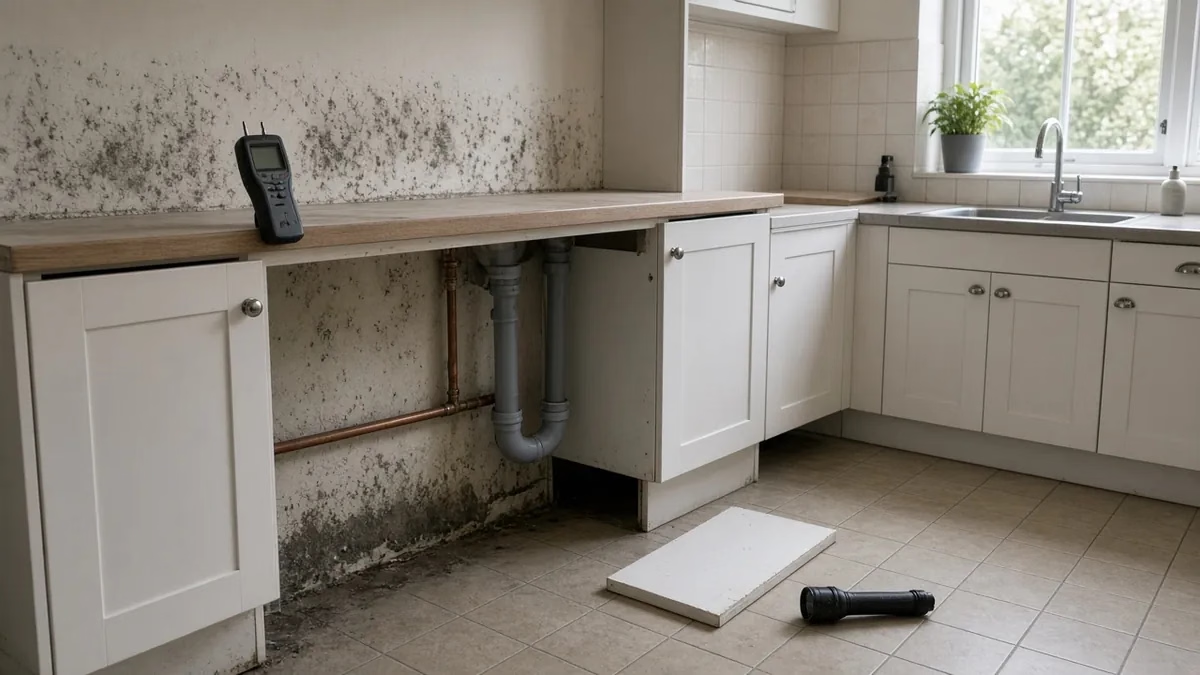
Damp behind kitchen units is one of those problems you usually find by accident. A plinth comes off to retrieve something that rolled underneath, a musty smell won’t go away, or a cupboard back starts to swell and stain. Behind it there’s a dark patch, black mould spots, or a wall that feels cold and wet. Because a fitted kitchen hides so much of the wall, it can have been building up for months.
This guide explains the four usual causes of damp behind kitchen units, how to tell them apart with a few simple checks, what fixes each one, and when it’s worth getting a proper damp inspection before anything is replaced.
Why the wall behind kitchen units gets damp
A kitchen produces a lot of moisture: cooking, kettles, dishwashers and, in many homes, drying washing. Fitted units then sit tight against the wall, with a plinth closing off the bottom, so the air behind them hardly moves. If that wall is an outside wall, it’s also the coldest surface in the room, and the cupboard stops the room’s warmth reaching it.
That combination makes the space behind units an easy place for moisture to collect, whatever its source. The important thing is that “damp” isn’t a diagnosis. As the RICS consumer guide to damp and mould puts it, to solve a damp problem you first need to find where the moisture is coming from.
The four usual causes
1. Condensation on a cold wall
This is the most common cause on outside walls. RICS explains that condensation forms on any surface at or below the dew point of the air in the room, and that mould often follows on external walls. It lists “recirculating-only” cooker hoods and poor kitchen ventilation among the things that increase condensation, because they keep the moisture indoors.
Typical signs: it’s worse in autumn and winter, it’s on the outside wall rather than inside walls, the mould is spotty and spread out rather than a single stain, it’s often at the top corners of wall cupboards or low down behind the plinth, and it doesn’t change after heavy rain.
2. A slow plumbing or appliance leak
A slow leak behind a cupboard makes no noise and may never make a puddle. Common sources are the sink waste, compression or push-fit joints on the supply pipes, isolation valves, and the hoses to the washing machine and dishwasher. Some only drip when a tap is running or an appliance is draining.
Typical signs: a patch concentrated near the sink or appliances, swollen cupboard bases or plinths, a wet floor under the units, and damp that doesn’t follow the seasons. Our guide to leaks that come back after repair explains how to trace one properly.
3. Rain getting through the outside wall
Penetrating damp comes through the wall from outside. Behind a kitchen, the usual routes are cracked render, eroded pointing, an overflowing gutter or downpipe above, or a badly sealed hole where a waste pipe, boiler flue or extractor duct passes through the wall.
Typical signs: the patch gets worse after wind-driven rain, it lines up with something you can see outside, and it may have a tide mark. Our guide to why a house smells damp when it rains lists the common entry points.
4. Ground moisture at the base of the wall
If the damp is low down, in a band near the floor, it may be ground moisture. Approved Document C expects an external wall’s damp-proof course to be at least 150mm above the adjoining ground, so a raised patio, path or flower bed outside the kitchen can bridge it. See patio higher than the damp-proof course. Be wary of anyone who jumps straight to “rising damp”: RICS notes that failure of an original damp-proof course is extremely rare and the term is often misused. Our guide to telling rising damp from condensation and penetrating damp goes into more detail.
Simple checks you can do yourself
- Take the plinth off and look. Use a torch to see where the damp is, how high it goes, and whether the floor under the units is wet.
- Look at the pattern. Spotty mould on a cold outside wall points to condensation. One wet patch near the sink points to a leak. A patch that follows rain points to the outside wall.
- Test the plumbing. With the plinth off, run the taps and put the dishwasher and washing machine through a cycle, then check every joint with a dry piece of kitchen roll.
- Check the water meter. Turn everything off and see if the meter is still moving. Our water meter leak guide explains how.
- Go outside. Look at the wall behind the kitchen: gutters, downpipes, render, pointing, pipe and flue openings, and the ground level against the wall.
- Check the extractor. Does your cooker hood actually duct to the outside, and is it used every time you cook?
A moisture meter can be misleading on its own, because salts, foil-backed plasterboard and some paints all give high readings. It’s one clue, not an answer.
How each cause is fixed
Condensation
- Extract the moisture at source. For new kitchens, Approved Document F sets a minimum intermittent extract rate of 30 litres per second for a cooker hood extracting to the outside, or 60 litres per second for a kitchen fan without one. A recirculating hood doesn’t remove moisture.
- Let air reach the wall. Leaving a small gap behind units and using a vented plinth helps the wall stay closer to room temperature.
- Warm up the wall. On a very cold solid wall, lining it with insulation is sometimes the lasting answer, but it needs to be detailed carefully to avoid moving the problem elsewhere.
- Keep the background heating steady and avoid drying washing in the kitchen without ventilation.
The same principles apply to mould behind fitted wardrobes, which is the bedroom version of this problem.
Leaks
Repair the joint, valve or hose, then let the wall, floor and units dry out fully before refitting. Chipboard carcasses and plinths that have swollen won’t recover and usually need replacing.
Penetrating damp
Fix the outside first: clear and repair gutters and downpipes, repair render or pointing, and seal around pipes and flues. The wall then needs time to dry before any replastering.
Ground moisture
Lower the ground level outside or form a drained channel so the damp-proof course isn’t bridged. Only after that should you judge whether the wall needs anything more.
Dealing with the mould and the units
Once the source is fixed, the mould can be cleaned off and the wall allowed to dry. Cleaning on its own won’t stop it returning if the cause is still there. Mould isn’t just a cosmetic problem: government guidance on the health risks of damp and mould explains that it can affect breathing and is a particular risk for children, older people and anyone with a respiratory condition.
If you’re planning a new kitchen anyway, deal with the damp before it’s fitted. It’s much easier to fix the wall, the ventilation and the plumbing route with the old units out than to discover the problem again in two winters’ time. If you’re dealing with uneven walls at the same time, see kitchen units that won’t sit flush against the wall.
When to get a damp inspection
Get an independent inspection if the checks above don’t point clearly to one cause, if more than one cause seems to be involved, if the damp has come back after a repair, or if you’ve been quoted for injected damp-proofing without a clear explanation of where the moisture is coming from. A good inspection explains the source and the evidence for it, not just a list of treatments.
Frequently asked questions
Is mould behind kitchen units always condensation?
No. Condensation is the most common cause on outside walls, but a slow leak or rain coming through the wall can look similar. Check the pattern, the plumbing and the outside of the wall before deciding.
Do I need to remove the whole kitchen to fix it?
Usually not. Taking off the plinths and removing one or two units is often enough to find the cause and fix it. Whole runs only come out if the wall needs major work or the units are already ruined.
Can I just paint over it with anti-mould paint?
Anti-mould paint can help once the cause is fixed, but on its own it hides the problem rather than solving it.
Why is it worse in winter?
Outside walls are colder in winter, windows are kept shut and more washing is dried indoors, so condensation increases. A patch that comes and goes with the seasons points strongly to condensation.
Found damp behind your kitchen units?
We find the moisture source first and then recommend the repair that deals with it, not a standard treatment. See our damp survey in north London and damp proofing in London, request a project review, call 020 7971 1318 or message us on WhatsApp.