
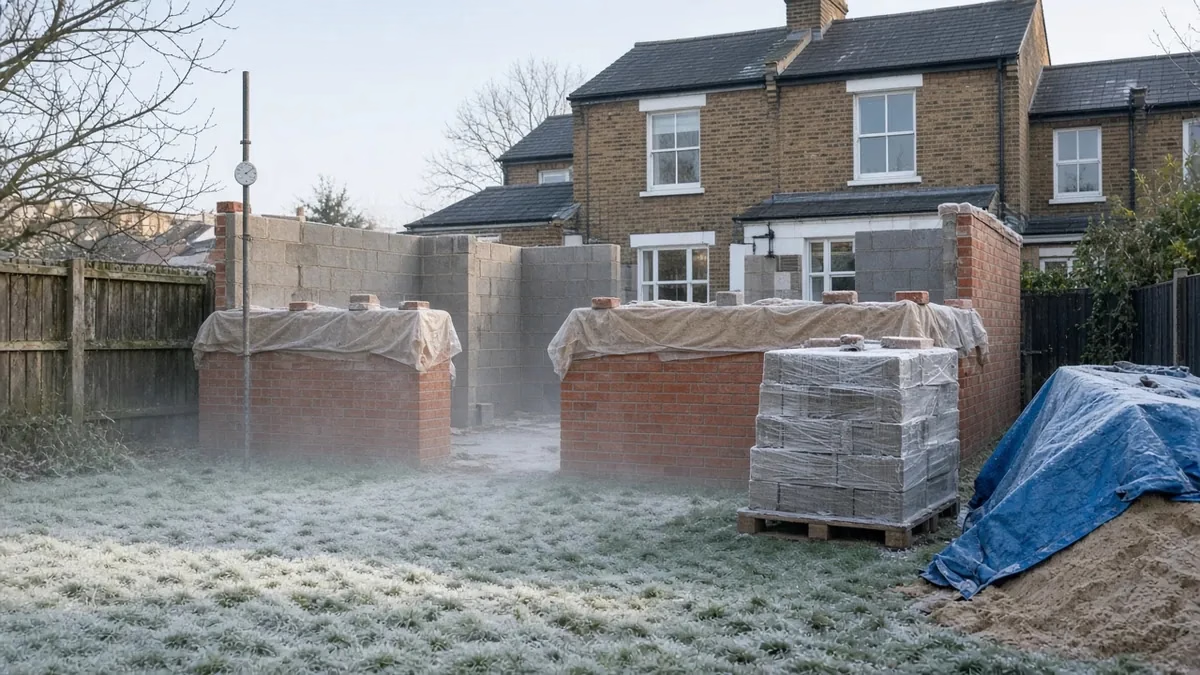
Many London homeowners get planning approval in the autumn and then hesitate. Is it sensible to start an extension in November or January, or should you wait for spring? The worry is usually the same: frost will spoil the brickwork, the concrete won’t set, and the job will drag on with the back of the house open to the weather.
The honest answer is that most of an extension can be built in winter, as long as the work is planned around the cold and the right precautions are taken. This guide explains what changes on a winter site, the temperature rules builders follow, which stages are most affected, and the questions to ask your builder before you commit.
Can you build an extension in winter?
Yes. Building work doesn’t stop because it’s winter; it stops, or changes, when particular conditions are met. Construction guidance is written around temperature and frost, not the calendar. NHBC Standards, chapter 3.2 on cold weather working, says work should be planned in advance and that site and weather conditions should be taken into account, either by stopping work or by taking adequate precautions. It also says a thermometer should be sited in the shade to show whether temperatures are rising or falling.
What winter does change is the pace of some stages and the amount of protection needed. A well-run winter job keeps going on mild days, protects fresh work overnight and moves to inside tasks when the weather turns.
Brickwork, blockwork and mortar
Mortar needs time to set and gain strength. If it freezes before then, it can be damaged, which is why bricklaying has the clearest cold weather rules.
- The 3°C rule. Hertfordshire Building Control’s cold weather guidance says bricklaying should normally stop when the temperature is 3°C and falling, and not begin again until it reaches 3°C and rising.
- Protection overnight. If frost is likely before newly laid mortar has set, the same guidance says to protect it with an insulating layer of hessian under polythene. In very low temperatures, insulation boards or heating may be needed.
- Dry, unfrozen materials. NHBC guidance says materials shouldn’t be used if they’re frozen, and bricks, blocks, sand and cement should be covered so they don’t get saturated and damaged by frost.
- Keeping the face clean. Hertfordshire also warns that staining often comes from saturated fresh brickwork, so work in progress should be sheeted during breaks.
In practice, that means a bricklayer on a cold morning may start once the temperature has climbed, and the walls are covered before the team leaves. If you see fresh brickwork left uncovered on a frosty night, ask why. Frost damage to new bricks and mortar is the same mechanism we describe in our guide to spalling bricks, just happening much sooner.
Foundations and concrete
Foundations are often the first thing people expect to be delayed, but in winter the bigger problem in London is usually water rather than frost. Clay trenches fill up after rain and the bottom softens, so excavating, inspecting and pouring close together matters.
For concrete, NHBC guidance says:
- ready-mixed concrete should be at least 5°C when it’s delivered;
- it shouldn’t be placed on frozen ground or against frozen surfaces;
- it should be covered to keep it above freezing, and heated if necessary;
- for slight overnight frosts, 50mm of insulation held down at the edges helps protect an oversite slab, but in very severe frost insulation alone isn’t enough.
The Concrete Society adds that lower temperatures slow the rate at which concrete gains strength, so curing times and the time before formwork is struck have to be extended. That’s one reason winter programmes need a little more slack. Ground conditions matter all year round too; if there are trees near the extension, see our guide to extending near trees.
Roofing and getting weathertight
The most important milestone on a winter extension is getting the structure weathertight: roof on, windows and doors in, or at least temporary protection in place. Once that’s done, most of the remaining work happens inside and the weather matters much less.
- Flat roofs. Many roofing systems have minimum temperatures and need a dry deck, so the roof covering may wait for a suitable day. A temporary sheet or the base layer can protect the structure meanwhile. Falls still need to be right; see flat roof extension ponding.
- Opening into the house. Where the extension joins the existing home, the knock-through can usually be timed for after the extension is weathertight, with a temporary dust and weather screen until then. That protects both the house and your heating bill.
- Rainwater. In winter, the soakaway or drainage connection needs to work from the moment the roof is on. Our guide to soakaways for extensions explains the options.
Inside work: plaster, screed and drying out
Plaster and screed dry more slowly in cold, damp air. A new extension holds a lot of construction water in its concrete, blockwork, plaster and screed, and if it’s sealed up and decorated too soon, that moisture can show up as condensation, mould or flooring problems. We explain this in detail in damp in a new extension.
The answer isn’t to blast heat at fresh plaster, which can cause cracking. It’s gentle background heat combined with ventilation, so the moisture has somewhere to go. Flooring should only go down once the screed has been tested as dry enough for the finish you’ve chosen.
External render and finishes
External render is the stage most likely to wait for milder weather. Render and finishing products have minimum application temperatures, and they shouldn’t go onto a frozen or saturated wall. Check the manufacturer’s data sheet, and don’t be surprised if your builder suggests leaving the render coat until a dry spell or early spring. The same goes for some external paints and sealants.
What winter means for the programme
- Shorter days. There are fewer daylight hours for outdoor work, so outside tasks tend to be done in the middle of the day and inside work fills the rest.
- Weather days. A realistic winter programme allows for days when brickwork or roofing can’t go ahead. Our article on why renovation projects get delayed covers how to plan for this.
- Paperwork carries on. Planning, party wall notices, building control applications and structural design aren’t affected by the weather. Winter is a good time to get those finished so the build isn’t held up later.
- Living at home. If you’ll be living in the house, think about heating, a temporary kitchen and keeping the cold out. See living in a building site.
Questions to ask your builder before a winter start
- How will you protect fresh brickwork and concrete from frost overnight?
- What will you do on days when it’s too cold for bricklaying?
- When do you expect the extension to be weathertight, and what temporary protection will there be until then?
- How will you dry the building before plastering, flooring and decorating?
- Which stages, such as render or roofing, might need to wait for better weather?
A builder who answers these clearly is planning for winter rather than hoping it’ll be mild.
Frequently asked questions
Is it cheaper to build an extension in winter?
We wouldn’t assume so. Prices depend on the design, the specification and the builder, not the season. Winter work can need extra protection and heating, which is part of a properly planned job.
Can concrete foundations be poured in frost?
Not onto frozen ground. Ready-mixed concrete should arrive at 5°C or more, be placed on unfrozen ground and be covered and protected while it cures. In severe frost, the pour should wait.
Does cold weather weaken new brickwork?
It can, if mortar freezes before it has set. That’s why bricklaying stops at 3°C and falling and fresh work is covered with hessian and polythene when frost is expected.
Will my extension be damp if it’s built in winter?
Not if it’s dried out properly before it’s sealed up and decorated. A winter build needs more time and ventilation at the drying stage, so plan for it.
Thinking of a winter start?
We plan winter extensions around the weathertight stage, protect fresh work properly and give you a realistic programme from the start. See our house extension service in London, request a quote and project review, call 020 7971 1318 or message us on WhatsApp.