
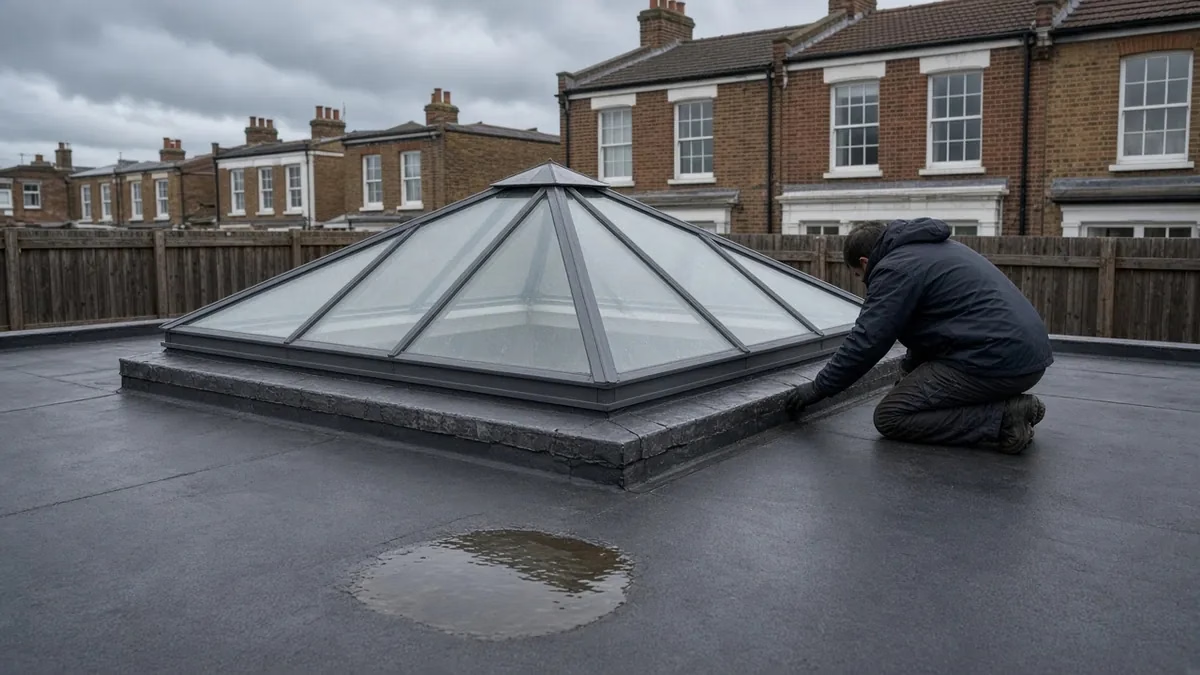
A roof lantern is often the best feature of a kitchen extension, so water dripping from it is especially frustrating. Before anyone starts covering joints in sealant, it’s worth working out what’s really going on. Many “leaking” lanterns are actually condensation, and many real leaks start not in the glass but at the kerb it sits on or in the flat roof around it.
This guide explains how to tell a leak from condensation, the usual failure points on a roof lantern, how each one is fixed, and when the problem is really the roof rather than the lantern.
Step 1: Is it a leak or condensation?
The single most useful thing you can do is note when the water appears.
- During or soon after rain, especially heavy or wind-driven rain, and in one consistent place: that points to a leak.
- On cold mornings, with no rain, as droplets spread across the inside of the glass or along the bars: that points to condensation.
- Misting between the two panes of a glass unit: that’s a failed sealed unit, not a roof leak or room condensation. The unit will need replacing.
Dry the area, take photos, and compare the next occurrence with the weather. A simple diary over a couple of weeks often settles the question.
If it’s condensation
Condensation forms on any surface colder than the dew point of the room air. A roof lantern is often the coldest surface in an extension, and kitchens produce a lot of moisture from cooking, kettles and dishwashers. Common reasons it’s worse on some lanterns:
- Cold frames. Aluminium bars without a thermal break conduct cold to the inside, so droplets form along the bars.
- An uninsulated kerb. If the timber or masonry upstand under the lantern isn’t insulated, its inside face runs cold and you can get a damp line or staining on the plaster where the lantern meets the ceiling, even when the glass is dry.
- Not enough ventilation. No extractor, a recirculating cooker hood, or trickle vents kept closed all keep the moisture in the room.
Improving extraction and background ventilation, and keeping the heating steady, reduces condensation. Cold frames and an uninsulated kerb are built-in, so they’re best dealt with at design stage. If your extension feels cold generally, see our guide to a kitchen extension that’s cold in winter.
If it’s a leak: the usual failure points
1. The kerb and the membrane
The lantern sits on a raised kerb, or upstand, so that water on the flat roof stays below the opening. The roof covering has to be carried up the kerb and finished properly at the corners. NHBC Standards for flat roofs show a minimum 150mm upstand above the roof surface at rooflight kerbs, and rooflight manufacturers’ installation guides give similar minimum kerb heights.
A kerb that’s too low, or a membrane that stops short and relies on sealant, lets standing water and driven rain get behind the waterproofing. A typical sign is a lantern that only leaks in heavy rain.
2. Seals, gaskets and caps
Lanterns shed water from the glass into designed drainage paths along the bars. A displaced cap, a failed gasket or a blocked channel interrupts that path. The leak usually follows one bar or one corner consistently.
3. Water ponding around the lantern
A lantern in the middle of a flat roof splits the drainage. If the roof falls don’t carry water around it to the outlet, water can sit against the kerb. A blocked outlet can do the same in heavy rain. Our guide to ponding on a flat roof extension explains the causes and fixes.
4. The roof, not the lantern
Water can enter elsewhere, such as at a wall abutment, a cracked membrane or a flashing, then travel along the deck or timbers and drip out at the lantern opening, because that’s the lowest gap in the ceiling. A stain near the lantern isn’t proof that the lantern is the entry point.
How a lantern leak should be investigated
- Check from the inside first. Follow the trail back to the highest wet point and compare it with the other bars and corners.
- Look at the roof around the lantern. Only if it’s safe to do so, or ask a roofer: is water standing near the kerb, is the outlet clear, is the membrane intact up the kerb and at the corners?
- Water test. A controlled water test, working upwards from the roof surface to the kerb, then the lantern, isolates where water gets in.
- Fix the cause, not the symptom. Repairs range from re-seating a cap or replacing a gasket to re-dressing the membrane up the kerb or correcting the roof falls.
A lantern that leaks again after being resealed usually has a kerb, membrane or drainage problem that sealant can’t solve.
What to avoid
- Smearing general-purpose sealant over every joint. It can block designed drainage paths and makes proper repairs harder.
- Walking on the glass or leaning ladders against the lantern.
- Replacing the whole lantern before checking the kerb and the roof. A new lantern on the same faulty kerb can leak in the same way.
- Ignoring a small drip. Water in a flat roof can wet the insulation and the deck long before it shows on the ceiling.
If the extension is still under warranty
If the extension is recent, report the problem to the builder or roofer in writing as soon as you notice it, with dates and photos. Many lantern and roofing products come with manufacturer and installer guarantees, but they usually depend on the product being installed to the manufacturer’s instructions.
Designing it right in a new extension
If you’re planning an extension, the leak and condensation risk is mostly settled at design stage: an adequate, insulated kerb, a membrane detail agreed between the roofer and the lantern supplier, falls that take water around the lantern, and a thermally broken frame. Our guide to roof lanterns vs skylights vs pitched roofs helps you choose the right type of roof glazing in the first place.
Damp patches in a new extension can also come from the building drying out after construction. See damp in a new extension for how to tell the difference, and mould on the ceiling if the problem is spreading across the ceiling.
Frequently asked questions
Why does my roof lantern drip on cold mornings when it hasn’t rained?
That’s almost always condensation: warm, moist room air meeting cold glass, bars or kerb. Better ventilation helps, and so does a frame with a thermal break.
Why does it only leak in heavy rain?
That’s typical of a kerb that’s too low, a membrane that isn’t dressed high enough up the kerb, or water ponding against it when the outlet can’t cope.
Can I fix a leaking roof lantern with sealant?
Sometimes a single failed seal can be resealed, but sealant won’t fix a low kerb, a short membrane or poor drainage. Find the entry point first.
What does misting between the panes mean?
The seal of that glass unit has failed. It isn’t a roof leak, but the unit will need replacing to clear.
Leaking roof lantern or flat roof?
We check the lantern, the kerb and the roof around it together, so the repair deals with where the water actually gets in. See our house extension service in London, request a project review, call 020 7971 1318 or message us on WhatsApp.