
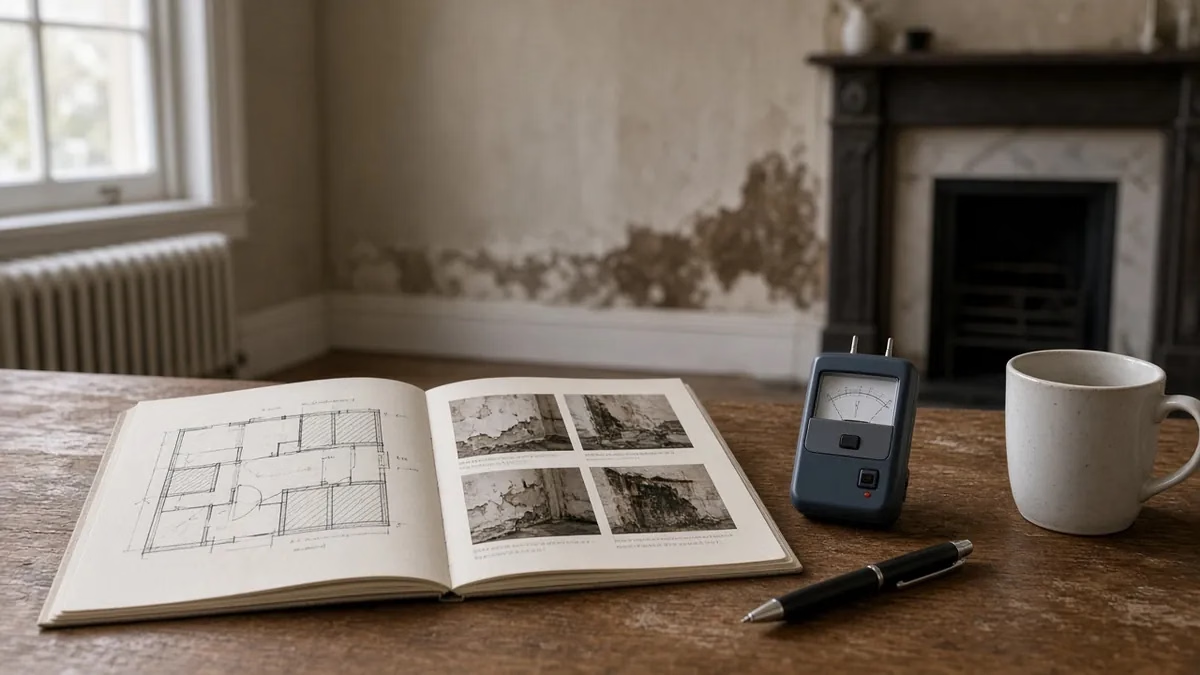
A damp survey is only as useful as the report you get afterwards. Some reports are clear, specific and easy to act on. Others are a page of standard wording, a few meter readings and a quote for treatment. If you’re about to spend money on damp work, or you’re buying a house with a damp report attached, it helps to know what a good one should contain.
This guide explains what a damp survey report should include, how to read the key sections, and the warning signs that a report is more of a sales document than a diagnosis.
What a damp survey report is for
The Property Care Association’s guidelines to survey report writing describe the report as several things at once: a record of the defects found, an instruction to the client and their builder, an instruction to whoever does the work, a permanent record of what was recommended, and a sales document. The same guidelines say that whether the survey is offered free or for a fee, the company takes the same responsibility for what it says.
That’s why the detail matters. A report should let you, or another professional, understand what was seen, why the surveyor reached their conclusion, and what needs to happen next.
What a good damp survey report should include
1. Basic details and instructions
- The property address, the date of the inspection and the name of the surveyor, with their qualifications.
- Who instructed the survey and what they asked for: for example, “inspect the damp patch in the rear reception room” or “a full damp and timber inspection before purchase”.
- Ideally, the weather at the time of the visit, since recent rain or a dry spell can change what shows.
2. The scope and limitations
The PCA’s code of practice for the control of dampness says the report should confirm the instructions received and record the areas the surveyor couldn’t access. That might be rooms with fitted furniture, floors covered with carpet, a locked cellar, or a roof that couldn’t be seen. If an area wasn’t inspected, the report should say so clearly rather than leave you to assume it was fine.
3. A description of the building
The type of house, its approximate age, and how the walls and floors are built: solid brick or cavity, suspended timber floor or solid floor, render or exposed brick. This matters because the right repair for a Victorian solid-walled terrace can be very different from a modern cavity-walled house.
4. External observations
A good survey looks closely at the outside of the building as well as the inside. The PCA guidelines list examples of things that should be highlighted: leaking roofs, rainwater goods, cracked rendering, defective sills and the absence of a conventional damp-proof course. Ground levels against the walls, blocked air bricks and leaking pipes should be noted too. If the report says nothing about the outside, ask why.
5. Internal observations and evidence
Where the damp is, how high it goes, what it looks like (tide marks, salts, mould, staining, decay) and where the readings were taken. Photos and a simple plan or sketch make this far easier to follow. The PCA code says reports must record significant defects relating to past, present or future water ingress.
6. The diagnosis
This is the core of the report. It should say what the surveyor thinks is causing the damp and why, linking each conclusion to the evidence above. RICS guidance on investigating moisture in traditional buildings says the report should give an impartial diagnosis, clearly explained and laid out systematically so the risks are understood.
7. Recommendations and options
The recommended repairs, in order of priority, with any work that must happen first, such as fixing a gutter or lowering a path before anything is done inside. The RICS guidance says clients should be given alternative options where they exist, each with advantages, disadvantages and cost and time implications. Where monitoring or staged work makes sense, it should explain why.
8. Associated work and responsibilities
The PCA code says preparatory and associated work, such as replastering, should be detailed, with clear instructions on who is responsible for preparation and finishing. If party walls are involved, the report should mention the Party Wall etc. Act 1996.
9. Timber
Damp and decay are linked. The PCA code says that where moisture is identified, the condition of associated timbers should be checked where possible, and the report should highlight the role of damp in fungal decay. Our guide to wet rot vs dry rot vs damp explains the differences.
10. Conflicts of interest
The RICS guidance says any conflicts of interest should be clearly stated. If the surveyor works for a company that will also carry out the treatment, that should be obvious from the report.
Reading the moisture readings
Most reports include readings from an electrical moisture meter. They’re useful, but they’re not proof on their own. The PCA code says the proper use of a meter can give a useful indication of rising damp but cannot give absolute proof, and that the surveyor must understand its limitations. Salts, foil-backed plasterboard and some paints can all give high readings on a dry wall.
The same code quotes BS 5250, which says one of the most reliable ways to tell condensation from rising damp is to compare moisture content in samples taken from within the depth of the wall with samples near the surface. If a report reaches a firm diagnosis of rising damp from meter readings alone, ask what other evidence supports it. Our guide to high damp readings in a homebuyer survey covers this in more detail.
Warning signs in a damp report
- Standard wording that could apply to any house, with nothing specific about yours.
- No mention of the outside, gutters, ground levels or leaks.
- A diagnosis of rising damp with no explanation of why other causes were ruled out.
- Treatment recommended for every wall regardless of where the damp actually is.
- No limitations section, even though furniture or flooring obviously restricted the inspection.
- A quote that doesn’t match the report. The PCA code says any quotation should be justified, free from ambiguity and directly related to the recommendations.
If the report is attached to a free survey, read our guide to free damp surveys and pressure selling. For the difference between an independent survey and a contractor’s quote, see damp survey vs damp-proofing quote.
If you’re buying a house
A lender may ask for a specialist damp report after a valuation or homebuyer survey. Read it with the points above in mind, and check whether it explains the cause or simply prices a treatment. Our guide to mortgage retentions for damp explains how these reports are used in a purchase.
Frequently asked questions
How long should a damp survey report be?
There’s no set length. What matters is that it covers the scope, the evidence, the diagnosis and clear recommendations for your property. A short report can be good if it’s specific; a long one can be poor if it’s mostly standard text.
Should a damp report include photos?
It doesn’t have to, but photos and a simple plan make it much easier to understand where the damp is and what was seen.
Can I get a second opinion on a damp report?
Yes. If the diagnosis isn’t explained or the recommended work seems out of proportion, an independent inspection can check the evidence before you commit.
Is a meter reading enough to diagnose rising damp?
No. The PCA code says a meter can give a useful indication but not absolute proof. Look for other evidence and for other causes being ruled out. See how to tell rising damp from condensation and penetrating damp.
Need a clear damp diagnosis?
Our damp inspections look for the moisture source first, inside and outside, and explain the evidence behind the recommendation in plain English. See our damp survey in north London and damp proofing in London, request a project review, call 020 7971 1318 or message us on WhatsApp.