
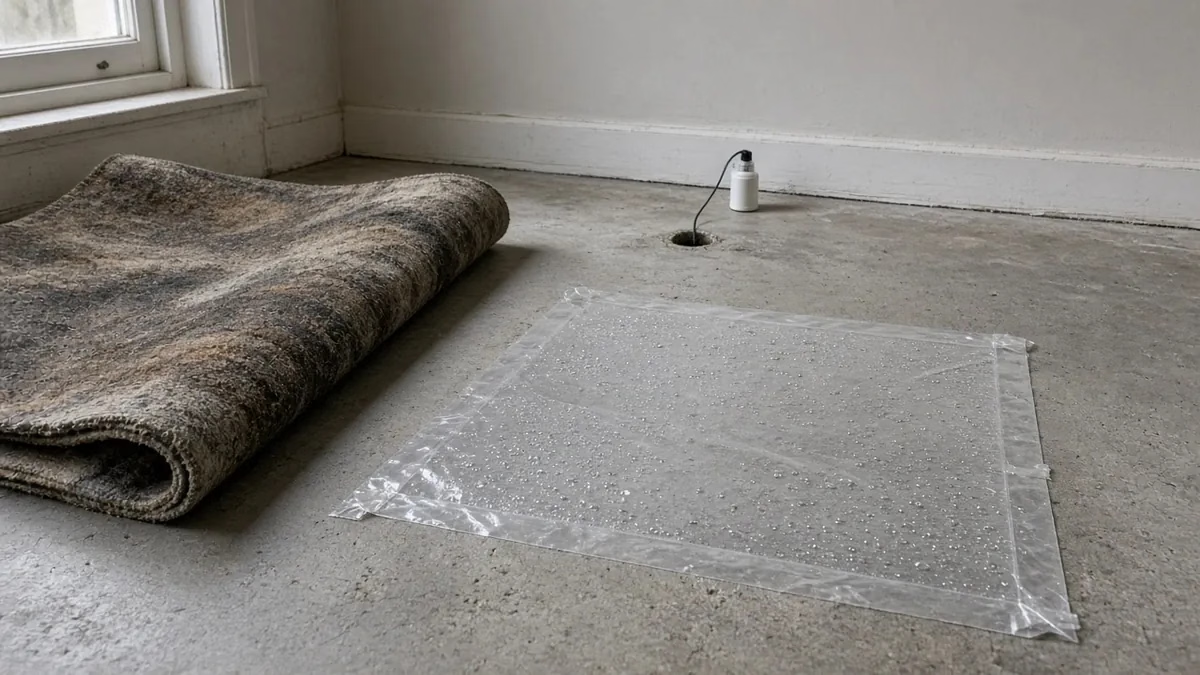
You lift a rug and the concrete underneath is dark and cold. Or the carpet in a ground-floor room smells musty, the underlay has mould on its underside, or laminate boards have started to cup and lift. A damp concrete floor is a common problem in older London houses, and in newer extensions too, but the cause isn’t always the one people assume.
This guide explains why concrete floors get damp, how to tell ground moisture from condensation, a leak or a slab that simply hasn’t dried, the tests that give a reliable answer, and the repairs that work for each.
How a concrete floor is meant to keep moisture out
Concrete is porous. Left to itself, a slab laid on the ground will draw moisture up from below. Modern floors stop this with a damp-proof membrane (DPM). Approved Document C describes a ground-supported concrete floor with a membrane above or below the slab that’s continuous with the damp-proof courses in the walls. Below the slab, that’s typically polyethylene at least 300 microns (1200 gauge) thick with sealed joints; above it, polythene or three coats of cold-applied bitumen solution or similar, protected by a screed or floor finish.
The weak points are where that system is missing, damaged or broken. Many older solid floors were laid with no membrane at all, and even where there is one, the join between the floor membrane and the wall damp-proof course is where moisture most often gets through.
The usual causes of a damp concrete floor
- No DPM, or a failed one. Common in older solid floors, especially ones that were later covered with something less breathable than the original finish.
- A broken link at the walls. If the floor membrane doesn’t meet the wall’s damp-proof course, damp shows up as a band around the edge of the room, often with damp skirting boards.
- Condensation on a cold slab. An uninsulated slab is cold, and moist room air condenses on it, especially under rugs, furniture and underlay where it can’t dry.
- A leak in or under the floor. A heating pipe, water supply or waste pipe buried in the screed can wet a patch of floor that has nothing to do with the ground.
- Construction moisture. A new slab or screed holds a lot of water. If flooring goes down before it has dried, the moisture comes up into it.
- Water from outside. High ground or paving against the wall, blocked drains or a high water table after heavy rain can push moisture in at floor level. See patio higher than the damp-proof course.
How to tell which one you have
Look at where the damp is
Damp around the edges of the room points to a problem at the wall junction or outside. A patch in the middle of the floor, or a line across it, points to a leak or a membrane problem. Damp only under rugs and furniture, with the open floor dry, points to condensation.
Look at when it happens
Condensation is worst in cold weather. Ground water often gets worse after long periods of rain. A leak usually stays wet whatever the weather, and may get worse when the heating is on.
Rule out a leak first
If the heating system keeps losing pressure, or the water meter moves with everything turned off, a hidden leak is likely. Our guide to finding leaks under floors explains how to locate one before anyone starts breaking up screed.
The polythene sheet test
Tape a square of clear polythene, about 300mm across, flat on the bare floor and leave it for a day or two. Droplets under the sheet suggest moisture coming up through the slab; droplets on top suggest condensation from the room. It’s a rough indicator, not a measurement, but it’s a useful first step.
A proper hygrometer test
For a reliable answer, especially before laying a new floor finish, the slab is tested with a hygrometer that measures the relative humidity of the air trapped against or within the concrete. The Contract Flooring Association‘s guidance says a solid base should be dry enough to give a hygrometer reading no greater than 75% relative humidity before most floor coverings are laid. A handheld pin meter on its own isn’t a reliable way to test concrete.
How it’s fixed
Fix the source first
Repair any leak, lower or drain the ground outside, and clear blocked drains. If the problem is condensation, the answer is usually warmth and air: better ventilation, steady heating, and not trapping the slab under thick rubber-backed rugs. None of these needs a membrane.
Surface damp-proof membranes
Where an old slab has no membrane and you want to keep it, a surface DPM can be applied to the prepared concrete before the smoothing compound and floor finish. Flooring manufacturers make epoxy membranes for this, and their data sheets set limits on the moisture levels they can handle. K&B Screeding’s guide to liquid DPMs points out two important limits: the membrane should be taken up to the damp-proof course in the wall, and this type of product isn’t for floors subject to water pressure. A floor that floods or is below ground level needs a different approach, such as a basement waterproofing design.
Replacing the floor
If the slab is broken up, very wet or you want to add insulation, the floor can be dug out and relaid with a new membrane, insulation and screed, linked properly to the wall damp-proof course. This is bigger work, it raises questions about floor levels, thresholds and doors, and building regulations may apply. Check with building control before you start.
Choose the right floor finish
The K&B guide also notes that putting an impermeable finish such as vinyl or LVT over an old floor with no membrane can trap moisture that used to evaporate through the old finish. If you’re relaying flooring in an older house, test the slab first.
New floors that won’t dry
In a new extension or a garage conversion, a damp floor is often construction water rather than a defect. The Contract Flooring Association’s guidance notes that, under ideal conditions, screeds up to 50mm thick take roughly a day per millimetre to dry, and thicker slabs take much longer. In winter, or without heating and ventilation, it can be slower still. Our guides to damp in a new extension and garage conversion floor damp explain how to plan for it.
What not to do
- Don’t inject the walls to cure a damp floor. Wall treatments don’t address moisture coming through the slab.
- Don’t seal a damp floor under new flooring without testing it.
- Don’t assume the whole floor needs replacing before you’ve ruled out a leak, condensation or a problem outside.
If you’ve been told the answer is rising damp, it’s worth reading our guide to rising damp vs penetrating damp before agreeing to any treatment.
Frequently asked questions
Is it normal for a concrete floor to feel cold and damp?
An uninsulated slab will feel cold, but it shouldn’t be wet. If the surface darkens, carpets smell or finishes lift, something needs investigating.
Can I lay laminate or vinyl on a damp concrete floor?
Not until the cause is dealt with and the slab tests dry enough for the product. Most floor coverings need the base to read no more than 75% relative humidity on a hygrometer, or a suitable surface membrane first.
How do I know if my old floor has a DPM?
You often can’t tell by looking. The age of the floor, the pattern of the damp and a hygrometer test usually tell you more than lifting a corner.
Will a dehumidifier fix it?
A dehumidifier can help a new screed dry or reduce condensation, but it won’t stop moisture coming up from the ground or a leaking pipe.
Damp floor in your home?
We test the floor, check the plumbing and the outside, and recommend the repair that fits the cause. See our damp survey in north London and damp proofing in London, request a project review, call 020 7971 1318 or message us on WhatsApp.