
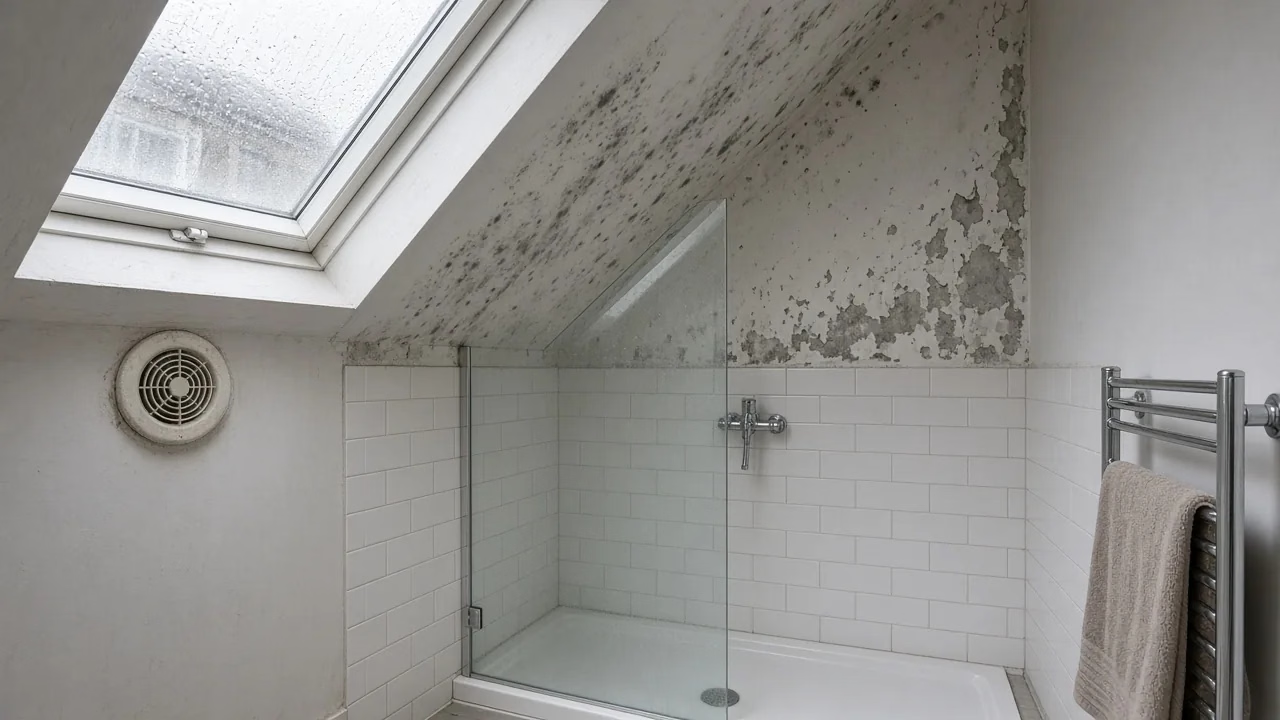
A loft conversion should be one of the warmest, driest rooms in the house. So it’s unsettling when mould appears where the sloping ceiling meets the wall, the paint starts peeling around a rooflight, or a brown stain shows up on the dormer ceiling. Damp in a loft conversion is almost never rising damp. It’s nearly always one of three things: condensation inside the room, condensation hidden inside the roof, or rain getting in. Telling them apart is the key to fixing it properly.
Why loft rooms are prone to damp
Warm, moist air rises. The Centre for Sustainable Energy’s guidance on loft conversions notes that loft conversions are prone to high moisture levels because warm, moist air from the rooms below rises into the roof, that mould in roof rooms is a common problem (particularly around timber-framed windows), and that condensation is particularly likely where the conversion includes a bathroom, shower or kitchen.
Loft rooms also have a lot of different surfaces meeting at awkward angles: sloping ceilings, dormer cheeks, knee walls, flat ceilings, party walls and gables. Every junction is a place where insulation can be thin or missing, creating a cold spot.
Cause 1: condensation on cold spots in the room
BCP Council’s guidance on damp and mould describes condensation as by far the most common cause of damp and mould in homes, and loft rooms are no exception. Moisture from showers, drying washing and breathing settles on the coldest surfaces, and mould follows.
Typical signs:
- black spot mould in corners, along the line where the slope meets the knee wall or the dormer cheek, and around rooflights;
- water on the inside of the rooflight or window glass on cold mornings;
- worse in winter, in bedrooms and in an en-suite;
- no clear link with rain.
The CSE guidance points out that cold spots (thermal bridges) at the junctions between insulated elements can lead to condensation and mould, and that insufficient heating also contributes. A loft room without a radiator, or with heating that’s rarely on, will run colder and wetter.
Is the en-suite fan doing its job?
An en-suite or shower room in the loft is a major source of moisture. Approved Document F asks for an extract fan ducted to the outside, with a minimum intermittent rate of 15 litres per second for a bathroom. Common faults are fans that are undersized, switched off, or ducted into the roof void instead of to the outside, which moves the moisture straight into the structure. See our guide to extractor fans not vented outside.
Cause 2: hidden (interstitial) condensation in the roof
This is more serious, because you can’t see it until it’s been going on for a while. The NHBC explains that interstitial condensation happens when warm, moist air moves into the building fabric, towards colder parts of the roof or walls, and condenses within the construction, for example above a ceiling or behind a wall lining. It can rot timber and reduce the performance of the insulation. The NHBC also notes that “cold” roofs with insulation between the rafters are more vulnerable, because it’s harder to form an effective vapour control layer below the insulation and keep the ventilation above it working.
Typical signs:
- a stain or mould patch that follows the line of the rafters or the dormer roof joists;
- a persistent musty smell, even in dry weather;
- damp or mould inside the eaves storage cupboards;
- worse in cold weather rather than after rain.
Building control guidance from Bath and North East Somerset Council explains why: turning an open roof space into a room restricts natural ventilation and can cause condensation between the insulation and the roof covering. For a ventilated roof, it describes a continuous 25mm opening at the eaves, a clear 50mm air space between the insulation and the roofing felt, and a continuous 5mm opening at the ridge, plus a vapour control layer (polythene or foil-backed plasterboard) on the warm side. Alternatively, a breathable roofing membrane can be used, following the manufacturer’s instructions.
The common faults are insulation pushed tight against the felt, blocking the air gap; eaves vents covered during the work; a missing or torn vapour control layer; and lots of unsealed holes for downlights and cables in the sloping ceiling. If you’re not sure how your roof was built, our guide to warm roofs and cold roofs explains the difference, and our guide to loft insulation not built as specified covers what to do if the build doesn’t match the drawings.
Cause 3: rain getting in
Dormers and rooflights add new joints to the roof, and every joint relies on flashings, seals and good detailing. Rain penetration usually shows as a brown stain in one area that appears or grows during or after heavy or wind-driven rain.
Common entry points:
- the flashing around a rooflight, or a rooflight fitted outside the manufacturer’s minimum pitch;
- the lead or flashing where the dormer cheek meets the main roof;
- the flat roof on top of the dormer, especially at the edge trims and where it meets the main roof;
- cladding on the dormer cheeks or face; see our guide to dormer cladding;
- a slipped or broken tile or slate near the conversion.
How to work out which it is
- Keep a diary for two or three weeks. Note the weather, the temperature, whether the heating was on, and when the patch got worse.
- Look at the pattern. Spotty mould in corners and around glass points to surface condensation. Stains that follow rafters or joists point to hidden condensation. A single growing stain after rain points to a leak.
- Check the en-suite fan. Does it run, and is there a vent outside where it should be?
- Open the eaves cupboards with a torch and look for damp insulation, mould on the timber or daylight where it shouldn’t be.
- Check outside (from the ground or a window, not on the roof): look at flashings, tiles and the dormer roof edges.
More than one cause can be present at the same time, and a small leak can make a condensation problem worse.
How damp in a loft conversion is usually fixed
- Surface condensation: a correctly sized extract fan in the en-suite, background ventilation that’s open, steady heating, and insulating cold spots where the junctions are weak.
- Hidden condensation: opening up the affected area to find out how the roof was built, then restoring the ventilation path or vapour control layer and replacing wet insulation and any decayed timber.
- Rain penetration: repairing the flashing, rooflight seal, dormer roof or cladding at the point where water gets in, then letting the structure dry before making good.
Painting over the mould or spraying it with cleaner treats the symptom only. For a wider look at mould on ceilings, see our guide to mould on the ceiling, and for an unconverted roof space, see condensation in the loft.
Frequently asked questions
Is mould in a new loft conversion normal?
No. A newly built room can take a little time to dry out, but recurring mould means there’s too much moisture, a cold spot, or both. The NHBC advises that any sign of condensation after construction should be investigated rather than assumed to be drying out.
Why is there damp around the rooflight in my loft room?
Either condensation on the cold glass and frame running onto the lining, or rain getting past the flashing. If it’s worse on cold mornings, it’s likely to be condensation; if it’s worse after rain, check the flashing and seals.
Can a loft conversion have rising damp?
No. Rising damp comes from the ground and can’t reach a loft room. Damp in a loft conversion comes from condensation or rain penetration, or occasionally a plumbing leak from a tank, en-suite or heating pipe.
Who should I call about damp in a loft conversion?
Someone who’ll look at the room, the roof construction and the outside together. If the conversion is recent, also check your builder’s guarantee and any structural warranty.
Damp or mould in your loft room?
We find the cause before suggesting any work, whether it’s condensation, the roof build-up or a leak. See our damp survey service and loft conversion service in London, request a quote and project review, call 020 7971 1318 or message us on WhatsApp.
General information only. Sources checked on 24 November 2026.