
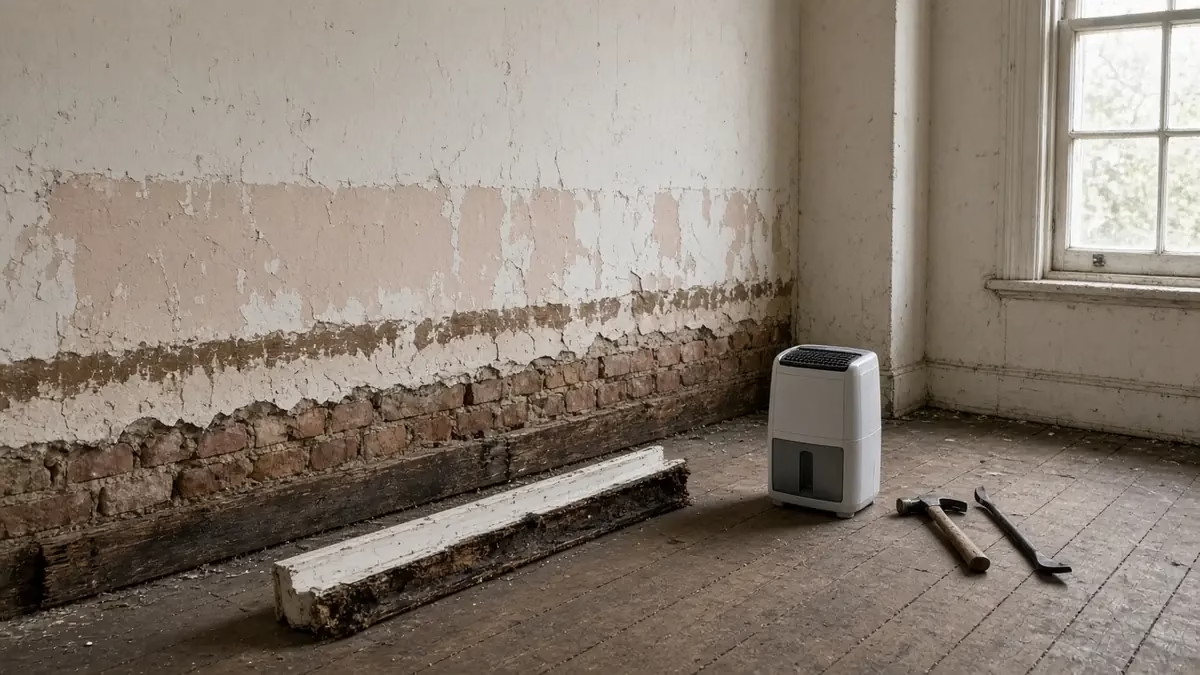
Paint bubbling along the bottom of the wall, a tide mark just above the skirting, a board that feels soft when you press it, or black spots of mould along the top edge: damp skirting boards are one of the most common damp complaints in London homes, from Victorian terraces to 1960s flats. Because skirting is right at floor level, it’s often blamed on rising damp straight away. Sometimes that’s right, but often it’s something simpler: a leak, rain getting in low down, ground or paving that’s too high outside, or condensation behind furniture.
Here’s how to tell the causes apart, what you can check yourself, and how to fix it so the new skirting doesn’t go the same way.
Why skirting boards show damp first
Skirting boards sit where the wall meets the floor. That junction collects moisture from several directions: water running down inside the wall, moisture from the ground and floor, leaks from pipes in the floor or behind the board, and condensation on the coldest part of an outside wall. Timber soaks up moisture from damp plaster or masonry behind it, so the board often shows the problem before the wall does. Paint fails, the timber swells and, if it stays wet, it starts to rot.
The usual causes
1. A plumbing or heating leak
A slow leak from a radiator valve, a pipe joint under the floor, a washing machine or dishwasher hose, or a bath or shower can soak the bottom of the wall and the skirting. Clues: the damp is localised, it appeared fairly quickly, it doesn’t change with the weather, and floorboards or carpet nearby may also be damp. A sealed heating system losing pressure is another hint. Our guides to damp behind a radiator and leaks that come back after repair cover tracing these.
2. Rain getting in low down
Penetrating damp at low level can come from a leaking or blocked gutter or downpipe splashing onto the wall, defective pointing or cracked render near the ground, or a leaking gully. The RICS consumer guide to damp and mould lists defects like these among the things to check outside. Clue: it gets worse after heavy rain and dries back in dry spells.
3. Ground or paving bridging the damp-proof course
In many London houses, a patio, path or flower bed has been raised over the years until it’s at or above the damp-proof course, or render has been taken down over it. Moisture then gets past the DPC and appears as a band along the bottom of the wall. See patio higher than the damp proof course.
4. Rising damp
Genuine rising damp, where the damp-proof course has failed or there isn’t one, can wet the lower wall and skirting. Typical signs are a fairly even tide mark, often with salts, along a length of wall, and damp that persists in all seasons. But leaks, bridging and penetrating damp can look very similar, so rising damp should be confirmed by investigation, not assumed from a meter reading on the skirting. Our guide to rising damp vs penetrating damp explains the difference.
5. Condensation
The bottom of an outside wall is often the coldest surface in a room, and air behind sofas, beds and wardrobes barely moves. Condensation there shows as patchy black mould on the skirting and lower wall, worst in autumn and winter, and often in other cold spots too. The RICS guide lists drying clothes indoors, poor ventilation and under-heating as things that increase condensation.
6. A damp suspended timber floor
If the ground floor is suspended timber, blocked air bricks or rubble in the void can keep it damp, and the skirting boards and joist ends suffer. A musty smell is a common clue. See musty smell under floorboards.
Checks you can do yourself
- Press the skirting with a screwdriver tip. Soft, spongy or crumbly timber means it’s been wet for a while and may be rotting.
- Map the damp. One small area near pipes or an appliance? A band along a whole wall? Only behind furniture? Only on outside walls?
- Note the timing. Worse after rain, worse in winter, or the same all year?
- Go outside and look at the same wall: ground level against the DPC, gutters and downpipes, pointing and render, air bricks.
- Check the plumbing: valves, pipes, appliance hoses, the bath or shower seal, and the boiler pressure gauge over a week.
- Look for condensation signs: wet windows in the morning, mould on window reveals and corners.
Is it rot? Wet rot vs dry rot
Skirting that stays damp can develop wet rot, which is confined to the damp timber and stops once the timber dries. Dry rot is less common but more serious, as it can spread beyond the damp area through masonry and plaster. Signs include cotton-wool-like strands, a fruiting body that looks like a pancake with rusty red spores, and cuboidal cracking in timber. If you see those, get a specialist inspection. Our guide to wet rot vs dry rot vs damp explains the differences.
How to fix it properly
- Find and fix the source first. Repair the leak, lower the ground or paving, fix gutters and pointing, clear air bricks, or deal with ventilation and heating for condensation.
- Remove the damaged skirting and look behind it. It’s common to find damp plaster, rotten grounds (the timber battens the skirting is fixed to) or salts.
- Let the wall dry out. Solid masonry can take months to dry. Rushing new skirting and paint onto a wet wall is a common reason the problem reappears.
- Replace damaged plaster with a suitable plaster for the wall type. On older solid walls, breathable materials are generally better; see plastering after damp proofing.
- Fit new skirting, with the back face sealed or primed, not in direct contact with wet masonry, and with any rotten grounds replaced.
Be wary of being sold a chemical damp-proof course on the basis of a damp skirting board alone. If the real cause is a leak, bridging or condensation, an injection won’t fix it. See is chemical DPC injection worth it? and damp surveys vs damp-proofing quotes.
Frequently asked questions
Are damp skirting boards a sign of rising damp?
Not necessarily. Leaks, rain penetration, bridged damp-proof courses and condensation all cause damp skirting. Rising damp should be confirmed by investigation, not assumed.
Can I just replace a damp skirting board?
Not until you’ve found and fixed the cause and let the wall dry. Otherwise the new board will get damp and may rot too.
Why is there mould on my skirting boards?
Mould along skirting, especially behind furniture on outside walls, is usually condensation on a cold surface with poor air movement. Moisture from a leak or wet wall can also cause it.
How do I know if my skirting board is rotten?
Press it with a screwdriver. If the timber is soft, crumbles or cracks into cubes, it’s rotten. Strands like cotton wool or rust-coloured dust nearby could mean dry rot, which needs specialist attention.
Damp skirting boards in your home?
We look at the wall inside and out, the floor, the plumbing and the room’s ventilation before recommending anything, so you fix the cause, not just the symptom. See our damp survey service and damp proofing in London, request a quote and project review, call 020 7971 1318 or message us on WhatsApp.
General information only. Heating and plumbing repairs should be carried out by a competent engineer. Sources checked on 16 November 2026.