
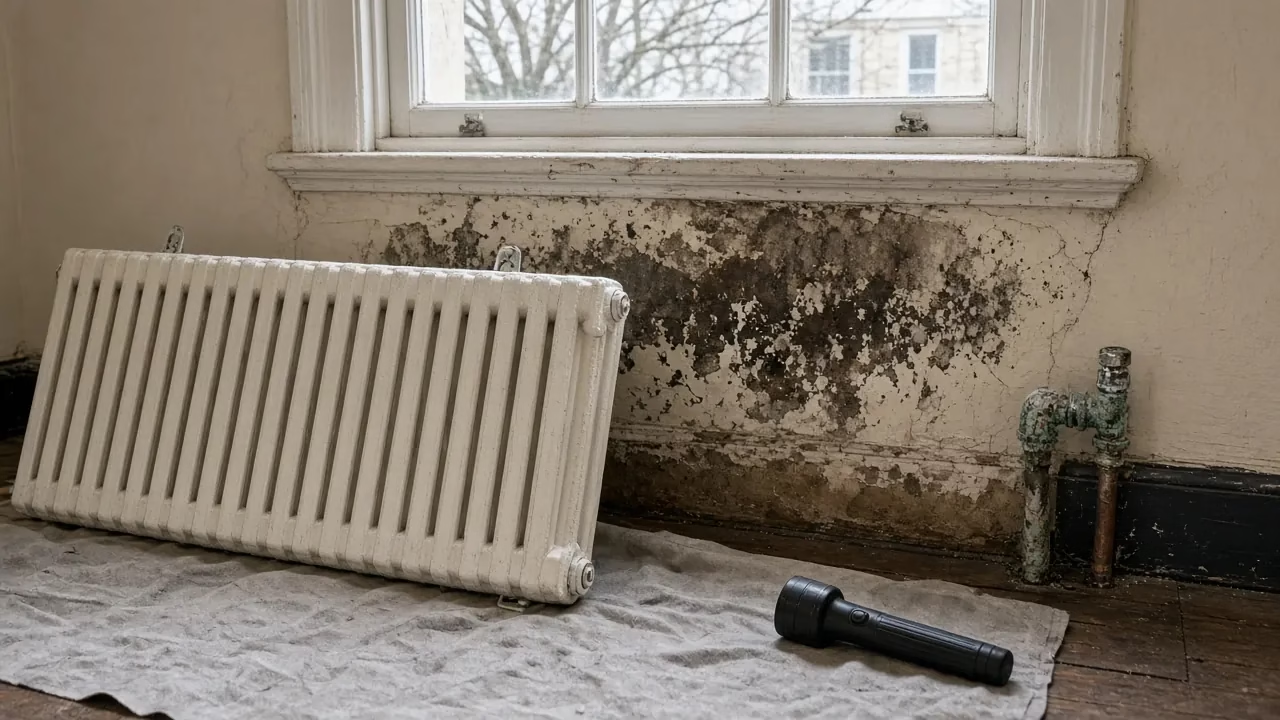
You take a radiator off the wall to decorate, or just look behind it with a torch, and find a dark patch, flaking paint, a tide mark or black mould. Because radiators are warm, it seems like the last place damp should be. In fact damp behind a radiator is common in London homes, and it has a handful of quite different causes: a slow leak from the radiator or its pipes, condensation on a cold outside wall, rain getting in under the window above, or moisture from the ground at low level.
Each one needs a different fix, and repainting or moving the radiator won’t solve any of them on its own. Here’s how to work out which you’re dealing with.
Why the wall behind a radiator gets damp
In most houses, radiators sit on an outside wall, usually under a window. In a London Victorian or Edwardian terrace that wall is often solid brick with no cavity and no insulation. The radiator heats the room, but the wall directly behind it can still be relatively cold, the air behind the panel doesn’t move much, and the area is hidden, so a problem can run for months before anyone sees it.
Add pipe joints and valves at floor level, a window sill directly above, and the bottom of the wall close to the ground on the ground floor, and you have four separate ways for moisture to get there.
The four usual causes
1. A slow leak from the radiator, valve or pipes
This is the first thing to rule out. A weeping valve, a joint where the pipe enters the floor, a pinhole in the radiator or a corroded bleed point can keep a patch damp for a long time without ever leaving a puddle.
Signs that point to a leak:
- the damp is at floor level, centred under one end of the radiator (the valve end) or around the pipes;
- rust marks, green or white crusty deposits on the valve or the pipe;
- a damp or stained carpet, gripper rod or floorboard near the pipes;
- a sealed (combi or system) boiler that keeps losing pressure;
- it stays damp in dry weather and doesn’t change with the seasons.
Leaks can also be hidden under the floor, where pipes run in a screed or between joists. Our guide to heating pressure dropping and leaks under floors explains how those are traced. The RICS consumer guide to damp and mould also lists internal plumbing leaks among the defects to check.
2. Condensation on a cold outside wall
If the wall behind the radiator is cold, and the room air is humid, moisture condenses on the wall surface. Because the gap behind a radiator is narrow and still, the surface stays damp, and mould grows in spots or patches, often higher up the wall rather than just at the bottom.
Condensation is more likely when:
- the radiator is often off (spare rooms, bedrooms heated only at night);
- washing is regularly dried on or over the radiator: the RICS guide lists drying clothes over radiators among the things that increase condensation;
- the room has little ventilation, for example trickle vents closed or no extract in a nearby bathroom or kitchen;
- there’s a cold spot in the wall, such as a concrete lintel, a patch of missing insulation, or a solid wall section.
Condensation mould also tends to show elsewhere in the room: window reveals, corners and behind furniture. If you see it in those places too, that supports the diagnosis. See mould behind fitted wardrobes and mould around new windows.
3. Rain getting in under the window
If the radiator is under a window, water can get in at the sill: a cracked or back-falling stone or concrete sill, a missing drip groove underneath it, failed sealant around the frame, or defective pointing below the sill. Rain soaks into the wall and appears as a damp patch, sometimes with a tide line, just below the window and running down behind the radiator.
The clue is timing. This kind of penetrating damp gets worse after driving rain and dries back in a dry spell. Look outside at the sill and the brickwork below it. Our guide to why a house smells damp when it rains covers the usual entry points.
4. Ground moisture at low level
On a ground floor, damp at the base of the wall behind a radiator can come from outside ground or paving that’s higher than the damp-proof course, a bridged or failed damp-proof course, or a damp floor void. It typically shows as a band of damp along the bottom of the wall, sometimes with salts, extending beyond the radiator. Before anyone recommends injection, check the outside first; see patio higher than the damp proof course and rising damp vs penetrating damp.
Simple checks you can do
- Feel and look at the valves and pipes with the heating on. Wrap dry kitchen paper around each valve and joint and check it the next day.
- Check the boiler pressure gauge over a week. A steady drop on a sealed system suggests a leak somewhere.
- Map the patch. Is it at floor level by the pipes, spread across the wall behind the panel, under the window, or along the whole base of the wall?
- Note the timing. Worse after rain? Worse in cold, closed-up weeks? The same all year?
- Go outside. Look at the sill, the pointing and render below it, gutters and downpipes, and the ground level against the wall.
- Look around the room for condensation signs: wet windows in the morning, mould in corners or behind furniture.
If you’re not confident working on heating pipework, don’t take the radiator off yourself. Draining down and refitting a radiator on a sealed system needs to be done properly to avoid leaks and air locks.
What usually fixes it
- Leak: repair or replace the valve, joint or radiator, then let the wall and floor dry out fully before redecorating.
- Condensation: reduce moisture in the room (stop drying washing on radiators, use extract fans and trickle vents), heat the room more evenly, and deal with any specific cold spot. Clean mould safely and don’t just paint over it. Our guide to PIV units and condensation covers one whole-house ventilation option.
- Rain penetration: repair the sill, seal the frame, repoint or repair render, and fix gutters or downpipes. The wall then needs time to dry.
- Ground moisture: lower bridging ground or paving, clear air bricks, and investigate the damp-proof course before choosing any treatment.
Avoid quick fixes that hide the problem: foil or plastic behind the radiator, waterproof paint over a damp patch, or moving the radiator without finding the cause. The GOV.UK guidance on damp and mould explains why the underlying cause should be dealt with, not just the visible mould.
When to get a damp inspection
Get professional help if the damp returns after you’ve fixed an obvious leak or cut down on condensation, if there’s a tide line or salts, if skirting or floorboards feel soft, or if you can’t tell which cause it is. A useful inspection looks at the heating pipework, the wall outside, the window and the room’s ventilation, not just a meter reading behind the radiator. Our guide to damp surveys versus damp-proofing quotes explains why diagnosis comes first.
Frequently asked questions
Why is there mould behind my radiator?
Usually condensation on a cold outside wall, where still, humid air sits behind the radiator, or moisture from a slow leak at a valve or pipe. Rain getting in under a window can also cause it.
Can a leaking radiator valve cause damp on the wall?
Yes. A slow weep from a valve or pipe joint can keep the wall and floor damp at low level for a long time without an obvious puddle.
Is damp behind a radiator rising damp?
Not necessarily. Rule out leaks, condensation and rain penetration first. Ground moisture shows as a band at the base of the wall that usually extends beyond the radiator.
Should I put foil behind my radiator to stop damp?
Reflective panels are sold to reduce heat loss, but they won’t fix a leak, rain penetration or a damp wall, and they can hide a problem. Find and fix the cause first.
Damp behind a radiator?
We check the heating pipework, the wall outside, the window and the room’s ventilation before recommending anything, so you fix the actual cause. See our damp survey service and damp proofing in London, request a project review, or call 020 7971 1318.
General information only. Heating work on sealed systems should be done by a competent heating engineer. Sources checked on 13 November 2026.